Listen to this Post
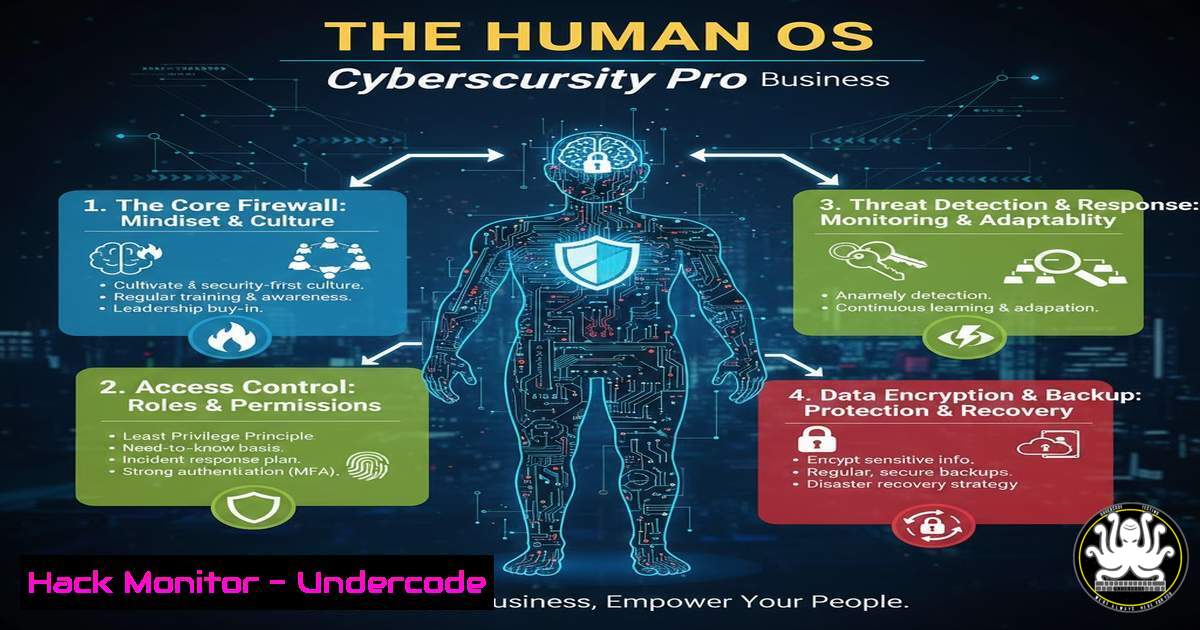
Introduction:
In today’s digital landscape, we meticulously harden servers and secure networks, yet often leave the most critical system—human operations—vulnerable to chaos. The Entrepreneurial Operating System (EOS) provides a framework for operational excellence, mirroring the principles of IT infrastructure: defined roles, accountability, and disciplined execution. This article explores how to apply cybersecurity methodologies to fortify your business’s human “operating system” against the vulnerabilities of misalignment and poor traction.
Learning Objectives:
- Understand how EOS principles parallel core IT and cybersecurity frameworks.
- Learn to apply system hardening concepts to business process and role clarity.
- Implement monitoring and accountability measures for your operational “humanware.”
You Should Know:
1. Foundational Hardening: Establishing Your Base Image
Just as you start a secure deployment with a hardened base OS image, a business needs a hardened foundation. EOS provides this through its core tools—the Vision/Traction Organizer (V/TO) and the Accountability Chart. This is your business’s source of truth, akin to a configuration management database (CMDB).
Step‑by‑step guide explaining what this does and how to use it.
Step 1: Define the Vision (V/TO). This is your mission-critical config.yaml. Document your core values, focus, and 10-year target. This file must be immutable for all leadership decisions.
Step 2: Chart Accountability. This is your organizational `nmap` scan. Map every role, not person, in the company. Define Responsibilities (list of core duties) and Authorities (ability to say “yes” or “no”) for each. Eliminate ambiguity like you would eliminate open ports.
Step 3: Socialize the Configuration. Use a disciplined process (like `git` for version control) to ensure every team member has the latest “build.” Review in quarterly sessions, updating only with full consensus.
2. Vulnerability Management: Identifying and Patching Role Gaps
In operations, vulnerabilities are gaps between a role’s responsibilities and a person’s capabilities. Regular scans are needed to find these “exploits” that cause projects to fail.
Step‑by‑step guide explaining what this does and how to use it.
Step 1: Conduct a “People Analyzer” Scan. This is your qualitative vulnerability assessment. Grade each person as a Strong, Medium, or Weak fit for their role based on core values and abilities.
Step 2: Run a “Get, Want, Capacity” Check. This is your technical audit. For each role, ask: Does the person Get it (understand it)? Do they Want it (have passion for it)? Do they have the Capacity (time and skills)? A “no” in any category is a critical finding.
Step 3: Apply the Patch. Execute the right person, right seat (RPRS) protocol. This is your remediation. It may involve coaching (patching), role redefinition (reconfiguration), or replacement (system rebuild).
- Process Integrity & Logging: The Discipline of Meetings as System Logs
Unstructured meetings are like systems with logging disabled. You have no audit trail. EOS implements Level 10 Meetings (L10) as structured, consistent system logs to ensure process integrity and traceability.
Step‑by‑step guide explaining what this does and how to use it.
Step 1: Standardize the Log Format. The L10 agenda is fixed: Segue (good news), Scorecard, Rock Review, Customer/Employee Headlines, To-Do List, IDS (Identify, Discuss, Solve), and Conclusion. No deviations.
Step 2: Enforce Log Rotation and Retention. Meetings are weekly, 90 minutes, on the same day and time. To-Do lists are captured, assigned, and reviewed the next week—like reviewing `journalctl` or Windows Event Logs for past issues.
Step 3: Analyze Logs for Anomalies. The Scorecard (weekly metrics) is your dashboards (e.g., Grafana). Rocks (90-day priorities) are your quarterly OKRs/KPIs. Regularly reviewing these “logs” identifies operational anomalies before they become incidents.
4. Access Control & Least Privilege: Clarifying Authorities
In cybersecurity, least privilege means giving only the access necessary. In operations, it means defining clear authorities to prevent decision bottlenecks (a form of DDoS) or reckless autonomy (a security breach).
Step‑by‑step guide explaining what this does and how to use it.
Step 1: Map Decision Rights. For each role on the Accountability Chart, explicitly document key authorities. Can the Ops Manager approve a $5k CAPEX? Can they hire without VP approval? This is your Access Control List (ACL).
Step 2: Implement the “Delegate and Elevate” Model. Encourage decisions at the lowest possible level. If a direct report brings a problem, first ask, “What do you recommend?” This trains the system to handle requests locally, reducing load on the core “server” (leadership).
Step 3: Conduct Authority Audits. Quarterly, review major decisions. Were authorities respected? Were decisions elevated that shouldn’t have been? Tune your “ACLs” accordingly.
5. Incident Response & The Issues List
Every business faces incidents—missed deadlines, client complaints, internal conflicts. The EOS Issues List is your centralized incident management system, preventing problems from being swept under the rug.
Step‑by‑step guide explaining what this does and how to use it.
Step 1: Triage and Log. Any issue raised is immediately added to a shared, visible Issues List (e.g., in a tool like Ninety or a shared spreadsheet). This is your SIEM dashboard.
Step 2: Apply the IDS Protocol. When discussing an issue, follow the IDS framework: Identify the root cause (5 Whys analysis), Discuss openly without blame, Solve by agreeing on a concrete To-Do. This is your formal incident response playbook.
Step 3: Close the Loop. Every To-Do from an issue is assigned, dated, and reviewed at the next meeting until complete. This is your incident resolution and closure log, ensuring no ticket is left open indefinitely.
What Undercode Say:
- Key Takeaway 1: Operational excellence is not about charisma; it’s about engineering a predictable, fault-tolerant human system. EOS is the open-source framework for achieving this, where documentation (V/TO, Accountability Chart) is as vital as network diagrams.
- Key Takeaway 2: The greatest vulnerability in any organization is ambiguity. Just as you would never leave a server with a default password, never leave a role with unclear responsibilities or authority. Consistent, logged processes (L10 Meetings) are the continuous integration/continuous deployment (CI/CD) pipeline for your business strategy.
Analysis: The post highlights a demand for Operations Managers who thrive in structured environments like EOS. This signals a market shift where businesses now recognize that operational resilience is as engineered as technical resilience. The principles are interchangeable: a secure system requires a known state, least privilege, robust logging, and proactive patch management. An Ops Manager in an EOS company is essentially a SOC analyst and systems engineer for the human stack, tasked with maintaining uptime (productivity), patching vulnerabilities (role gaps), and responding to incidents (issues) with a formal playbook. The “quiet conversations” mentioned are akin to responsible vulnerability disclosure—discrete, professional, and aimed at fortifying the system.
Prediction:
The future of business leadership will increasingly hybridize operational and cybersecurity thinking. As AI automates more technical tasks, the premium will shift to leaders who can architect and defend complex human systems. Frameworks like EOS will be studied not just by MBAs but by tech architects, and the next generation of COOs will be expected to read a dashboard of KPIs with the same fluency as a cloud monitoring console. Businesses that fail to apply systematic hardening to their operations will be as exposed as those with unpatched, internet-facing systems, vulnerable to competitive threats and internal decay. The “human OS” will become the critical attack surface to defend.
▶️ Related Video (82% Match):
🎯Let’s Practice For Free:
IT/Security Reporter URL:
Reported By: Debrachantry Taylor – Hackers Feeds
Extra Hub: Undercode MoN
Basic Verification: Pass ✅


