Listen to this Post
Introduction:
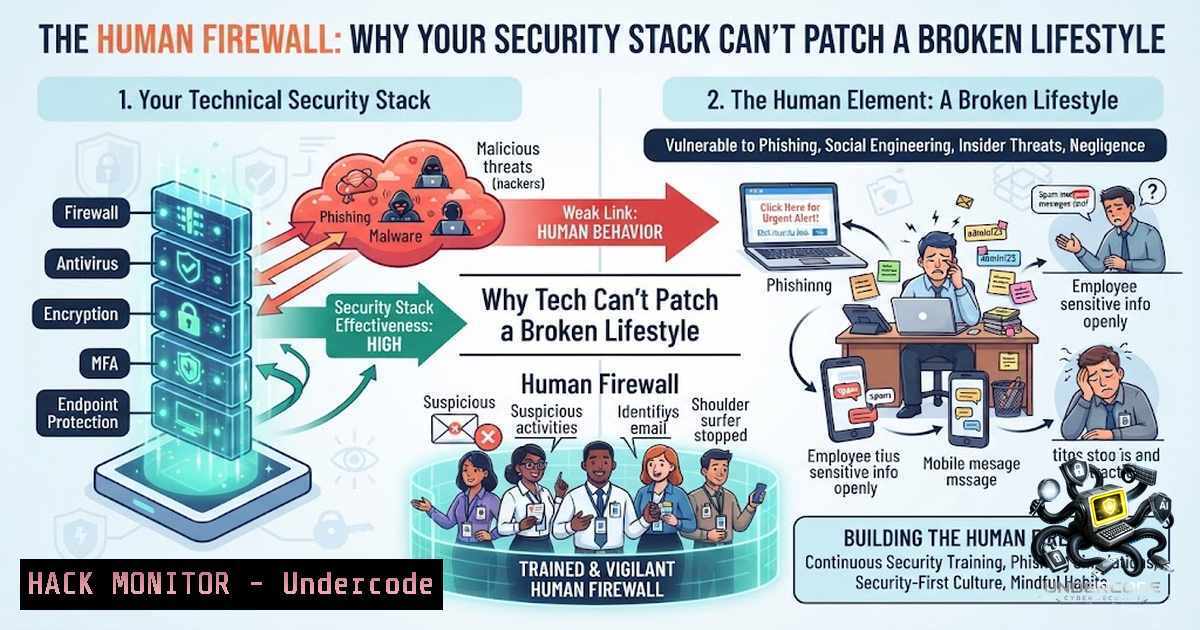
In cybersecurity, we obsess over patching vulnerabilities, deploying next-generation firewalls, and implementing zero-trust architectures. Yet, the most critical component of any security infrastructure—the human operating it—is often running on an outdated, unpatched, and critically overloaded system. The hard truth emerging from boardrooms and SOCs alike is that high-performing security professionals are attempting to supplement their way out of a lifestyle problem, throwing advanced tools at foundational failures. This article explores the cognitive ergonomics of cybersecurity, revealing why the most expensive EDR solution cannot compensate for chronic sleep deprivation, and why your security posture is only as resilient as the daily habits of the people managing it.
Learning Objectives:
- Understand the critical intersection between human biology, cognitive performance, and security incident response efficacy.
- Identify the gap between technological “supplements” (tools/automation) and foundational lifestyle “hardening” (sleep, nutrition, recovery).
- Implement practical, low-tech protocols to enhance decision-making under pressure and reduce alert fatigue in security operations.
You Should Know:
- The Cognitive Vulnerability Assessment: Mapping Human Resource Exhaustion
In the world of IT and cybersecurity, we conduct rigorous vulnerability assessments on our networks. We scan for open ports, outdated software, and misconfigurations. Yet, we rarely perform a similar assessment on our most valuable asset: the human firewall. The post from Andre Heeg highlights a phenomenon endemic to our industry: the relentless pursuit of optimization through external tools. In security, this manifests as buying the next SIEM, the latest AI-driven threat intelligence platform, or another automation tool to reduce alert fatigue. While these tools are essential, they are often deployed as a supplement to a fundamentally broken lifestyle.
The incident responder pulling a 72-hour shift during a breach, surviving on energy drinks and adrenaline, is the equivalent of running your production environment without a UPS. The system is destined to fail. High cortisol levels, a byproduct of chronic stress and poor sleep, impair cognitive function, reduce working memory, and degrade the very judgment needed to triage a sophisticated attack.
The Security Analogy: Just as a layered security model includes perimeter defense, endpoint protection, and data encryption, a layered human performance model includes sleep, movement, recovery, and stress management. We cannot rely on a “supplement” layer (like a new SIEM or a wearable) to compensate for a missing “foundational” layer (sleep and recovery).
Step‑by‑step guide: Conducting a Personal Security Posture Audit
- Map Your “Attack Surface”: List all cognitive demands on your time (meetings, incident triage, report writing).
- Identify the “Zero-Day Vulnerabilities”: Pinpoint chronic sleep debt, poor dietary habits, or lack of physical activity.
- Assess Your “Security Controls”: Evaluate your current tools—are they mitigating the root cause or just managing symptoms?
- Implement “Security Patches”: Commit to a single foundational change (e.g., a fixed bedtime) for 30 days.
- Monitor “System Logs”: Journal your cognitive performance and energy levels daily.
-
The “Alert Fatigue” Equivalent: How Supplements Mask System Failure
The post draws a powerful distinction between feeling productive and being effective. In cybersecurity, this is the difference between “alert triage” and “true incident analysis.” A new AI tool that generates hundreds of alerts feels like progress (a supplement). It gives the illusion of control and advanced capability. However, if the underlying issue is that your team is understaffed and overwhelmed (the lifestyle problem), the new tool just creates more noise. It is a product solving a problem that belongs to organizational design and human capacity planning.
The temptation is always to reach for the “magic bullet” tool. We see this with the rush to implement AI for every function, hoping it will replace human cognitive load. While AI is a powerful force multiplier, it’s useless if the humans using it are cognitively impaired. A machine learning model is only as good as the data it receives and the analyst interpreting its outputs.
Linux/Windows Command Analogy: The Difference Between a Band-Aid and a Fix
– The “Supplement” (Band-Aid): `kill -9
– The “Foundation” (Fix): Reviewing the application logs (tail -f /var/log/syslog), identifying the root cause, and deploying a code patch. This is the equivalent of going to bed earlier—it’s less exciting but more effective.
Step‑by‑step guide: Differentiating Symptom Management from Root Cause Analysis
1. Identify the Symptom: “We have too many alerts. We need AI.”
2. Question the Root Cause: “Why do we have too many alerts? Is our SIEM tuned correctly? Do we have too many overlapping rules?”
3. Test the Hypothesis: Temporarily disable or tune a set of low-fidelity alerts (the supplement) and observe if the analyst team performs better.
4. Address the Foundation: Implement a workload management strategy to ensure analysts are not facing 8 hours of continuous alert streams.
5. Validate: Monitor metrics like Mean Time to Detect (MTTD) and Mean Time to Respond (MTTR) with the new foundational changes.
- The “Firewall of the Mind”: Protecting Sleep and Recovery
The most advanced intrusion prevention system in the world cannot protect your network if the security engineer managing it is sleep-deprived. Sleep deprivation has been shown to impair cognitive function to a degree comparable to alcohol intoxication. For a security professional, this means slower reaction times, poorer pattern recognition, and a diminished ability to think abstractly. In a high-stakes incident response scenario, this is the difference between stopping a ransomware attack and becoming a victim.
The Sleep Command for Your System:
In Linux, you can use the `shutdown -r +60` command to schedule a reboot. Similarly, you need to schedule a “reboot” for your brain. The cybersecurity community is beginning to recognize burnout as a systemic risk, not just a personal problem. Some organizations are even implementing “no-meeting” days and mandatory “offline” periods to allow for cognitive recovery.
Windows and Linux Commands for Stress Management:
- Linux:
– `systemctl suspend` (To suspend the system and clear memory buffers).
– `crontab -e` (To schedule regular maintenance tasks—similarly, schedule your rest). - Windows:
– `shutdown /r /t 60` (To schedule a restart).
– `powercfg -h off` (To disable hibernation, freeing up system resources—metaphorically, to clear mental clutter).
Step‑by‑step guide: Implementing Cognitive Recovery in Your SOC
- Schedule “Maintenance Windows”: Block out 90-minute periods in your calendar for deep, uninterrupted work, followed by a 15-20 minute break.
- Define “Off-Hours”: Clearly delineate when you are “on-call” and when you are “offline.” Treat downtime as a critical security patch for your brain.
- Implement the “Recovery Protocol”: Incorporate a 15-minute post-lunch walk to reduce cortisol and improve afternoon cognitive function.
- Monitor “Cognitive Resources”: Use a simple 1-10 scale to rate your mental fatigue three times a day. This is your personal “system resource monitor.”
4. Stress Management: Hardening the Human Endpoint
The post mentions “stress management” as a foundational pillar. In cybersecurity, stress is not an external variable; it’s a direct function of the job. Constant vigilance against threats, high-stakes decision-making, and the pressure of potential financial or reputational damage are all significant stress vectors. When we are chronically stressed, our bodies enter a state of “fight or flight,” prioritizing immediate survival over complex cognitive processing. This is the opposite of what is needed for strategic, long-term security planning.
The “telnet” of Stress: Just as `telnet` is a deprecated and insecure protocol, our old ways of handling stress (ignoring it, pushing through, self-medicating with caffeine) are deprecated and insecure for modern security demands. We need a secure protocol for stress management—one that includes proper breathing techniques, mindfulness, and physical activity.
Linux Commands for “Life Hardening”:
- Monitor System Resources: `htop` (Monitor CPU and memory usage—analogous to monitoring your heart rate and cortisol levels).
- Check System Logs: `journalctl -xe` (Review logs for errors—analogous to journaling to identify stress triggers).
- Kill a High-Resource Process: `kill -15
` (Gracefully stop a process—analogous to politely declining a meeting to protect your time).
- The “High-Performance” Trap: AI, Automation, and the Illusion of Efficiency
Leaders are often tempted to see AI and automation as the ultimate solution to human limitations. The post reflects on how a “new wearable” or “IV drip” feels like progress but might be just a distraction. In our field, this is mirrored in the hype surrounding Autonomous Security. We invest heavily in Machine Learning models to automate threat detection and response, hoping to reduce the burden on our analysts.
However, if you automate a broken process, you are just automating a broken process at scale. If your analysts are exhausted and making poor decisions, an AI tool that learns from their patterns might inadvertently learn and amplify those poor decisions. The “progress” of a new AI is an illusion if it’s built on a foundation of human error.
Step‑by‑step guide: Implementing AI Without Losing Your Mind
- Define “Success” for Your AI: Clearly articulate what problem the AI is solving. Is it reducing Mean Time to Resolve (MTTR)? Is it reducing false positives?
- Audit Your Human Process: Before deploying AI, ensure your human process is as efficient as possible. If the human process is flawed, the AI will inherit those flaws.
- Develop a “Human-in-the-Loop” Strategy: Use AI to augment, not replace, human decision-making. The AI handles the grunt work (the “supplements”), while the human focuses on high-level strategy (the “foundation”).
- Monitor Performance: Track both the AI’s performance and the human operators’ fatigue levels. A drop in human performance will likely be reflected in the AI’s output.
- Iterate: Treat your AI and your human team as a single, integrated system. Optimize both.
-
Relationships and Collaboration: The “Security Operations Center” of Life
The post finally touches on relationships. In cybersecurity, this is the “team” aspect. A security team that works well together, communicates transparently, and supports each other is infinitely more resilient than a team of siloed, brilliant individuals who don’t collaborate. Stress can be contagious, but so can calmness and resilience. A leader who models good habits and prioritizes the well-being of their team creates a culture of resilience that can weather any storm.
Step‑by‑step guide: Building a Resilient Security Team Culture
- Lead by Example: Prioritize your own health and recovery. If you are constantly working 14-hour days, your team will feel compelled to do the same.
- Encourage Communication: Create a safe space for team members to discuss their workload and stress levels. Vulnerability is not a weakness; it’s a strength.
- Implement “No-Meeting” Days: Protect time for deep work and recovery.
- Celebrate Wins (and Failures): Acknowledge and celebrate successes, but also openly discuss failures to foster a culture of learning and continuous improvement.
What Undercode Say:
- Key Takeaway 1: The relentless pursuit of technological “supplements” (AI, automation, new tools) to fix human systemic failures (chronic stress, sleep deprivation, poor lifestyle) is a fundamentally flawed strategy. The tech stack is only as resilient as the humans operating it.
- Key Takeaway 2: True peak performance in cybersecurity relies on foundational “hardening” of the human resource: sleep, movement, recovery, and stress management. These “boring” basics are the non-1egotiable security patches that no amount of caffeine or advanced tech can replace.
Analysis:
The post serves as a critical mirror for the cybersecurity industry. We are obsessed with the latest technological advancement, often viewing it as a silver bullet for our problems. However, this is a cognitive bias known as the “McNamara Fallacy,” where we focus on quantifiable metrics (new tools, faster response times) while ignoring the unquantifiable but critical human factors.
The high-performance culture in tech glorifies the “grind,” rewarding those who work the longest hours and sacrifice their health. Yet, this is the antithesis of what is needed for security. A sleep-deprived, stressed-out security analyst is not a high performer; they are a high-risk vulnerability. The real “advanced” protocol is not the new AI-driven XDR platform; it’s the discipline to consistently maintain a healthy lifestyle amidst the chaos. It’s about understanding that a robust network demands a robust operator. The future of cybersecurity lies not just in securing our data and systems but in securing the cognitive well-being of the people who protect them. The boring advice to “sleep more” and “manage stress” is the most sophisticated security strategy available, and it’s time we start treating it as such.
Prediction:
- +1 The growing awareness of burnout and cognitive fatigue will lead to the formalization of “Human Resilience” as a core component of cybersecurity frameworks and compliance standards, much like NIST or ISO 27001.
- -1 If ignored, the compounding effects of cognitive decline in the workforce will lead to a significant increase in security incidents caused by human error, as the fundamental rule of “garbage in, garbage out” applies to both AI systems and human operators.
- +1 AI will mature to a point where it can effectively act as a “cognitive co-pilot,” handling the mundane and repetitive tasks and freeing up human time for strategic thinking and recovery, thus acting as a genuine supplement to a healthy lifestyle rather than a replacement for it.
- -1 The gap between organizations that invest in employee well-being and those that don’t will widen, creating a “digital divide” in security maturity, with the former becoming significantly more resilient to sophisticated attacks.
▶️ Related Video (84% Match):
🎯Let’s Practice For Free:
🎓 Live Courses & Certifications:
Join Undercode Academy for Verified Certifications
🚀 Request a Custom Project:
Secure, high-velocity infrastructure and disruptive technological engineering. Contact our engineering team for high-tier development and proprietary systems:
[email protected]
💎 Smart Architecture | 🛡️ Secure by Design | ⭐ Trusted by Thousands
IT/Security Reporter URL:
Reported By: High Performers – Hackers Feeds
Extra Hub: Undercode MoN
Basic Verification: Pass ✅


