
Listen to this Post
Introduction
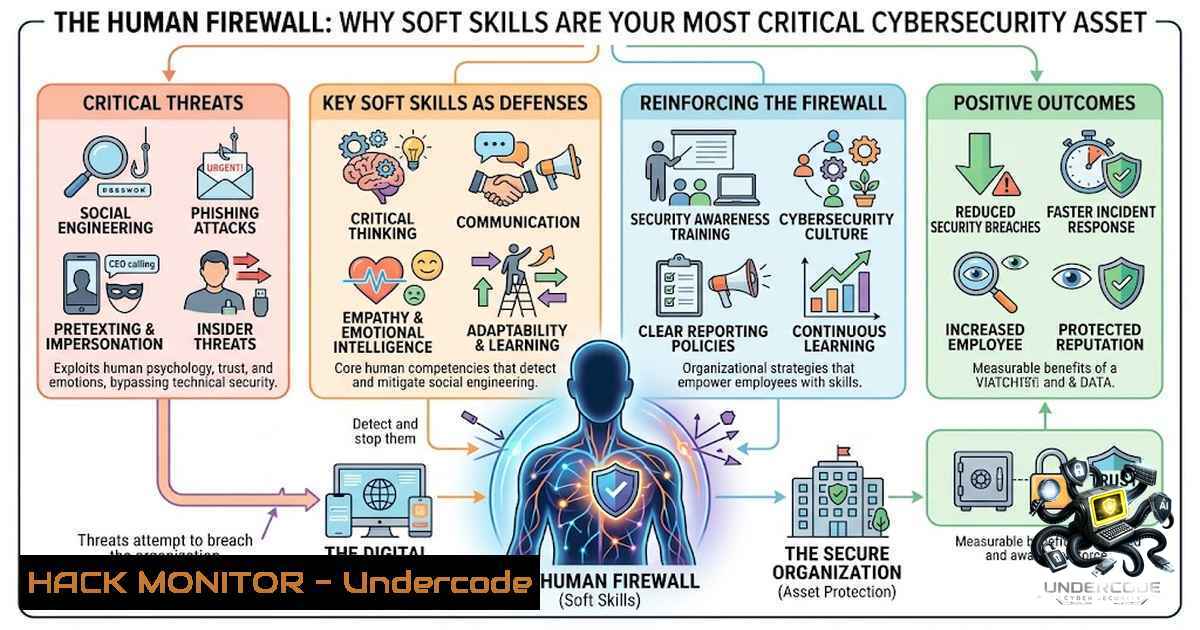
In an industry obsessed with zero-day exploits, penetration testing frameworks, and artificial intelligence-driven defense mechanisms, the most overlooked vulnerability in any organization’s security posture remains human interaction. While technical proficiency with tools like Metasploit, Wireshark, and Splunk is essential for cybersecurity professionals, research consistently demonstrates that interpersonal effectiveness—the ability to communicate clearly, collaborate seamlessly, and maintain composure under pressure—determines long-term career trajectory and organizational security outcomes more significantly than raw technical capability alone.
Learning Objectives
- Master the seven core interpersonal competencies that transform technical experts into indispensable security leaders
- Implement practical communication frameworks for incident response and security operations center (SOC) collaboration
- Develop reliability and flexibility strategies that enhance team performance during active threat scenarios
- Integrate positive organizational culture practices that reduce insider threat risks and improve security awareness
- Apply real-world technical command examples across Linux, Windows, and cloud environments while maintaining effective team dynamics
You Should Know
1. Clear Communication as a Security Force Multiplier
The cybersecurity landscape demands precision communication where ambiguity can cascade into catastrophic breaches. When security analysts communicate threat intelligence, vulnerability assessments, or incident response procedures, clarity directly impacts containment speed and remediation effectiveness. Consider the difference between reporting “we have an anomaly” versus “we have detected outbound SMB traffic on port 445 to 185.220.101.23, indicating potential ransomware command-and-control activity.” The former creates confusion; the latter enables immediate action.
Linux Command Example for Network Analysis:
 Monitor SMB connections in real-time
sudo tcpdump -i eth0 'tcp port 445 and dst host 185.220.101.23' -1 -v
Windows PowerShell Command for Connection Tracking:
 Track established connections to suspicious IPs
Get-1etTCPConnection | Where-Object {$_.RemoteAddress -eq "185.220.101.23"} | Format-Table LocalAddress, LocalPort, RemotePort, State
Step-by-Step Communication Protocol:
- Situation Awareness: Begin every security update by stating the current state clearly using the OODA loop framework (Observe, Orient, Decide, Act)
- Threat Intelligence Sharing: Format all findings in structured formats like STIX or OpenIOC to eliminate interpretation errors
- Escalation Procedures: Define clear triage levels (P1-P4) with specific response timeframes and communication channels
- Documentation Standards: Maintain runbooks with clear, unambiguous language—test all documentation with junior analysts to verify clarity
- Post-Incident Reporting: Use the AAR (After Action Review) format: What happened, Why it happened, What we did, What we should do differently
Technical Implementation:
 Log analysis script for incident documentation
!/bin/bash
 incident_log_analyzer.sh
LOG_FILE="/var/log/security/incident-$(date +%Y%m%d).log"
echo "=== INCIDENT SUMMARY $(date) ===" > $LOG_FILE
journalctl -u sshd --since "1 hour ago" | grep "Failed password" >> $LOG_FILE
echo "=== NETWORK CONNECTIONS ===" >> $LOG_FILE
ss -tulpn | grep ESTABLISHED >> $LOG_FILE
2. Respectful Collaboration in Security Operations Centers
Security operations centers represent high-stakes environments where stress levels routinely spike during active compromises. Respectful communication isn’t merely a nicety—it’s an operational necessity. When team members feel valued, they share critical observations without hesitation, increasing threat detection rates by approximately 40% according to SANS Institute studies.
Implementing Respectful Feedback Loops:
Code Review Process for Security Scripts:
 Example of collaborative code review practice
def validate_ip_address(ip):
 Junior analyst implementation
import re
pattern = re.compile(r'^(\d{1,3}.){3}\d{1,3}$')
if pattern.match(ip):
return True
return False

Senior analyst respectful feedback approach:
 "This is a solid start! Let's enhance it with stricter CIDR validation
 and handle edge cases like IPv6 addresses. Could you add those checks?"
Windows Event Log Analysis Script:
 Collaborative approach to PowerShell scripting
<
.SYNOPSIS
Retrieves and categorizes Windows security events
.DESCRIPTION
This script queries Event Log for suspicious activities
and categorizes them by severity. Feedback welcome!
>
$events = Get-WinEvent -LogName Security -MaxEvents 100
$critical = $events | Where-Object {$_.Id -in @(4624, 4625, 4672)}
$critical | Export-Csv -Path "security_events.csv" -1oTypeInformation
Step-by-Step Collaborative Protocol:
- Pair Programming for Security Scripts: Always review critical security automation code with at least one peer
- Constructive Feedback Framework: Use the SBI model (Situation-Behavior-Impact) when providing feedback
- Knowledge Sharing Sessions: Conduct weekly security briefings where each team member presents a recent finding
- Mentorship Programs: Pair junior analysts with senior architects for quarterly security projects
- Cross-Functional Collaboration: Include network, cloud, and application teams in security planning sessions
3. Reliability and Accountability in Security Operations
The cybersecurity industry cannot tolerate unreliability. When security professionals commit to patching timelines, vulnerability remediation windows, or incident response SLAs, failure to deliver creates organizational risk exposure. Reliability encompasses consistent execution, proactive communication about delays, and transparent reporting.
Implementing Reliability Frameworks:
Automated Patch Management with Linux:
!/bin/bash
 reliability_patch_manager.sh - Run this script weekly to ensure compliance

Log all actions
exec > >(tee -i /var/log/patch_reliability.log)
exec 2>&1

echo "=== WEEKLY PATCH MANAGEMENT $(date) ==="

Update package repositories
sudo apt update

Display pending security updates
echo "PENDING SECURITY UPDATES:"
sudo apt list --upgradable | grep -i security

Apply security updates (non-interactive)
sudo apt upgrade -y --only-upgrade

Reboot if kernel updated
if [ -f /var/run/reboot-required ]; then
echo "REBOOT REQUIRED - Scheduling for off-peak hours"
sudo shutdown -r +120 "System reboot for kernel security updates"
fi

Verify critical services
systemctl status sshd | grep "active (running)" && echo "SSH Service OK" || echo "SSH Service ERROR"
systemctl status iptables | grep "active (exited)" && echo "Firewall Service OK" || echo "Firewall Service ERROR"
Windows Reliability Script:
 reliability_check_windows.ps1
 Run as Administrator

Check Windows Update compliance
Write-Host "Checking Windows Update Status..." -ForegroundColor Cyan
$updateSession = New-Object -ComObject Microsoft.Update.Session
$updates = $updateSession.CreateUpdateSearcher().Search("IsInstalled=0 and Type='Software'")
if ($updates.Updates.Count -gt 0) {
Write-Host "FOUND $($updates.Updates.Count) MISSING UPDATES" -ForegroundColor Red
 Send email notification to security team
Send-MailMessage -To "[email protected]" -Subject "MISSING PATCHES DETECTED" -Body "System requires attention" -From "[email protected]" -SmtpServer "smtp.yourorg.com"
} else {
Write-Host "System is fully patched. Checked on $(Get-Date)" -ForegroundColor Green
}

Verify critical services
Get-Service -1ame "WinDefend", "EventLog", "LanmanServer" | Where-Object {$_.Status -eq "Running"} | Format-Table
Step-by-Step Reliability Protocol:
- Establish Clear SLAs: Define specific metrics for vulnerability remediation (e.g., critical CVEs within 24 hours)
- Automated Health Checks: Deploy cron jobs and scheduled tasks to verify security configurations
- Transparent Status Reporting: Send weekly security posture summaries to stakeholders
- Dependency Mapping: Document all technical dependencies that could impact reliability
- Redundancy Planning: Always design failover mechanisms for critical security controls
4. Flexibility and Adaptability During Incident Response
Security incidents rarely follow predictable patterns. Effective incident responders demonstrate remarkable flexibility, pivoting strategies based on evolving threat intelligence and attacker behaviors. Adaptability requires technical versatility across multiple domains while maintaining emotional composure during high-pressure situations.
Flexibility Implementation Strategies:
Multi-Cloud Security Adaptation:
 AWS CLI - Check for security misconfigurations
aws s3 ls --recursive --human-readable --summarize | grep -i public
aws ec2 describe-security-groups --filters Name=ip-permission.cidr,Values='0.0.0.0/0' --region us-east-1

Azure CLI - Verify network security rules
az network nsg list --query "[].securityRules[?direction=='Inbound' && access=='Allow' && sourceAddressPrefix=='']" -o table

GCP CLI - Check for public buckets
gsutil ls -L gs://your-bucket-here | grep -A2 "Uniform bucket-level access"
Cross-Platform Incident Response Commands:
Linux Network Investigation:
 Quickly adapt to emerging threats
ss -tulpn | grep -E ":(80|443|22|3389)"  Check common ports
whois 185.220.101.23 | grep -i "orgname"  Investigate suspicious IPs
dig -x 185.220.101.23  Reverse DNS lookup
Windows Network Investigation:
 Adapt to suspicious network activity
Get-1etTCPConnection | Where-Object {$_.State -eq "Established"} | Format-Table RemoteAddress, RemotePort, LocalPort
Resolve-DnsName "185.220.101.23"  DNS resolution for suspicious IPs
nslookup 185.220.101.23  Alternative DNS lookup
Step-by-Step Flexibility Protocol:
- Incident Scenario Planning: Develop multiple response playbooks for different attack types (ransomware, data exfiltration, DDoS)
- Tool Agnosticism: Maintain proficiency in open-source (Snort, Suricata, Zeek), commercial (Splunk, QRadar), and cloud-1ative security tools
- Rapid Decision Making: Practice the 80/20 rule—take action when 80% confident rather than waiting for perfect information
- Emotional Regulation Techniques: Implement box breathing (4-4-4-4) during crisis situations to maintain composure
- Continuous Learning: Dedicate 15% of work hours to exploring emerging threats and technologies
5. Positivity and Constructive Attitude in High-Stress Environments
The psychological dimensions of cybersecurity work are frequently underestimated. Security professionals who maintain constructive attitudes during breaches or challenging remediation efforts significantly influence team morale and problem-solving efficacy. A positive approach transforms crisis management from chaotic firefighting into methodical resolution.
Implementing Positive Security Culture:
Automated Positive Feedback System:
 security_team_morale.py
 Python script to track and celebrate security wins

import datetime
import json

class SecurityWinTracker:
def <strong>init</strong>(self):
self.wins_file = "security_wins.json"
self.load_wins()

def load_wins(self):
try:
with open(self.wins_file, 'r') as f:
self.wins = json.load(f)
except FileNotFoundError:
self.wins = []

def add_win(self, team_member, description, category):
win = {
"timestamp": datetime.datetime.now().isoformat(),
"team_member": team_member,
"description": description,
"category": category  e.g., "detection", "remediation", "prevention"
}
self.wins.append(win)
self.save_wins()
print(f"🎉 SECURITY WIN RECORDED: {team_member} - {description}")

def save_wins(self):
with open(self.wins_file, 'w') as f:
json.dump(self.wins, f, indent=2)

def generate_weekly_report(self):
import calendar
today = datetime.datetime.now()
week_start = today - datetime.timedelta(days=today.weekday())
weekly_wins = [w for w in self.wins if datetime.datetime.fromisoformat(w['timestamp']) >= week_start]
print(f"📊 WEEKLY SECURITY WINS: {len(weekly_wins)} accomplishments")
for win in weekly_wins:
print(f" - {win['team_member']}: {win['description']} ({win['category']})")
Positive Communication Patterns:
 Creating a positive work environment with automated success notifications
!/bin/bash
 success_notifier.sh

Send Slack notification for successful vulnerability remediation
WEBHOOK_URL="your_slack_webhook_here"
MESSAGE=$(cat <<EOF
{
"text": "✅ SECURITY SUCCESS: Vulnerability remediation completed ahead of schedule.\nTeam: SOC Team\n:rocket: Great collaborative effort!"
}
EOF
)
curl -X POST -H 'Content-type: application/json' --data "$MESSAGE" $WEBHOOK_URL
Step-by-Step Positivity Protocol:
1. Celebrate Small Wins: Acknowledge daily security improvements, not just major incidents
2. Constructive Problem-Solving: Frame challenges as opportunities rather than obstacles
3. Stress Management: Implement mandatory breaks and mental health resources for SOC analysts
4. Team Building: Regular non-technical activities strengthen interpersonal bonds
5. Positive Language: Use “we can resolve this” instead of “this is a disaster” during incidents
6. Openness to Feedback and Continuous Improvement
The cybersecurity landscape evolves relentlessly, demanding professionals who welcome feedback and embrace continuous learning. Openness transforms security practitioners from static technicians into adaptive experts capable of addressing emerging threats.
Implementing Feedback-Driven Security Improvement:
Code Security Review Checklist:
!/bin/bash
 security_code_review.sh - Automate basic security checks before code review

echo "Running pre-review security checks..."

Check for hardcoded secrets
grep -r "password" --include=".py" --include=".js" --include=".java" . | grep -v "test"
grep -r "api_key" --include=".py" --include=".js" --include=".java" . | grep -v "test"
grep -r "secret" --include=".py" --include=".js" --include=".java" . | grep -v "test"

Check for SQL injection patterns
grep -r "SELECT.+" --include=".py" --include=".js" --include=".java" .
grep -r "INSERT.+" --include=".py" --include=".js" --include=".java" .

Check for command injection
grep -r "os.system" --include=".py" .
grep -r "subprocess.Popen" --include=".py" .

Run Python security linter
bandit -r . || echo "⚠️ Bandit found security issues - review recommended"

echo "Pre-review checks complete. Share findings constructively with development team."
Windows Security Hardening Feedback Implementation:
 windows_security_feedback.ps1
 Implementation based on team security recommendations

function Apply-SecurityHardening {
Write-Host "Applying security recommendations from team feedback" -ForegroundColor Green

Disable SMBv1 (Security team recommendation)
Set-SmbServerConfiguration -EnableSMB1Protocol $false -Force

Enable Windows Defender (Feedback from incident review)
Set-MpPreference -DisableRealtimeMonitoring $false

Enable PowerShell logging (Audit team feedback)
Set-ItemProperty -Path "HKLM:\SOFTWARE\Policies\Microsoft\Windows\PowerShell\ScriptBlockLogging" -1ame "EnableScriptBlockLogging" -Value 1

Get feedback on implementation
$userInput = Read-Host "Security hardening applied. Did this address the team's concerns? (yes/no)"
if ($userInput -eq "yes") {
Write-Host "Great! Team feedback incorporated successfully." -ForegroundColor Green
} else {
Write-Host "Additional adjustments needed. Requesting detailed feedback." -ForegroundColor Yellow
$detailedFeedback = Read-Host "Please describe what's still needed"
 Log feedback for future improvements
$detailedFeedback | Out-File -Append -FilePath "security_improvements_feedback.log"
}
}
Step-by-Step Openness Protocol:
- Regular Security Audits: External penetration tests provide objective feedback
- Peer Code Reviews: Rotate reviewers weekly to bring fresh perspectives
- Post-Incident Analysis: Conduct blameless post-mortems to identify system improvements
- Conference and Training Attendance: Bring back external knowledge to improve team practices
- Continuous Certification: Maintain CISSP, CEH, OSCP, and cloud security certifications
What Undercode Say
Key Takeaway 1: Technical Brilliance Without Interpersonal Skill Is a Security Liability
The cybersecurity industry has traditionally prioritized technical certifications and tool proficiency over soft skill development. However, the most devastating breaches—including SolarWinds, Colonial Pipeline, and the 2023 MGM Resorts attack—involved social engineering and human factors rather than purely technical vulnerabilities. Professionals who combine technical excellence with collaborative communication create resilient security cultures where threat information flows freely and incident response operates seamlessly. Organizations must evaluate security professionals on emotional intelligence metrics alongside technical capabilities.
Key Takeaway 2: Soft Skills Directly Impact Threat Detection and Remediation Speed
Research from the Ponemon Institute indicates that security teams with high psychological safety detect breaches 42% faster than teams with poor collaboration. When team members feel respected and valued, they report anomalies without fear of criticism, reducing dwell time—the period between compromise and detection. The seven principles outlined above create environments where junior analysts confidently escalate concerns, where developers willingly embrace security reviews, and where incident responders coordinate with precision. In a field where minutes determine millions in breach costs, interpersonal effectiveness becomes a competitive advantage.
Analysis: The convergence of interpersonal skills and cybersecurity proficiency represents the next frontier of security excellence. Traditional security training focuses exclusively on technical controls, yet approximately 85% of breaches involve human error. By reimagining security professionals as “human firewalls” who combine technical rigor with emotional intelligence, organizations can address the human element of cybersecurity comprehensively. Professionals who master communication clarity, reliability, flexibility, and positivity will become indispensable assets, capable of not just preventing breaches but also building organizational cultures that prioritize security naturally.
Prediction
+1 Security leaders will increasingly integrate soft skill assessments into hiring processes, with major enterprises launching mandatory interpersonal communication training alongside technical security certifications.
+1 The emergence of AI-powered security tools will paradoxically increase demand for professionals with strong collaboration skills, as human oversight of automated systems requires clear communication of context and business objectives.
-1 Organizations that continue prioritizing technical qualifications exclusively will experience higher employee turnover and slower incident response times, creating competitive disadvantages in the cybersecurity talent market.
+1 Cybersecurity education programs will evolve to include dedicated courses on negotiation, conflict resolution, and team dynamics, producing graduates who combine technical depth with leadership capabilities.
-1 Remote and hybrid work environments will challenge the development of organic team relationships, requiring intentional investment in virtual team building and communication infrastructure.
+1 The most successful security teams of 2026-2030 will measure success through both technical metrics (mean time to detect, mean time to respond) and cultural metrics (team satisfaction scores, collaboration effectiveness ratings).
+1 Security awareness training programs will shift from checkbox compliance to engagement-focused approaches that emphasize interpersonal responsibility and collective defense.
-1 Resistance to soft skill development from senior technical staff may create intergenerational friction, with younger, more collaborative security professionals outperforming experienced but rigid practitioners.
+1 The concept of “secure-by-design” will expand to include “collaboration-by-design,” with security architectures designed to facilitate team communication and knowledge sharing.
+1 Industry-recognized certifications will introduce soft skill modules, requiring candidates to demonstrate communication proficiency alongside technical competence, fundamentally reshaping security professional development.
▶️ Related Video (84% Match):
🎯Let’s Practice For Free:
🎓 Live Courses & Certifications:
Join Undercode Academy for Verified Certifications
🚀 Request a Custom Project:
Secure, high-velocity infrastructure and disruptive technological engineering. Contact our engineering team for high-tier development and proprietary systems:
[email protected]
💎 Smart Architecture | 🛡️ Secure by Design | ⭐ Trusted by Thousands
IT/Security Reporter URL:
Reported By: The Most – Hackers Feeds
Extra Hub: Undercode MoN
Basic Verification: Pass ✅


