Listen to this Post
Introduction:
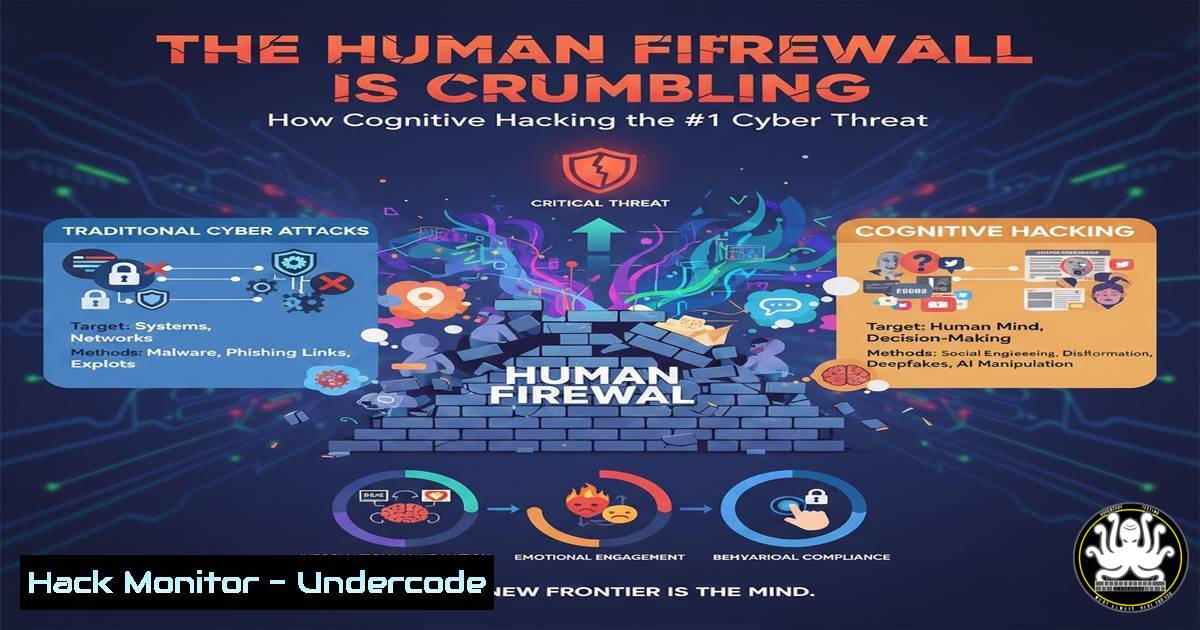
The battlefield of cybersecurity is shifting from firewalls and servers to the human mind. Social engineering and cognitive security are emerging as the primary attack vectors, exploiting psychological biases and emotions to bypass technical defenses. This article deconstructs how attackers are hacking the human brain and provides a technical and procedural blueprint for building cognitive resilience.
Learning Objectives:
- Understand the psychological principles and technical methodologies behind cognitive hacking attacks.
- Implement technical controls and monitoring to detect and prevent social engineering attempts.
- Develop a strategic framework for continuous security awareness training that moves beyond compliance.
You Should Know:
- The Anatomy of a Cognitive Hack: Weaponizing Human Biases
Cognitive hacking is not about guessing passwords; it’s about systematically exploiting hardwired human psychological shortcuts (heuristics). Attackers use principles like urgency (scarcity bias), authority (deference to experts), and social proof (the “everyone else is doing it” effect) to manipulate targets into taking actions that compromise security.
Step‑by‑step guide explaining what this does and how to use it.
Step 1: Reconnaissance (OSINT): Attackers use open-source intelligence (OSINT) to profile targets. Tools like Maltego or theHarvester can aggregate public data from LinkedIn, GitHub, and social media.
Linux Command: `theharvester -d yourcompany.com -b linkedin,google` – This scrapes publicly available employee names and details from specified sources.
Step 2: Pretexting & Payload Delivery: Based on the profile, a pretext (a fabricated scenario) is created. The “payload” is often a phishing email, a malicious link, or a phone call (vishing).
Step 3: Exploitation & Execution: The victim, manipulated by the pretext, executes the attacker’s will—clicking a link, downloading a file, or divulging credentials.
- From Phishing to Deepfakes: The AI-Powered Evolution of Social Engineering
AI is supercharging social engineering. Generative AI can create flawless, personalized phishing emails in any language. Deepfake audio and video can impersonate executives to authorize fraudulent wire transfers or access sensitive systems.
Step‑by‑step guide explaining what this does and how to use it.
Step 1: Defense with Advanced Email Filtering: Go beyond basic spam filters. Implement solutions that use machine learning to analyze email headers, body language, and sender reputation for advanced phishing detection.
DMARC/DKIM/SPF Configuration: Ensure these email authentication protocols are correctly configured in your DNS to prevent domain spoofing.
Step 2: Technical Deepfake Detection: For high-security environments, invest in APIs that can detect deepfakes by analyzing facial micro-expressions, audio glitches, and digital fingerprints.
Step 3: Process Hardening: Establish a mandatory secondary verification channel (e.g., a quick phone call via a known number) for any financial transaction or sensitive access request initiated electronically, especially from a superior.
3. Hardening the Human Layer: Implementing Technical Deterrents
While you cannot patch a human, you can build a technical environment that minimizes the impact of human error. This involves implementing the principle of least privilege and robust application control.
Step‑by‑step guide explaining what this does and how to use it.
Step 1: Enforce Least Privilege: No user should have administrative rights on their local workstation by default. This prevents the silent installation of malware from a phishing payload.
Windows Command (via Group Policy): `secpol.msc` -> Navigate to Local Policies -> User Rights Assignment -> Modify “Allow log on locally” to remove standard users.
Linux Command: Use `sudo` policies judiciously. Regularly audit with `sudo -l` to review user privileges.
Step 2: Application Whitelisting: Use tools like Windows AppLocker or third-party solutions to only allow pre-approved executables, scripts, and installers to run.
Step 3: Network Segmentation: Isolate critical systems and data. If a user in the marketing department is compromised, the attacker should not have a direct network path to the R&D servers.
- Simulating the Attack: Red Teaming the Human Factor
The most effective way to test cognitive security is through controlled, ethical attacks. Regular phishing simulations and red team exercises that include vishing and physical social engineering are crucial.
Step‑by‑step guide explaining what this does and how to use it.
Step 1: Plan the Campaign: Define the scope and goals. Will you simulate a credential phishing attack, a vishing call to the help desk, or a USB drop attack?
Step 2: Use a Phishing Simulation Platform: Tools like GoPhish or commercial platforms allow you to create realistic phishing campaigns, track clicks, and identify vulnerable individuals.
Step 3: Debrief and Educate, Don’t Punish: The goal is education. Immediately after a simulation, provide feedback to users who “fell for it,” explaining the red flags they missed. This turns a failure into a powerful learning moment.
- Building a Culture of Cognitive Security: Beyond Annual Training
Security awareness must be continuous, engaging, and integrated into the company culture. Move away from annual, checkbox-compliance training to a model of constant reinforcement.
Step‑by‑step guide explaining what this does and how to use it.
Step 1: Microlearning: Deliver short (3-5 minute) security lessons regularly—e.g., a monthly video on a new phishing tactic or a weekly security tip in internal communications.
Step 2: Gamification: Create leaderboards for departments with the best phishing simulation results or offer rewards for employees who report real-world phishing attempts.
Step 3: Foster Psychological Safety: Create an environment where employees feel comfortable reporting security mistakes without fear of reprisal. A reported mistake can be contained; a hidden one becomes a breach.
What Undercode Say:
- The C-Suite is the New Attack Surface. Executives, with their broad access and authority, are high-value targets for sophisticated cognitive attacks like deepfake vishing and whaling phishing campaigns. Their security training must be specialized and rigorous.
- Compliance Does Not Equal Security. A checkbox mentality towards security training creates a fragile defense. True resilience comes from cultivating a pervasive “human firewall” mindset where every employee is an active, skeptical, and empowered guardian of organizational security.
The paradigm is clear: the most sophisticated technical defenses are rendered useless if an employee can be psychologically manipulated into handing over the keys. The future of cybersecurity is not just about building higher walls; it’s about ensuring that the people inside the walls are vigilant, critical thinkers. This requires a fundamental shift in strategy, where investments in human-centric security training and cognitive resilience are given the same priority as investments in next-generation firewalls and endpoint detection. The attack surface has expanded to include the human mind, and our defense strategies must evolve accordingly.
Prediction:
In the next 3-5 years, cognitive hacking will become the dominant initial access vector for major cyber incidents, surpassing technical vulnerabilities. We will see a rise in “Cognitive Security” as a dedicated domain within cybersecurity, led by specialists blending expertise in psychology, AI, and traditional infosec. The market for AI-driven social engineering simulation and deepfake detection tools will explode. Organizations that fail to invest in hardening their human layer will face exponentially higher risks of catastrophic breaches, making cognitive security not just a technical necessity but a core business and political imperative.
🎯Let’s Practice For Free:
IT/Security Reporter URL:
Reported By: Youna Chosse – Hackers Feeds
Extra Hub: Undercode MoN
Basic Verification: Pass ✅


