Listen to this Post
Introduction:
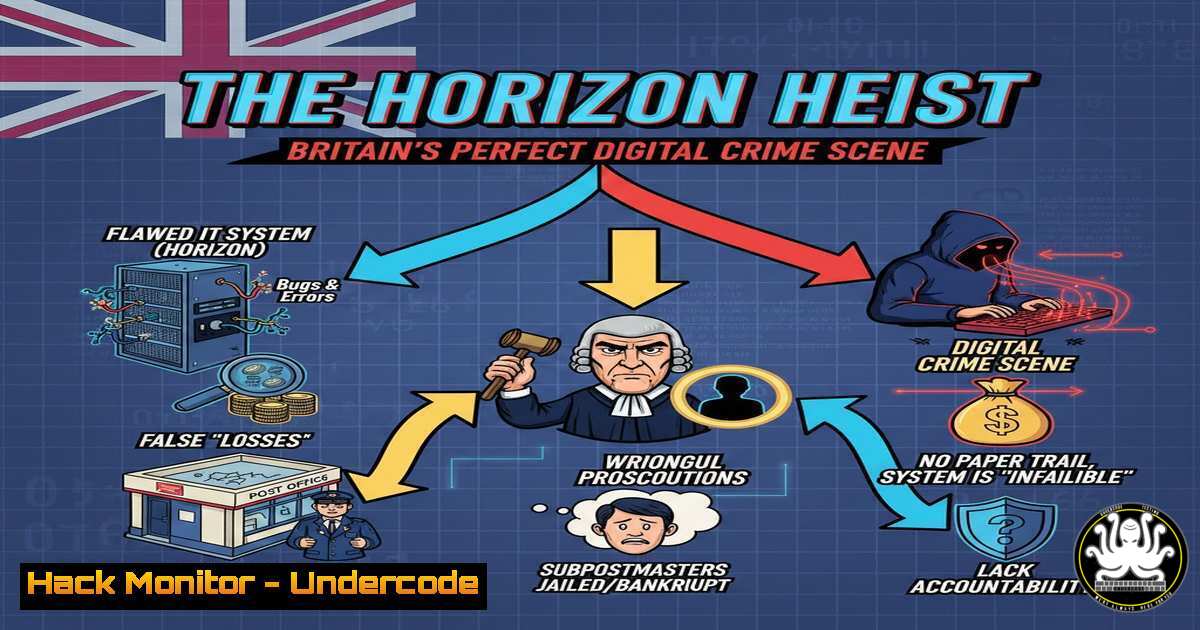
The UK Post Office Horizon scandal represents one of the most catastrophic failures of digital evidence integrity in legal history. Between 1999 and 2015, over 900 sub-postmasters were wrongly prosecuted based on faulty data from the Horizon accounting system, leading to imprisonment, bankruptcy, and profound personal trauma. This case transcends a mere software glitch, exposing a lethal cocktail of confirmation bias, institutional failure, and the abandonment of fundamental cybersecurity and audit principles, turning a trusted government IT system into an engine of injustice.
Learning Objectives:
- Understand the critical technical failures in the Horizon system’s data integrity and logging mechanisms that enabled the miscarriage of justice.
- Learn key system audit and forensic commands to verify the integrity of financial transactions and logs in Linux/Windows environments.
- Recognize the organizational and “human firewall” failures that allowed technical flaws to escalate into systemic fraud and abuse.
You Should Know:
- The Illusion of Infallibility: Questioning “Single Source of Truth” Systems
The Post Office and courts treated Horizon data as an incontrovertible “single source of truth.” This is a critical error in any IT governance model. No system is inherently foolproof; data must be verifiable, not just digital.
Step-by-step guide explaining what this does and how to use it.
A core defense is implementing independent audit trails. For any critical system like Horizon, transactions must be logged in a separate, immutable system. On a Linux server, you can use `rsyslog` to forward logs to a secure, centralized log server.
 1. On the application server (e.g., Horizon), configure rsyslog to send specific logs to a secure audit server.
 Edit the rsyslog configuration file:
sudo nano /etc/rsyslog.conf

<ol>
<li>Add a line to forward all 'local0' facility logs (often used for application logs) to the audit server (replace 192.168.1.100 with your audit server IP):
.local0 @192.168.1.100:514</p></li>
<li><p>In your application code, ensure all financial transactions are logged to the local0 facility.</p></li>
<li>On the central audit server, configure rsyslog to receive logs and store them in a write-once, read-many (WORM) format to prevent tampering.
Edit /etc/rsyslog.conf on the audit server:
module(load="imtcp")
input(type="imtcp" port="514")
$template SecureLog,"/var/log/secure_audit/%$YEAR%/%$MONTH%/%$DAY%.log"
:msg, contains, "TRANSACTION" -?SecureLog
& stop
This setup creates a segregated, time-stamped audit trail that is resilient to tampering on the source system, providing a crucial layer of validation.
- Data Integrity Failures: Corrupted Ledgers and Missing Rollbacks
The Horizon system exhibited “data integrity” failures—phantom shortfalls appeared that couldn’t be reconciled. A robust system must have atomic transactions (complete fully or not at all) and allow for authorized rollbacks or dispute flags.
Step-by-step guide explaining what this does and how to use it.
Database integrity can be proactively monitored. Use checksums on critical tables to detect unauthorized changes. In a PostgreSQL environment (common for financial systems), you can schedule a daily integrity check.
-- 1. Create a function to calculate a checksum of the key transaction table.
CREATE OR REPLACE FUNCTION get_transaction_checksum()
RETURNS TEXT AS $$
BEGIN
RETURN md5(string_agg(tx_id::text || amount::text || date::text, ',' ORDER BY tx_id));
END;
$$ LANGUAGE plpgsql;

-- 2. Schedule a cron job (Linux) to run this checksum daily and compare it to the previous day's value.
-- The cron job would execute:
psql -U auditor -d horizon_db -c "SELECT get_transaction_checksum();" > /var/log/audit/checksum_$(date +\%Y\%m\%d).txt

-- 3. Use a simple diff command to compare. Any change without a corresponding, logged change request flags an investigation.
diff /var/log/audit/checksum_20250109.txt /var/log/audit/checksum_20250110.txt
- The “Black Box” Problem: Lack of Transparency and Audit Access
Sub-postmasters were denied access to Horizon’s underlying data and logs to challenge the accusations. This violates the core security principle of “non-repudiation” and due process.
Step-by-step guide explaining what this does and how to use it.
Modern systems must provide secure, role-based audit access. Implementing a tool like `Auditd` on Linux allows you to track access to the data itself.
 1. Install and configure auditd to monitor access to the transaction database or log files.
sudo apt-get install auditd
sudo auditctl -w /var/lib/postgresql/16/main/horizon_transactions.db -p rwa -k horizon_critical_data

<ol>
<li>This rule (-w) watches the database file, logging any Read, Write, or Attribute change (-p rwa) with a key tag (-k).</li>
<li>Query the audit logs to see who accessed the data:
sudo ausearch -k horizon_critical_data | aureport -f -i
This creates an immutable record proving who viewed or modified the data, preventing claims that the system’s internal view was the only possible one.
- Failure of the Human Firewall: Ignoring Whistleblower Logs
For years, technicians and sub-postmasters raised alarms, which were systematically ignored. Effective Security Information and Event Management (SIEM) requires actionable alerts and escalation procedures.
Step-by-step guide explaining what this does and how to use it.
Implement a simple log monitoring rule that triggers alerts for frequent error codes from the same branch—a potential early indicator of systemic issues, not user error.
 Using a tool like Fail2ban or a custom logwatch script:
 1. Monitor the application log for "shortfall" or "error" codes.
sudo tail -f /var/log/horizon/app.log | grep "ERROR CODE: STF"

<ol>
<li>A Python script (monitor.py) could count these errors per branch ID and email an IT manager if a threshold (e.g., 5 in an hour) is exceeded.
import re, smtplib
from collections import Counter
log_file = "/var/log/horizon/app.log"
error_pattern = r"BRANCH:(\d+).ERROR CODE: STF"
branch_errors = Counter()</li>
</ol>

with open(log_file, 'r') as f:
for line in f:
match = re.search(error_pattern, line)
if match:
branch = match.group(1)
branch_errors[bash] += 1
if branch_errors[bash] > 5:
send_alert(branch)
5. Network and Remote Access: The Unexamined Vector
The Horizon system relied on remote access for updates and support. Unverified or poorly logged remote sessions could have been a vector for undetectable data manipulation.
Step-by-step guide explaining what this does and how to use it.
Harden remote access by mandating SSH key-based authentication (disabling passwords) and logging all session activity comprehensively.
 1. On the Horizon server, enforce SSH key authentication and log commands.
sudo nano /etc/ssh/sshd_config
 Set: PasswordAuthentication no
 PermitRootLogin no
 LogLevel VERBOSE

<ol>
<li>Use <code>sudo</code>'s logging or a tool like `tlog` to record entire SSH sessions for audit purposes.
Install tlog and configure it to record sessions to a central server.</li>
<li>Regularly audit SSH access attempts:
sudo grep "Failed password" /var/log/auth.log | awk '{print $11}' | sort | uniq -c | sort -nr
What Undercode Say:
- Digital Evidence is Not Infallible: The Horizon scandal is the ultimate proof that digital data must be treated with the same rigorous skepticism as physical evidence. It requires provenance, chain-of-custody, and must be open to challenge by the defense. Building systems without this principle baked in is a design flaw that enables tyranny.
- The Ethics of Code and Conscience: The technicians, auditors, and lawyers involved committed a profound ethical breach: they prioritized the perceived integrity of the system over the observable suffering of people. In IT and cybersecurity, your ultimate “human firewall” is the courage to say, “The log files show this, but the people show otherwise—the system must be wrong.”
This was not a hack in the traditional sense, but a “slow drip” institutional hack where the trust placed in a digital system was weaponized. The technical failures—poor logging, lack of rollback, no external checksums—were severe but common. The catastrophic multiplier was the human and institutional layer that chose to use that flawed system not as a tool for inquiry, but as a weapon for conviction. It reveals that the most dangerous vulnerability often sits between the chair and the keyboard, especially when that chair is in a position of unaccountable power.
Prediction:
The Horizon scandal will become the canonical case study, driving a generational shift in how digital evidence is treated in law and government IT contracts. We will see: 1. Legislative Mandates for “Auditable by Design” for all public-sector software, with open-source algorithms for critical functions. 2. The Rise of the Digital Forensics Auditor as a standard role in any large organization, with direct, protected reporting lines. 3. “Right to Inspect” Clauses in software licenses, allowing users to audit the code and logs governing their fate. The future impact is a world where code is no longer a black box of authority but a transparent, challengeable artifact. The hack wasn’t on Horizon’s code, but on society’s trust; the mitigation is building systems where that trust is verified, not blindly bestowed.
▶️ Related Video (78% Match):
🎯Let’s Practice For Free:
IT/Security Reporter URL:
Reported By: Brian Rogers – Hackers Feeds
Extra Hub: Undercode MoN
Basic Verification: Pass ✅


