Listen to this Post
Introduction:
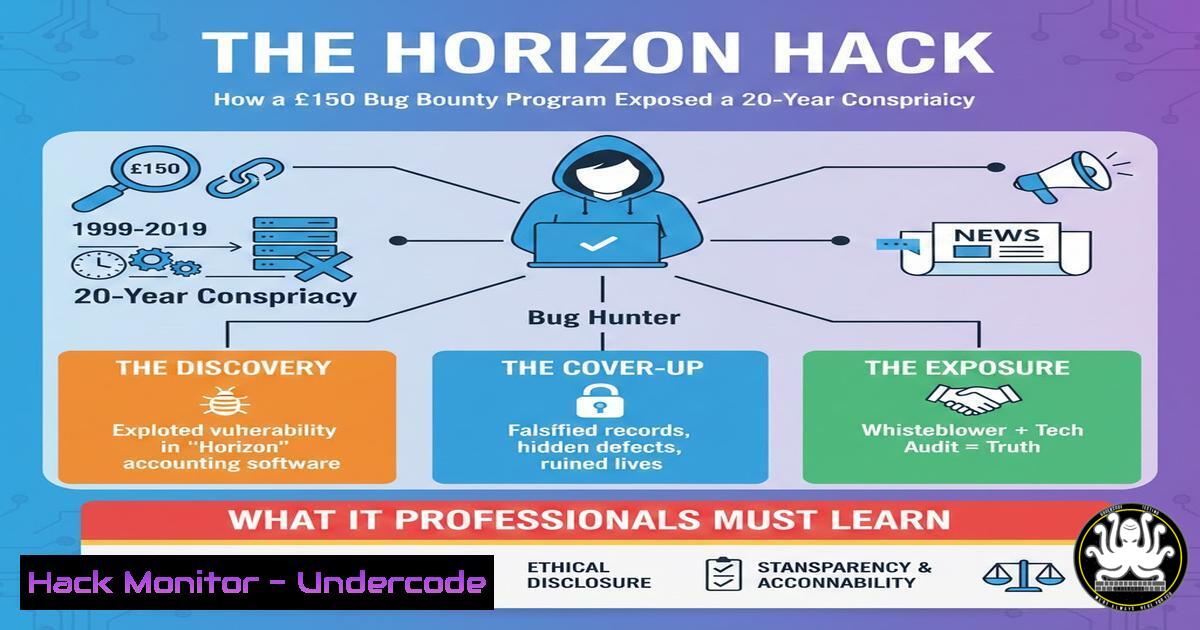
The Post Office Horizon scandal is not merely a story of wrongful prosecutions; it is a catastrophic failure of software accountability, institutional governance, and forensic integrity. A 2006 contract, revealing a formal agreement to fix software bugs for a fee, proves a conscious cover-up of systemic flaws while sub-postmasters were criminally prosecuted. This case study serves as a dire warning for cybersecurity, IT governance, and ethical software development, highlighting how technical failures can be weaponized by institutions.
Learning Objectives:
- Understand the critical intersection of software defect management, contractual SLAs, and legal accountability.
- Learn forensic techniques to detect unauthorized remote access and audit system integrity in legacy environments.
- Develop governance frameworks to prevent institutional denial of technical truth and protect whistleblowers.
You Should Know:
- The Bug Bounty That Became a Cover-Up: Decoding SLAs and Liability
The 2006 agreement between Post Office and Fujitsu established a price list for fixing bugs—up to £150 per transaction failure—while publicly denying any systemic issues existed. This represents a perversion of standard IT Service Level Agreements (SLAs) and bug bounty programs, which should foster transparency, not concealment.
Step‑by‑step guide explaining what this does and how to use it.
In modern IT governance, defect logging and SLA management must be transparent and auditable. Here’s a basic audit command to search for high-priority bug logs in a Linux-based system using `journalctl` and grep:
 Search system logs for high-priority errors related to a specific application (e.g., 'Horizon')
sudo journalctl -u horizon-service --since="2006-01-01" --until="2010-12-31" --priority=3 | grep -E "bug|defect|fail|error|transaction" > horizon_bug_audit.log

Use `jq` to parse structured JSON logs from a modern application for financial discrepancies
cat /var/log/app/transactions.json | jq 'select(.status == "failed") | {timestamp, user, amount, error_code}' > failed_transactions_audit.json
This command chain demonstrates how systematic log aggregation and analysis could have surfaced pattern failures. Contracts must mandate independent audit access to such logs.
2. Forensic Detection of Covert Remote Access
Post Office executives repeatedly claimed remote access to Horizon terminals was “impossible,” a key point used in prosecutions. Forensic IT techniques can prove otherwise.
Step‑by‑step guide explaining what this does and how to use it.
On a Windows system (similar to Horizon terminals), check for remote desktop, PSExec, and WMI connections—common vectors for administrative remote access.
 Check Event Logs for Remote Desktop connections
Get-WinEvent -LogName 'Microsoft-Windows-TerminalServices-LocalSessionManager/Operational' | Where-Object {$_.Id -in (21,22,23,24,25)} | Select-Object TimeCreated, Id, Message | Format-Table -AutoSize

Examine WMI activity for remote execution
Get-WinEvent -FilterHashtable @{LogName='Microsoft-Windows-WMI-Activity/Operational'; Id=5861} | Select-Object -First 20

List established network connections (look for unexpected RDP or admin ports)
netstat -ano | findstr ":3389 :5985 :5986"  RDP and WinRM ports
Regularly baselining normal network connections and monitoring for anomalous outbound/inbound traffic is crucial for proving or disproving remote access claims.
3. Software Integrity Verification: Hashing and Immutable Logs
The scandal relied on disputing the integrity of local terminal data. Implementing cryptographic hashing for transactions and immutable logging could have prevented this.
Step‑by‑step guide explaining what this does and how to use it.
Use SHA-256 hashing to create a verifiable chain of integrity for critical files and logs.
 Generate a hash of a critical transaction batch file
sha256sum /opt/horizon/batch_001.trans > batch_001.trans.sha256

Recursively hash an entire directory structure for later integrity checks
find /var/log/horizon -type f -exec sha256sum {} \; > /secure_audit/log_hashes_$(date +%Y%m%d).txt

Verify integrity at a later date
sha256sum -c /secure_audit/log_hashes_20231001.txt 2>&1 | grep FAILED
Store these hashes in an immutable, append-only ledger (e.g., using a blockchain-based timestamping service or a write-once-read-many (WORM) storage system).
4. Incident Response: Whistleblower System and Anomaly Detection
Sub-postmasters reported discrepancies but were ignored. Automated anomaly detection coupled with secure, anonymous reporting channels is vital.
Step‑by‑step guide explaining what this does and how to use it.
Implement a simple anomaly alert using statistical deviation on transaction logs, and a secure intake system.
 Python pseudo-code for basic anomaly detection on daily balances
import pandas as pd, numpy as np
transactions = pd.read_csv('daily_transactions.csv')
mean = transactions['balance_delta'].mean()
std = transactions['balance_delta'].std()
 Flag anomalies beyond 3 standard deviations
anomalies = transactions[np.abs(transactions['balance_delta'] - mean) > (3  std)]
anomalies.to_csv('anomalies_report.csv', index=False)
 Automatically generate alert to secured, encrypted whistleblower mailbox
Use a tool like Mattermost or Signal with a dedicated, encrypted channel where automated alerts and human reports are cryptographically signed and stored.
5. Cloud Hardening and Accountability in Modern Systems
Legacy monolithic systems like Horizon lack transparency. Modern cloud architectures can enforce better accountability through IAM, traceability, and sealed audit trails.
Step‑by‑step guide explaining what this does and how to use it.
In AWS, enforce strict IAM policies with mandatory logging via CloudTrail. Ensure no changes can go untracked.
 Use AWS CLI to ensure CloudTrail is enabled and logging to a secure, immutable S3 bucket
aws cloudtrail describe-trails --trail-name-list default
 Enable S3 bucket versioning and MFA delete for the audit log bucket
aws s3api put-bucket-versioning --bucket my-audit-logs --versioning-configuration Status=Enabled
aws s3api put-bucket-mfa-delete --bucket my-audit-logs --mfa-delete Enabled --mfa "arn:aws:iam::123456789012:mfa/root-account-mfa-device 123456"
Implement AWS IAM Access Analyzer and Azure Policy to enforce “least privilege” and generate alerts on any overly permissive policies that could allow data manipulation without trace.
What Undercode Say:
- Technical Truth is Non-Negotiable: The foundation of any IT system used in legal or financial contexts must be objectively verifiable. Logs, hashes, and audit trails are not optional; they are the bedrock of justice.
- Governance Over Geekery: Agile development and “working code” cannot come at the expense of rigorous documentation, independent oversight, and ethical accountability frameworks. Licensing for critical system developers, as suggested in the thread, warrants serious debate.
The Horizon scandal was enabled by a willful gap between technical reality and institutional narrative. IT professionals have a duty to build systems where truth is technologically enforced—through immutable logs, transparent SLAs, and whistleblower-friendly anomaly detection. The next Horizon will be a blockchain-ledgered, AI-audited, cloud-native system, but only if we mandate that its code and its governance are open to scrutiny. The alternative is more lives destroyed by a conspiracy of silence between bits and bytes.
Prediction:
The fallout will accelerate regulatory demand for “Explainable AI” and “Certified Software Integrity” in public sector contracts. We will see the rise of mandatory, real-time API-based auditing hooks for government systems, and a new professional liability for software architects and forensic IT auditors. Within five years, a “Software Due Diligence” certificate, akin to financial auditing, will become a procurement prerequisite for any mission-critical system, turning IT governance into a non-delegable, criminal-liability-backed responsibility.
🎯Let’s Practice For Free:
IT/Security Reporter URL:
Reported By: Stuart G – Hackers Feeds
Extra Hub: Undercode MoN
Basic Verification: Pass ✅


