Listen to this Post
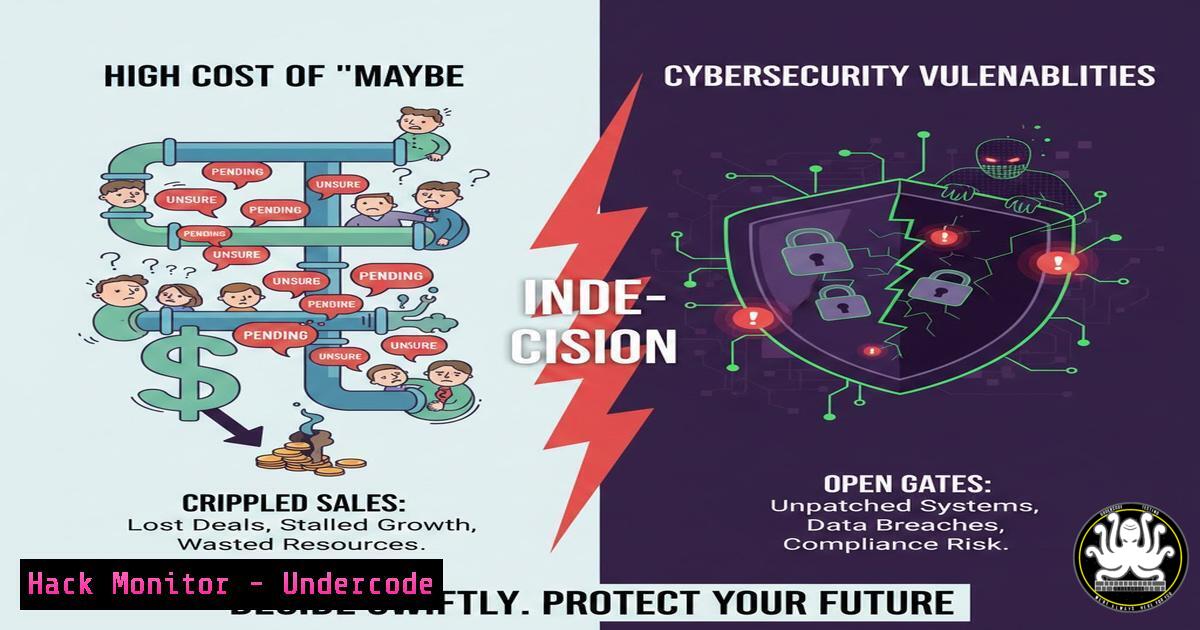
Introduction:
In business, a “maybe” is often seen as a polite placeholder, but it represents a critical point of failure in both sales pipelines and security postures. This analysis reframes professional indecision as a systemic vulnerability, drawing parallels between lost revenue opportunities and exploitable security gaps created by delayed action. Just as a stalled deal consumes resources, unpatched systems and unenforced policies drain IT budgets and increase attack surfaces.
Learning Objectives:
- Understand how the psychology of “maybe” in sales correlates with complacency in IT security protocols.
- Learn to implement technical enforcement mechanisms that replace human hesitation with automated, decisive action.
- Develop a framework for quantifying the cost of indecision in both business development and cybersecurity risk management.
You Should Know:
- From “Maybe” to Meltdown: The Psychology of Complacency
The original post correctly identifies “maybe” as a trap that kills momentum. In cybersecurity, this manifests as “risk acceptance” without proper review, delayed patch deployment, and ignored security alerts. The mental model is identical: the temporary comfort of inaction (postponing a difficult security change) is preferred over the short-term discomfort of decisive action (applying a patch that might cause downtime). This creates a window of exposure that attackers exploit.
Step‑by‑step guide to identifying complacency:
- Audit Logs for Ignored Alerts: Use SIEM or endpoint detection tools to find re-occurring, dismissed alerts.
Linux (Check failed login attempts): `sudo grep “Failed password” /var/log/auth.log | head -20`
Windows (PowerShell – Get Security Event Log failures): `Get-WinEvent -FilterHashtable @{LogName=’Security’; ID=4625} -MaxEvents 20`
2. Review Patch Management Policies: Document the average time between patch release and deployment for critical systems. - Quantify the “Maybe” Window: Calculate the potential financial impact (using a formula like Risk = Threat x Vulnerability x Cost) for a known vulnerability during the period of indecision.
-
Automating the “No”: Enforcing Zero-Trust with Technical Controls
High-performers push for a decision. High-performing security architectures enforce decisions automatically. Zero-Trust is the ultimate “If not ‘Yes’, then ‘No'” framework. It assumes no implicit trust is granted to assets or user accounts based solely on their location or ownership.
Step‑by‑step guide to implementing a basic Zero-Trust rule:
- Principle: Never trust, always verify. Every access request must be authenticated, authorized, and encrypted.
2. Example – Network Segmentation with Micro-Segmentation:
Tool: Use `iptables` (Linux) or Windows Defender Firewall with Advanced Security (Windows).
Goal: Isolate a sensitive database server so only the specific application server can communicate on port 5432 (PostgreSQL).
Linux (on database server):
 Flush existing rules (caution on production)
 sudo iptables -F
 Default deny all incoming
sudo iptables -P INPUT DROP
 Allow SSH from management subnet
sudo iptables -A INPUT -p tcp --dport 22 -s 10.0.1.0/24 -j ACCEPT
 Allow PostgreSQL ONLY from the app server IP
sudo iptables -A INPUT -p tcp --dport 5432 -s 10.0.1.50 -j ACCEPT
 Save rules (distribution dependent)
sudo iptables-save > /etc/iptables/rules.v4
Windows (via PowerShell):
New-NetFirewallRule -DisplayName "Allow_PGSQL_From_AppServer" -Direction Inbound -LocalPort 5432 -Protocol TCP -Action Allow -RemoteAddress 10.0.1.50
3. This configuration leaves no room for “maybe.” Traffic is either explicitly allowed or denied.
- Pushing for a Decision: Implementing Just-In-Time (JIT) Access
Instead of standing access (“maybe you’ll need it”), JIT access requires users to request and justify elevated privileges for a limited time. This forces a security-conscious decision at the point of need.
Step‑by‑step guide to conceptual JIT with PAM:
- Tool: Use an open-source PAM tool like Teleport or a commercial solution.
2. Workflow:
A developer needs SSH access to a production server for debugging.
They request access via the PAM portal, specifying the server, reason, and duration (e.g., 2 hours).
The request pings a configured approver (or auto-approves based on rules).
Upon approval, the PAM system provisions temporary SSH credentials or adds the user’s key to the server for the exact duration.
After 2 hours, access is automatically revoked. No lingering “maybe” access.
- The “No” is a Gift: Leveraging Security Defaults and Hardening Benchmarks
A secure default configuration is a proactive “No” to unnecessary risk. Systems should ship in a locked-down state, requiring explicit action to enable services.
Step‑by‑step guide to applying CIS Benchmarks:
- Reference: Download the CIS Benchmark PDF for your OS (e.g., Ubuntu Linux 22.04 LTS).
2. Automated Hardening with `cockpit` (Example for RHEL/CentOS/Fedora):
Install: `sudo dnf install cockpit-scans`
Access the web UI (https://server-ip:9090`) and navigate to "Tools" -> "SCAP."sudo nano /etc/lightdm/lightdm.conf
Choose a CIS profile and run a scan. The tool will report compliance and can often remediate automatically.
3. Manual Example - Disable Guest Account in Ubuntu (pre-24.04):
<h2 style="color: yellow;"> Edit the lightdm config:</h2>allow-guest=false`
<h2 style="color: yellow;"> Add or modify:
This is a definitive “No” to anonymous access.
5. Killing Empty Promises: Continuous Vulnerability Assessment
A pipeline full of unqualified leads is like a network with unassessed vulnerabilities—both create a false sense of security. Continuous scanning forces confrontation with reality.
Step‑by‑step guide with Nessus Essentials/OpenVAS:
- Setup: Install Nessus Essentials (free for 16 IPs) or OpenVAS.
2. Configure a Basic Network Scan:
Define the target IP range (e.g., 10.0.1.0/24).
Select a scan policy (e.g., “Basic Network Scan”).
Enable safe checks and schedule it to run weekly.
3. Act on Findings: The scan report eliminates “maybe we are vulnerable.” It provides a definitive list. Prioritize critical CVSS 9+ vulnerabilities for immediate patching.
6. Building a Culture of Decisive Security
This transcends tools. It’s about creating processes that mandate clear decisions.
Change Management: No change is implemented without an explicit Approve/Reject.
Incident Response: Declare an incident early. Don’t “maybe” it. Follow the NIST (Identify, Protect, Detect, Respond, Recover) cycle.
Training: Use phishing simulation platforms. A user who clicks isn’t a “maybe” phish—they are a definitive target for more training.
What Undercode Say:
- Indecision is a Configurable Vulnerability. The tolerance for “maybe” in business processes or security policies is a quantifiable risk parameter that must be minimized through automation and explicit policy design.
- Speed and Security Are Not Antithetical. A decisive “No” via an automated control is faster and more secure than a human’s delayed “Yes.” Professionalism in cybersecurity means architecting systems that make correct, rapid decisions at scale.
The original insight on sales is a profound metaphor for security governance. The expensive “maybe” in sales has a direct counterpart in the delayed patch, the unenforced policy, and the ignored alert. Both domains suffer from the hope that inaction is a safe middle ground, when it is, in fact, the most dangerous territory. The future belongs to organizations that replace human hesitation with engineered certainty.
Prediction:
The convergence of AI/ML and security automation will rapidly eliminate the “maybe” from technical systems. We will see the rise of Autonomous Security Operations Centers (ASOCs) where AI agents, trained on global threat intelligence, will automatically enact containment measures (a definitive “No”) at machine speed in response to threats, with human oversight shifting to auditing these decisions. In sales and security alike, the human role will evolve from making repetitive decisions to designing and governing the systems that make them.
▶️ Related Video (80% Match):
🎯Let’s Practice For Free:
IT/Security Reporter URL:
Reported By: Elijahebulue The – Hackers Feeds
Extra Hub: Undercode MoN
Basic Verification: Pass ✅


