Listen to this Post
Introduction:
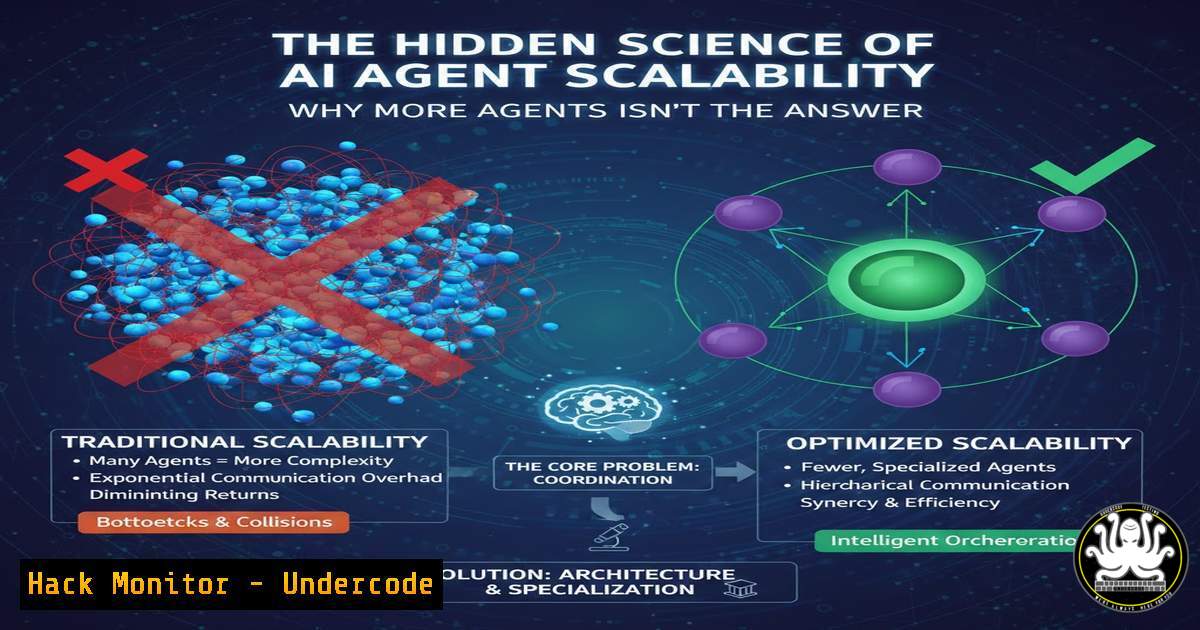
The widespread belief that adding more AI agents automatically improves system performance is being dismantled by groundbreaking research. Google DeepMind’s 2025 paper, “Towards a Science of Scaling Agent Systems,” establishes a quantitative framework proving that performance is dictated by task structure and coordination costs, not agent count. This paradigm shift moves agentic AI from a realm of prompting tricks into a disciplined field of systems design, where architecture must be empirically chosen based on measurable constraints.
Learning Objectives:
- Understand the three dominant forces governing agent system performance: the tool coordination tradeoff, the capability ceiling, and error amplification.
- Learn to analyze task decomposability to select the optimal system architecture—single agent, centralized, or decentralized.
- Apply practical, verified commands and methodologies for measuring coordination overhead and preventing error propagation in AI agent deployments.
You Should Know:
1. The Foundational Forces: Quantifying Agent Performance
The research identifies three core principles that predict system success. First, the tool coordination tradeoff reveals that tasks requiring many tools suffer under multi-agent overhead within fixed computational (token) budgets. Second, a capability ceiling exists; once a single agent achieves roughly 45% task accuracy, adding more agents yields diminishing or negative returns. Third, architecture-dependent error amplification occurs, where independent agents propagate errors, while centralized orchestration can contain failures through validation checkpoints.
Step‑by‑step guide:
To apply these principles, you must first benchmark your single-agent baseline. For a coding assistant task, you could measure performance using a framework like LangChain’s evaluation modules.
 Example: Setting up a single-agent baseline evaluation
from langchain.evaluation import load_evaluator
from langchain.agents import initialize_agent, AgentType
from langchain_community.llms import HuggingFacePipeline

<ol>
<li>Initialize your base LLM/agent
llm = HuggingFacePipeline.from_model_id(...)
evaluator = load_evaluator("score_string", criteria="correctness")</p></li>
<li><p>Run the agent on your test suite and score performance
test_task = "Write a Python function to reverse a linked list."
agent_response = your_agent.run(test_task)
evaluation_result = evaluator.evaluate_strings(
prediction=agent_response,
reference="def reverse_list(head):..."
)</p></li>
<li>Record the accuracy score. If it's near or above 45%, multi-agent may hurt performance.
print(f"Single Agent Baseline Accuracy Score: {evaluation_result['score']}")
2. Architecture Selection: Matching System to Task Structure
The paper’s predictive model, which explains over half of performance variance, guides architecture choice. Centralized coordination (e.g., a primary orchestrator agent) excels for decomposable, sequential reasoning tasks like financial reporting. Decentralized coordination benefits exploratory tasks like web navigation where parallel exploration is key. Single agents remain superior for strictly linear, planning-heavy workflows where coordination would fragment reasoning.
Step‑by‑step guide:
Use this decision workflow to select your architecture.
- Profile Your Task: Classify it as Parallelizable, Sequential, or Exploratory.
Parallelizable: Independent sub-tasks (e.g., analyzing multiple, unrelated financial documents).
Sequential: Later steps depend on earlier outputs (e.g., a multi-step code debugging and refactoring pipeline).
Exploratory: The path to a solution is unknown and requires searching (e.g., multi-source web research).
2. Choose Your Architecture:
For Parallelizable tasks, consider a decentralized system with a router. Implement a simple routing logic in your orchestrator.
 Pseudo-code for a task router in a decentralized system
task_description = "Analyze Q3 sales PDF and summarize latest competitor news."
if "pdf" in task_description and "news" in task_description:
 Route to two different specialist agents in parallel
sales_agent_result = await sales_agent.arun("Analyze Q3 sales PDF")
research_agent_result = await research_agent.arun("summarize competitor news")
final_result = combine_results(sales_agent_result, research_agent_result)
For Sequential tasks, use a single powerful agent or a strictly centralized controller that validates each step before proceeding.
For Exploratory tasks, a decentralized system where agents work independently and merge findings is often optimal.
3. Validate Choice with Metrics: Instrument your system to track the key metrics from the paper: token overhead and error propagation rate.
- Measuring the Real Cost: Token Overhead and Coordination Efficiency
A critical finding is that multi-agent systems consume 3–5× more tokens than single agents for the same task, a direct cost in latency and API expenses. This overhead stems from inter-agent communication, re-prompting, and context sharing. The paper emphasizes that developers must measure coordination efficiency—the performance gain per unit of additional token cost—before adding complexity.
Step‑by‑step guide:
Instrument your agent system to track token usage and calculate coordination efficiency.
1. Enable Logging: Most LLM providers and frameworks offer detailed token usage in response metadata.
 Example using OpenAI's Python client to track token usage
from openai import OpenAI
client = OpenAI()
response = client.chat.completions.create(
model="gpt-4",
messages=[{"role": "user", "content": "Your task here"}],
max_tokens=1000
)
 Extract token counts
prompt_tokens = response.usage.prompt_tokens
completion_tokens = response.usage.completion_tokens
total_tokens = response.usage.total_tokens
print(f"Tokens used: {total_tokens}")
2. Run Comparative Tests: Execute your task suite with a single-agent and a multi-agent architecture. Log the total tokens for each run.
3. Calculate Metrics:
Token Overhead Multiplier: (Multi-agent Tokens) / (Single-agent Tokens). If this is >3, question the multi-agent value.
Coordination Efficiency Score: (Performance Gain %) / (Token Overhead Multiplier). A score less than 1 indicates inefficient coordination.
4. Containing Failures: Mitigating Error Propagation
In decentralized systems, a single agent’s error can be amplified as it’s passed to others. The paper shows centralized orchestration mitigates this via “validation bottlenecks.” Implementing explicit validation steps at handoff points is crucial for production reliability.
Step‑by‑step guide:
Implement a validation layer in your agent orchestration logic.
1. Define Validation Rules: For a coding agent, this could be a syntax check; for a research agent, a fact-source consistency check.
2. Insert Validation Checkpoints: In your orchestration code, do not pass a result forward until it passes validation.
 Example: Simple validation checkpoint in an agent chain
from langchain_core.pydantic_v1 import BaseModel, Field, validator
class ValidatedResponse(BaseModel):
answer: str = Field(description="The agent's answer")
confidence: int = Field(description="Confidence score 1-10")
@validator('confidence')
def confidence_must_be_sufficient(cls, v):
if v < 7:  Set a confidence threshold
raise ValueError('Agent confidence too low to proceed.')
return v
 Use this Pydantic model to structure and validate the output of each agent step
3. Implement a Fallback Routine: If validation fails, the system should have a fallback, such as rerouting the task, invoking a more capable “reviewer” agent, or defaulting to a safe action.
5. From Framework to Practice: A Security-Conscious Implementation
Deploying agentic systems introduces new security and operational risks: increased API attack surfaces, prompt injection risks between agents, and unpredictable costs from token overhead.
Step‑by‑step guide:
Harden your agent deployment using infrastructure and monitoring tools.
1. Secure Inter-Agent Communication: Isolate agent networks and use service meshes (e.g., Istio) to encrypt and control traffic. Implement strict API gateways with rate limiting and authentication for any external agent calls.
 Example: Using Istio to apply a strict authorization policy for an agent service
kubectl apply -f - <<EOF
apiVersion: security.istio.io/v1beta1
kind: AuthorizationPolicy
metadata:
name: agent-auth
namespace: ai-agents
spec:
selector:
matchLabels:
app: research-agent
action: ALLOW
rules:
- from:
- source:
principals: ["cluster.local/ns/ai-agents/sa/orchestrator-agent"]
EOF
2. Implement Aggressive Cost and Anomaly Monitoring: Use cloud monitoring tools (e.g., AWS CloudWatch, GCP Operations) to set alarms on token usage and error rates. Define a budget and shut down procedures.
3. Conduct Fault Injection Testing: Before production, deliberately introduce errors (e.g., malformed data, API timeouts) to test your system’s resilience and error containment mechanisms, ensuring failures do not cascade.
What Undercode Say:
– Agent Count is an Optimization Variable, Not a Goal. The seminal insight is to treat the number of agents like any other hyperparameter—such as batch size or learning rate—to be tuned based on empirical measurement of task decomposability and coordination cost, not adopted by default.
– The 45% Rule is a Critical Decision Threshold. When a single agent’s accuracy surpasses approximately 45%, the marginal cost of coordination (in tokens, latency, and error risk) almost always outweighs the marginal benefit. This provides a clear, actionable heuristic for architects.
The analysis reveals a maturation in AI systems engineering. The initial “more is better” phase is ending, replaced by a discipline of measurable system dynamics. This research provides the crucial vocabulary and quantitative models—like coordination efficiency and error amplification—needed to move from impressive demos to reliable, production-grade systems. The developers and organizations that will lead will be those who master this systems thinking, recognizing that scalable intelligence is achieved not just through powerful models, but through intelligent, constrained design that aligns architecture with the inherent structure of the problem.
Prediction:
The immediate future will see a surge in “agent observability” tools focused on measuring token overhead, coordination efficiency, and error propagation graphs. Framework competition will shift from simply enabling multi-agent setups to providing built-in predictive models for optimal architecture selection. In the longer term, this scientific foundation will enable the automated, runtime orchestration of agent systems—where a meta-controller dynamically adjusts the number and configuration of agents in response to real-time performance metrics and changing task demands, truly realizing efficient, scalable, and resilient autonomous systems.
▶️ Related Video (82% Match):
🎯Let’s Practice For Free:
IT/Security Reporter URL:
Reported By: Greg Coquillo – Hackers Feeds
Extra Hub: Undercode MoN
Basic Verification: Pass ✅


