Listen to this Post
Introduction:
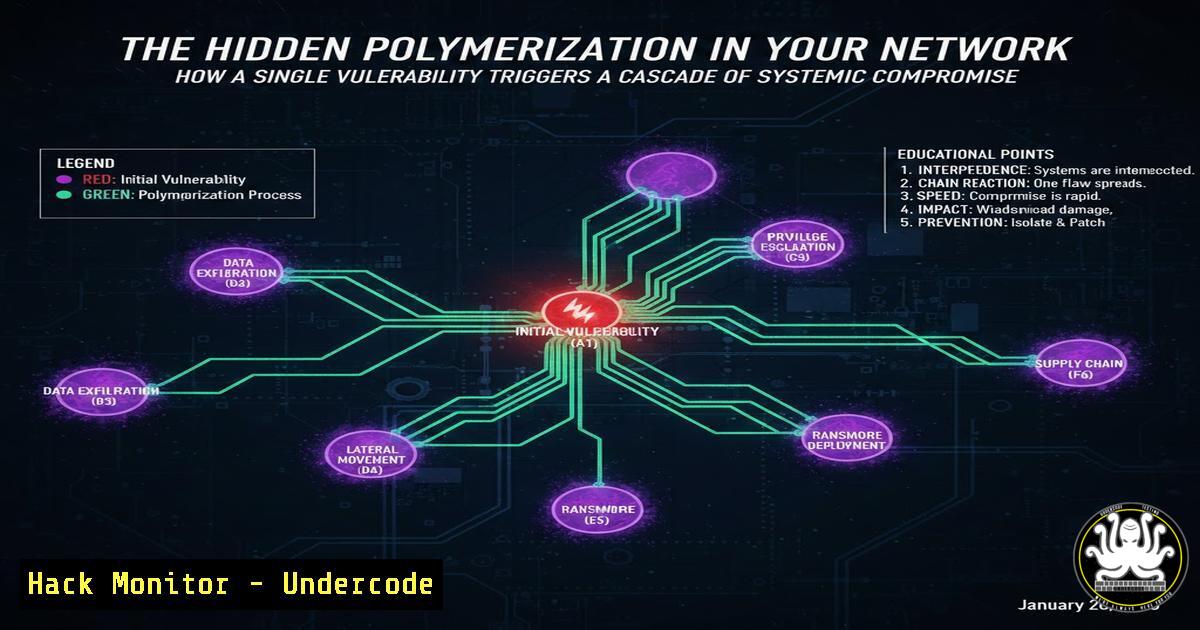
In cybersecurity, as in polymer chemistry, a stable system can be transformed irreversibly by a catalyzed, self-sustaining reaction. The process of Fiber Reinforced Plastic (FRP) curing—where a liquid resin becomes a rigid solid through initiated, promoted, and exothermic cross-linking—provides a powerful metaphor for Advanced Persistent Threat (APT) campaigns. Understanding this “curing” process reveals how attackers move from initial access to total network dominion.
Learning Objectives:
- Decode the APT lifecycle using the chemical principles of initiation, promotion, and exothermic propagation.
- Apply intrusion detection strategies at each stage of the attack “cure” to halt the reaction.
- Harden systems by controlling the “catalytic variables” that attackers depend on for lateral movement and persistence.
You Should Know:
- The Stable but Vulnerable State: Your Network as an Unsaturated Resin
Just as UPR resin remains liquid yet contains reactive double bonds, a corporate network may appear stable but is inherently vulnerable. Attackers seek these latent “double bonds”—unpatched services, misconfigurations, or excessive privileges—that are kept in check only by security “inhibitors” like firewalls and endpoint protection.
Step-by-step guide to identifying your “reactive double bonds”:
- Network Enumeration (Linux): Use `nmap -sV -O –top-ports 100
` to discover live hosts and services. The `-sV` flag probes for service/version info, revealing potential vulnerable applications. - Vulnerability Mapping: Pipe results into a vulnerability scanner or cross-reference with databases like the NVD. For a manual check on a specific web server, use `nikto -h http://
` to list potential vulnerabilities. - Privilege Audit (Windows): Run the PowerShell command `Get-LocalUser | Select Name, Enabled, LastLogon` and `Get-LocalGroupMember Administrators` to list active accounts and privileged users, identifying stale accounts or over-provisioned rights.
-
MEKP as the Initial Exploit: The Free-Radical Initiator
Methyl Ethyl Ketone Peroxide (MEKP) represents the initial exploit or phishing payload. It decomposes to generate the first “free radicals”—the initial foothold (e.g., a reverse shell or credential dump). This stage is often silent and requires minimal “energy,” akin to a user clicking a malicious link.
Step-by-step guide to detecting the initial “decomposition”:
- Endpoint Detection: Monitor for suspicious process creation. On Linux, audit with `auditctl -a always,exit -F arch=b64 -S execve` to log all executions. On Windows, use Sysmon (Config: `ProcessCreate` event) and filter for parent processes like `mshta.exe` or `rundll32.exe` spawning `cmd.exe` or
powershell.exe. - Network Anomaly Detection: Look for beaconing. A simple `tcpdump` filter can spot regular call-outs:
tcpdump -nn 'dst <external_suspicious_ip> and (tcp[bash] & tcp-syn != 0)'. -
Containment Command: Immediately isolate a compromised host on a Linux gateway:
iptables -A FORWARD -s <compromised_host_ip> -j DROP. -
Cobalt Salts as the Persistence & Lateral Movement Catalyst
Cobalt salts accelerate the reaction at ambient temperature. In an attack, this is the toolkit of post-exploitation frameworks (e.g., Cobalt Strike, Metasploit) and living-off-the-land binaries (LoLBins) that enable credential harvesting, privilege escalation, and lateral movement without triggering major alerts.
Step-by-step guide to hunting for “cobalt” activity:
- Detect PsExec & WMI Abuse (Windows): In your SIEM, create alerts for `Event ID 4688` (process creation) with a parent process of `services.exe` and an image path containing `\ADMIN$` or
\PSEXESVC.exe. For WMI, alert on `Event ID 4688` with a parent ofwmiprvse.exe. - Find Pass-the-Hash Attempts: Monitor Windows Security event logs for `Event ID 4624` (logon) with a `Logon Type 3` (network) and using `NTLM` authentication, especially from unusual source workstations.
- Lateral Movement Mitigation (Linux): Enforce SSH key hygiene and use
fail2ban. To audit SSH connections, run `lastb | head -20` andgrep "Accepted password" /var/log/auth.log.
4. The Exothermic Propagation: Self-Sustaining Compromise
The polymerization reaction releases its own heat. In a breach, this is the phase of automated lateral movement, data exfiltration, and ransomware deployment. The attack sustains itself, using compromised assets to attack others, creating an internal “exotherm” of malicious traffic.
Step-by-step guide to monitoring for “exothermic” propagation:
- Internal Network Flow Analysis: Use tools like Zeek (
zeekctl deploy) to monitor internal SMB, RDP, and SSH traffic. Look for one host connecting to many others in quick succession. - Data Exfiltration Detection: Set netflow or firewall alerts for large outbound data transfers. A simple `iptables` rule can log this:
iptables -A OUTPUT -d 0.0.0.0/0 -m limit --limit 100/s -j LOG --log-prefix "HIGH-OUTPUT: ". - Containment Script (Example): If a host is detected scanning internally, automatically block it via a script triggered by your SIEM:
ssh firewall.example.com "iptables -A INPUT -s <infected_ip> -j DROP". -
Cross-Linking: The Formation of a Botnet or Persistent Backdoor
Styrene bridges create a rigid, 3D network. This is the establishment of command-and-control (C2) channels, backdoors, and dormant persistence mechanisms (e.g., rootkits, scheduled tasks). The network is no longer a collection of individual hosts but a compromised, interconnected entity.
Step-by-step guide to finding and removing “cross-links”:
- Find Persistence (Windows): Check scheduled tasks:
Get-ScheduledTask | Where-Object {$_.State -ne "Disabled"} | Select TaskName, TaskPath, Actions. Examine registry run keys:reg query HKLM\Software\Microsoft\Windows\CurrentVersion\Run. - Find Persistence (Linux): Check cron jobs:
cat /etc/crontab; ls -la /etc/cron./. Check for malicious kernel modules: `lsmod | grep -E “diamon|urando|backdoo”` (check for unusual names). -
C2 Detection: Use network IDS like Suricata with rules from Emerging Threats to detect known C2 traffic. Perform DNS analysis for beaconing: `tcpdump -i eth0 port 53 -vvv` and look for regular queries to nonsense subdomains.
-
Controlling the Cure Variables: The Security Practitioner’s Formula
The final mechanical properties of FRP depend on precise control of MEKP concentration, cobalt level, and temperature. Similarly, your network’s resilience depends on controlling key security variables.
Step-by-step guide to implementing “process control”:
- Variable 1: Patch Management (Resin Reactivity): Automate. For Linux, use
unattended-upgrades. For Windows, configure WSUS or use `Get-WindowsUpdate -Install -AcceptAll -AutoReboot` in a managed pipeline. - Variable 2: Least Privilege (Inhibitor Level): Implement Just-In-Time (JIT) access. Use Azure PIM or similar tools. Enforce with PowerShell: `Get-ADUser -Filter -Properties MemberOf | Where-Object {$_.MemberOf -match “Domain Admins”} | Select Name` to audit for over-privileged accounts.
- Variable 3: Network Segmentation (Heat Dissipation): Create VLANs and enforce micro-segmentation with NSX, Illumio, or simple firewall rules: `iptables -A FORWARD -i internal_vlan -o dmz_vlan -p tcp –dport 443 -j ACCEPT` (explicitly allow only necessary traffic).
What Undercode Say:
- Key Takeaway 1: A sophisticated cyber attack is not a single event but a catalyzed, self-amplifying chemical reaction. Defenders must focus on breaking the reaction chain at the promotion (lateral movement) stage before the exothermic propagation makes containment exponentially harder.
- Key Takeaway 2: Security is a process of controlling variables. By rigorously managing the equivalents of MEKP concentration (initial attack surface), cobalt promoters (post-exploitation tools), and ambient temperature (network permeability), you can prevent the “cure” of a fully realized, cross-linked adversary presence.
The parallels between controlled polymer chemistry and cyber intrusion lifecycles are profound. Defensive success hinges on the early identification of the catalytic agent—the post-exploitation framework. Once the “cobalt-promoted” lateral movement begins, the attack generates its own momentum. Future threats will increasingly exploit this principle, using AI to auto-tune their “catalytic variables” in real-time, optimizing lateral movement paths and persistence mechanisms based on the specific “chemical composition” of your network. The defender’s role is to be the ultimate inhibitor, constantly monitoring for the initial free radical and possessing the capability to neutralize the catalyst before the irreversible exotherm begins.
▶️ Related Video (76% Match):
🎯Let’s Practice For Free:
IT/Security Reporter URL:
Reported By: Vishal Shah – Hackers Feeds
Extra Hub: Undercode MoN
Basic Verification: Pass ✅


