Listen to this Post
Introduction:
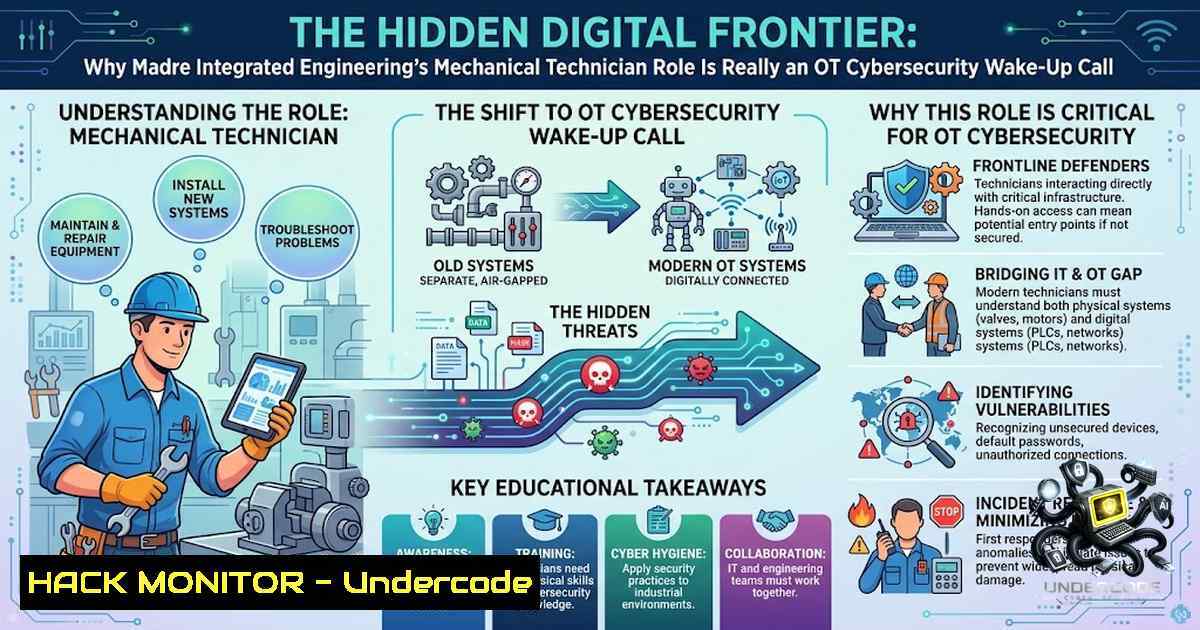
When Madre Integrated Engineering, a multinational talent outsourcing corporation headquartered in Qatar,posts an urgent opening for a Mechanical Technician (Utilities & Product Handling), the job description reads like a traditional industrial maintenance checklist—cooling towers, boilers, air compressors, conveyors, and ship loaders. But beneath the surface of this seemingly mechanical role lies a critical and often overlooked reality: every pump, valve, and gearbox in a modern industrial plant is now part of a digitally networked ecosystem. The convergence of Information Technology (IT) and Operational Technology (OT) has transformed these physical assets into cyber-physical systems, making mechanical technicians inadvertent frontline defenders against industrial cyber threats. As industrial environments increasingly integrate predictive maintenance, IoT sensors, and cloud-connected monitoring systems, the mechanical technician’s role extends far beyond wrenches and alignment tools—it now demands a fundamental understanding of industrial cybersecurity.
Learning Objectives:
- Understand the cybersecurity risks introduced by IT/OT convergence in utilities, fertilizer plants, power stations, and heavy industrial facilities.
- Learn practical commands and techniques for securing and auditing industrial control systems (ICS) and SCADA environments.
- Master step-by-step procedures for implementing secure remote maintenance, access control, and incident response in OT settings.
You Should Know:
- The OT Security Landscape: Why Mechanical Systems Are Prime Targets
Operational Technology (OT) refers to the hardware and software that monitors and controls physical devices, processes, and events in industrial environments. For decades, OT systems operated in isolated “air-gapped” networks, effectively shielded from external cyber threats. However, the drive for operational efficiency has shattered these barriers. Today, 67% of manufacturers utilize live OT/IT data streams for continuous production optimization, and 55% have integrated predictive maintenance using IoT sensors connected to central IT systems.
This connectivity has dramatically expanded the attack surface. Legacy Programmable Logic Controllers (PLCs) and SCADA systems—many built without security-by-design principles—now sit exposed to the same threats that plague corporate IT networks. The consequences are severe: in 2024, a major energy provider suffered a ransomware attack that disrupted pipeline operations for 48 hours, resulting in losses exceeding $30 million.
For a mechanical technician maintaining cooling towers, boilers, and conveyors, this means the equipment you service could be remotely commandeered, sabotaged, or held hostage. Attackers exploit weak authentication, default credentials, limited logging, and unpatched vulnerabilities in OT products. The NSA, CISA, and international cybersecurity agencies now urge OT owners to select products with configuration management, secure-by-default settings, strong authentication, and vulnerability handling capabilities. Understanding these risks is the first step toward protecting the physical assets you maintain.
Step‑by‑Step Guide: Basic OT Network Reconnaissance
To understand what’s connected to your industrial network, you need visibility. Here’s how to perform basic, non-disruptive OT network discovery using Nmap:
1. Install Nmap on a secure administrative workstation:
- Linux (Ubuntu/Debian): `sudo apt-get install nmap`
– Linux (RHEL/CentOS): `sudo yum install nmap`
– Windows: Download from https://nmap.org/download.html
- Perform a safe, slow scan to avoid overwhelming fragile OT devices (many legacy PLCs crash under aggressive scanning):
nmap -Pn -sT --scan-delay 1s --max-parallelism 1 -p 80,102,443,502,530,593,789,1089-1091,1911,1962,2222,2404,4000,4840,4843,4911,9600,19999,20000,20547,34962-34964,34980,44818,46823,46824,55000-55003 <target-IP-range>
This command targets common ICS/SCADA ports including Siemens S7 (102), Modbus (502), Ethernet/IP (44818), and Bacnet (47808).
-
Identify Siemens S7 PLCs (common in utilities and heavy industry):
nmap --script s7-info.nse -p 102 <host>
This reveals hardware models, system names, firmware versions, and serial numbers.
-
Discover Modbus devices (widely used in power plants and water treatment):
nmap -Pn -sT -p502 --script modbus-discover <target>
-
Document all discovered devices, their IP addresses, open ports, and identified services in a secure inventory log.
2. Implementing Secure Remote Maintenance
Remote maintenance is a critical operational necessity but also a primary attack vector. When mechanical technicians or external vendors access plant systems remotely, they create potential entry points for adversaries. The 2024 energy pipeline attack succeeded precisely because of an exposed remote access system.
Securing remote maintenance requires a multi-layered approach. First, implement role-based access control (RBAC) with least-privilege principles. Second, enforce strong authentication—preferably multi-factor authentication (MFA)—for all remote sessions. Third, segment OT networks from IT networks using firewalls with strict rules that allow only necessary communication. Fourth, maintain comprehensive audit logs of all remote activities, including video recordings where feasible.
For mechanical technicians, this translates to practical habits: never use default credentials, always log out of remote sessions, report any unusual system behavior immediately, and follow Lockout/Tagout (LOTO) procedures not just for physical safety but also for digital isolation during maintenance.
Step‑by‑Step Guide: Hardening Remote Access
- Inventory all remote access points—VPNs, jump servers, vendor portals, and direct internet-facing devices.
-
Implement firewall rules to restrict OT network access:
– Linux (iptables):
iptables -A INPUT -p tcp --dport 102 -s 192.168.1.0/24 -j ACCEPT
iptables -A INPUT -p tcp --dport 102 -j DROP
(Allow S7 traffic only from trusted management subnet)
- Windows Firewall (PowerShell):
New-1etFirewallRule -DisplayName "Block S7 from Untrusted" -Direction Inbound -Protocol TCP -LocalPort 102 -Action Block
- Enable comprehensive logging for all remote access attempts:
– Linux: Configure rsyslog to forward OT device logs to a centralized SIEM.
– Windows: Enable Advanced Audit Policy for Logon/Logoff events.
- Conduct regular access reviews—audit and revoke unnecessary accounts at least quarterly.
3. The Zero Trust Approach to Industrial Security
Traditional perimeter-based security assumes that threats are external. Zero Trust architecture flips this assumption: never trust, always verify. In OT environments, Zero Trust means continuously authenticating and monitoring every device, user, and data flow, regardless of location.
Applying Zero Trust to ICS infrastructure requires adapting principles to the Purdue Enterprise Reference Architecture model. At Level 0 (physical processes) and Level 1 (basic control), security controls must be non-intrusive—you cannot reboot a power plant to install updates or run active scans during business hours if it risks disrupting operations. Instead, deploy passive monitoring, unidirectional gateways, and industrial intrusion detection systems that observe without interfering.
For mechanical technicians, Zero Trust translates to device-level awareness: know what’s connected to your equipment, verify firmware integrity before maintenance, and treat every network connection as potentially hostile.
Step‑by‑Step Guide: Implementing OT Zero Trust Controls
- Map your OT network according to the Purdue model—identify which devices operate at each level.
-
Deploy passive network monitoring to detect anomalies without disrupting operations:
– Use tools like Wireshark in monitor mode (not promiscuous) to capture traffic for analysis.
- Implement unidirectional gateways (data diodes) between Levels 3-4 (IT/OT boundary) to ensure data flows only one way—out of the OT network.
-
Enforce device authentication using 802.1X on industrial switches to prevent unauthorized device connections.
-
Maintain a Software Bill of Materials (SBOM) for all OT devices to track vulnerabilities.
4. Practical Commands for OT Security Auditing
Security auditing in industrial environments requires specialized tools and techniques. Here are verified commands for assessing OT device security:
Scanning for Siemens S7 Devices en masse:
masscan <IP-Range> -p 102 -oL possible_ics.txt
cat possible_ics.txt | while read LINE; do nmap --script s7-info.nse -p 102 $(awk '{print $4}'); done
This uses masscan for fast discovery then Nmap for detailed enumeration.
Stopping a Siemens S7 CPU (use only in test environments with authorization):
import snap7
client = snap7.client.Client()
client.connect("<PLC-IP>", 0, 0)
cpu_state = client.get_cpu_state()
if cpu_state == "S7CpuStatusRun":
client.plc_stop()
This Python script uses the snap7 library to remotely stop a PLC—demonstrating why access controls are critical.
Scanning for Modbus devices:
nmap -sT -Pn -p502 --script modbus-discover --script-args modbus-discover.aggressive=true <target>
Discovering Bacnet building automation devices:
nmap -Pn -sU -p47808 --script bacnet-info <target>
Enumerating Ethernet/IP devices (common in manufacturing):
nmap -Pn -sU -p44818 --script enip-info <target>
Warning: Never run these scans on production OT networks without explicit authorization and change control approval. Aggressive scanning can crash legacy devices and disrupt operations.
5. Building an OT Incident Response Plan
Only 6% of industrial organizations lack an OT-specific incident response plan—but having a plan and having an effective plan are vastly different. OT incident response differs fundamentally from IT incident response because availability and safety take precedence over confidentiality.
An effective OT incident response plan must include: predefined escalation paths that account for 24/7 operations, playbooks for specific scenarios (ransomware, sabotage, data exfiltration), offline backup and restoration procedures for OT configurations, and clear communication protocols with both IT security teams and plant operations.
Step‑by‑Step Guide: Developing an OT Incident Response Capability
- Form a cross-functional incident response team including IT security, OT engineers, and mechanical technicians.
-
Conduct tabletop exercises simulating realistic attack scenarios (e.g., ransomware on a DCS, unauthorized PLC program modification).
-
Establish offline backups of all PLC programs, SCADA configurations, and device firmware. Store backups in a physically separate location.
-
Define containment strategies that prioritize safety—know which systems can be isolated without causing physical harm.
-
Document forensic collection procedures for OT devices, including how to acquire memory dumps and logs without disrupting operations.
-
Test the plan quarterly with full-scale simulations involving all stakeholders.
What Undercode Say:
-
Key Takeaway 1: The mechanical technician role advertised by Madre Integrated Engineering exists at the intersection of physical maintenance and digital security. Every pump, conveyor, and cooling tower is now a cyber-physical asset that requires both mechanical expertise and cybersecurity awareness.
-
Key Takeaway 2: IT/OT convergence is irreversible. With 67% of manufacturers already leveraging live OT/IT data streams, the attack surface will only expand. Organizations that fail to integrate cybersecurity into their maintenance and operations will face increasingly severe consequences.
Analysis:
The hiring notice from Madre Integrated Engineering reflects a broader industrial reality: the talent gap isn’t just about mechanical skills—it’s about digitally literate technicians who understand that their work has cybersecurity implications. The requirement for PTW (Permit to Work) and LOTO (Lockout/Tagout) procedures already acknowledges safety protocols; extending these to include digital safety measures is the logical next step.
The NSA and CISA’s recent guidance on secure OT product selection signals that regulatory pressure is mounting. Industrial organizations will soon be held accountable not just for physical safety incidents but for cybersecurity breaches originating from poorly secured OT environments. This shifts the responsibility onto every technician who interacts with networked equipment.
Moreover, the Trend Micro/SANS Institute survey revealing that 51.2% of IT/OT security challenges are “people” problems underscores the urgent need for cross-training. Mechanical technicians must learn basic OT security concepts, and IT security professionals must understand operational constraints. The traditional silos are collapsing—and those who adapt will be indispensable.
Prediction:
+1 The demand for mechanical technicians with OT cybersecurity training will surge dramatically over the next 3-5 years, creating new career pathways and premium salaries for those who upskill.
+1 Regulatory frameworks like ISA/IEC 62443 will become mandatory across critical infrastructure sectors, driving widespread adoption of security protection schemes and creating a multi-billion-dollar training and compliance industry.
-1 Organizations that delay integrating cybersecurity into their maintenance operations will face increasingly frequent and costly ransomware attacks targeting OT environments, with downtime costs potentially exceeding $30 million per incident.
-1 The talent shortage in OT cybersecurity will worsen before it improves, leaving many industrial plants vulnerable to attacks that exploit legacy systems with no security-by-design.
+1 AI-powered edge devices and digital twins will revolutionize predictive maintenance while simultaneously providing new security monitoring capabilities, enabling real-time threat detection without disrupting operations.
-1 State-sponsored cyber-physical attacks targeting utilities, power plants, and ports will increase, making industrial cybersecurity a matter of national security.
+1 The convergence of IT and OT security teams will accelerate, breaking down silos and creating more resilient industrial organizations.
-1 Companies that fail to secure their supply chains will face cascading breaches, as a single compromised vendor system can propagate malware into the OT environment.
+1 Mechanical technicians who embrace OT cybersecurity training will become the most valuable assets in industrial organizations, bridging the critical gap between physical maintenance and digital defense.
▶️ Related Video (72% Match):
🎯Let’s Practice For Free:
🎓 Live Courses & Certifications:
Join Undercode Academy for Verified Certifications
🚀 Request a Custom Project:
Secure, high-velocity infrastructure and disruptive technological engineering. Contact our engineering team for high-tier development and proprietary systems:
[email protected]
💎 Smart Architecture | 🛡️ Secure by Design | ⭐ Trusted by Thousands
IT/Security Reporter URL:
Reported By: Urgent Hiring – Hackers Feeds
Extra Hub: Undercode MoN
Basic Verification: Pass ✅


