Listen to this Post
Introduction:
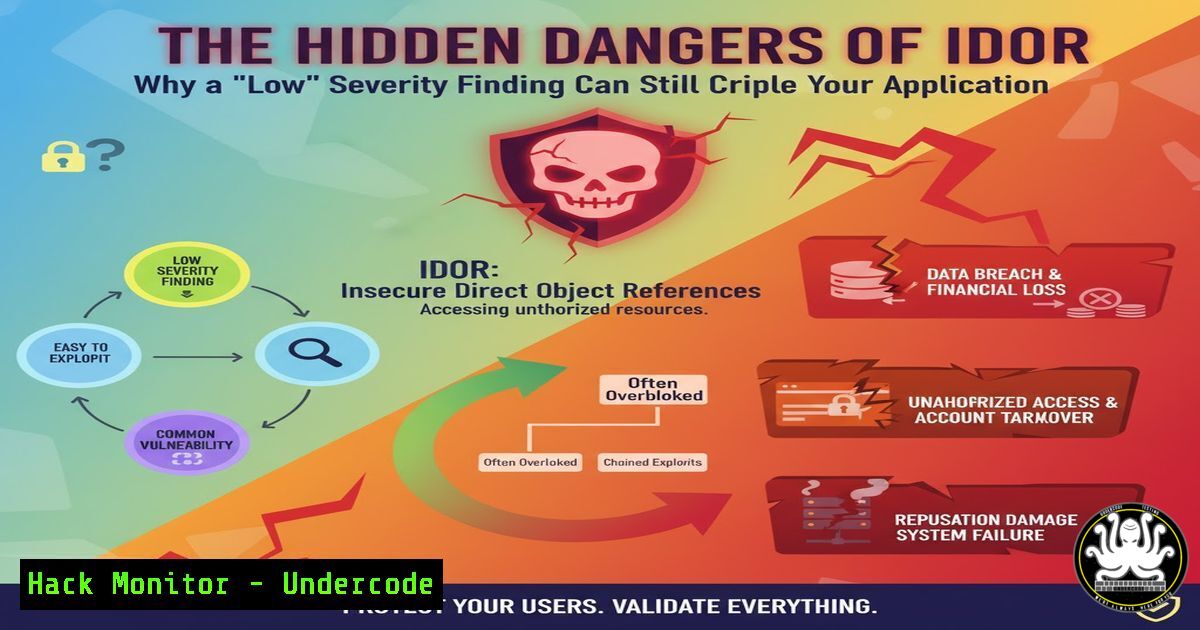
Insecure Direct Object Reference (IDOR) vulnerabilities remain a pervasive and often underestimated threat in web application security. A recent case, where a security researcher reported a high-severity IDOR only for it to be downgraded to low due to “complex GUIDs,” highlights critical misconceptions in vulnerability assessment. This incident underscores the need for developers and security teams to look beyond superficial complexity and understand the fundamental access control flaws that IDORs represent.
Learning Objectives:
- Understand the core mechanics of an IDOR vulnerability and how to identify them in modern applications.
- Learn techniques for exploiting IDORs, even when complex identifiers like GUIDs are used.
- Implement robust mitigation strategies to prevent IDOR vulnerabilities at the code and architectural level.
You Should Know:
- Decoding the IDOR Vulnerability: Beyond Simple Numeric IDs
An Insecure Direct Object Reference occurs when an application provides direct access to objects based on user-supplied input without proper authorization checks. The classic example is a URL parameter like `/user/profile?user_id=123` which can be changed to `124` to access another user’s data. However, modern applications often use more complex identifiers, such as Globally Unique Identifiers (GUIDs) or UUIDs, which can create a false sense of security. The complexity of a GUID does not equate to security; it is merely obscurity. If the application does not verify that the authenticated user has permission to access the object referenced by that GUID, the vulnerability is still an IDOR.
Step-by-step guide explaining what this does and how to use it.
Step 1: Understand the Object Reference. Identify every point in the application where an object is referenced—in URLs (e.g., ?invoice_id=abc123-def...), form fields, API endpoints (e.g., GET /api/v1/orders/{order_uuid}), or cookies.
Step 2: Map User Permissions. Create a test environment with at least two user accounts (e.g., `user_a` and user_b) that have different privilege levels but similar types of data (e.g., each has a profile, an order, a document).
Step 3: Test for Lack of Authorization. While logged in as user_a, capture a request made by the application that fetches user_a‘s data. Replace the object identifier in the request with the one belonging to user_b. If you can access user_b‘s data, you have successfully exploited an IDOR.
- The GUID Illusion: Why Complexity Doesn’t Equal Security
The case mentioned in the post, where a triager downgraded the severity because of a “complex guid,” is a critical error in judgment. A GUID is a 128-bit number (e.g., f47ac10b-58cc-4372-a567-0e02b2c3d479) designed for uniqueness, not for secrecy or security. It is not a random password. If an attacker can discover or predict these GUIDs—often through other information leaks or by enumerating them—the underlying vulnerability is identical to one involving a simple integer.
Step-by-step guide explaining what this does and how to use it.
Step 1: Identify the GUID in Transit. Use an intercepting proxy like Burp Suite or OWASP ZAP to monitor all application traffic. Look for long, alphanumeric strings in parameters and headers.
Step 2: Check for Predictability. Analyze the structure of the GUID. Is it a version 1 UUID (based on timestamp and MAC address) or a version 4 (pseudo-random)? While v4 is harder to predict, if the application’s own API exposes lists of GUIDs belonging to the user (e.g., in a “recent items” feed), an attacker can simply harvest them.
Step 3: Test with Harvested GUIDs. Log in with a low-privilege account and attempt to access resources by using GUIDs harvested from responses to a high-privilege account or from other users. A successful access attempt confirms the IDOR.
3. Practical Exploitation: From Theory to Proof-of-Concept
Finding an IDOR is only the first step. Demonstrating its impact is crucial for accurate severity assessment. This involves showing what data can be accessed, modified, or deleted.
Step-by-step guide explaining what this does and how to use it.
Step 1: Read-Based IDOR. This is the most common type, allowing unauthorized viewing of data. Your Proof-of-Concept (PoC) should include a side-by-side comparison of two HTTP requests: one authorized and one unauthorized, both returning the same sensitive data (e.g., another user’s personal information, tax documents, or private messages).
Step 2: Write-Based IDOR. This is more severe. It allows an attacker to change data. Test by using a `POST` or `PUT` request intended for `user_a` to modify the data of user_b. For example, change the shipping address on user_b‘s order or update their email address for a password reset.
Step 3: Automated Testing with Scripts. For large-scale testing, simple scripts can be used. Below is a Python example using the `requests` library to test for a read-based IDOR on an API endpoint.
import requests

Configuration
target_url = "https://api.example.com/v1/user/"
auth_cookie = {"session": "your_session_cookie_here"}
user_a_guid = "guid_of_user_a"
user_b_guid = "guid_of_user_b"

Test access to User B's data while authenticated as User A
response = requests.get(f"{target_url}{user_b_guid}", cookies=auth_cookie)

if response.status_code == 200:
print(f"[bash] IDOR VULNERABILITY CONFIRMED!")
print(f"Accessed data for {user_b_guid}: {response.text[:500]}")
else:
print(f"Access attempt failed with status: {response.status_code}")
4. Mitigation Strategies: Implementing Proper Access Control
The only way to eliminate IDOR vulnerabilities is to implement mandatory, server-side authorization checks for every access attempt. Never rely on obfuscation or the client to enforce security.
Step-by-step guide explaining what this does and how to use it.
Step 1: Adopt a Standardized Framework. Use well-established web frameworks (e.g., Django, Spring Security, Ruby on Rails) that provide built-in mechanisms for authorization. Avoid rolling your own access control logic from scratch.
Step 2: Implement a “Check Permissions” Function. Before any data is fetched or an action is performed, the server must check if the currently authenticated user (from the session token) has permission to perform the requested action on the target object.
 Pseudocode example for a robust access check
def get_user_invoice(invoice_guid):
 1. Get the current user from the session
current_user = get_authenticated_user()

<ol>
<li>Fetch the object from the database
invoice = Invoice.query.filter_by(guid=invoice_guid).first()
if not invoice:
return "Invoice not found", 404</p></li>
<li><p>THE CRITICAL CHECK: Verify ownership/permissions
if invoice.user_id != current_user.id and not current_user.is_admin:
Log this unauthorized access attempt!
log_security_event(f"UNAUTH_ACCESS: User {current_user.id} for Invoice {invoice_guid}")
return "Access denied", 403</p></li>
<li><p>Only if the check passes, return the data
return serialize(invoice), 200
Step 3: Use Indirect Reference Maps. Instead of exposing internal object identifiers (like a database primary key or a GUID), use a per-user mapping. For example, user A sees order_id=1, which maps to internal uuid_abc, while user B sees order_id=1, which maps to internal uuid_xyz. This adds a layer of abstraction but must still be backed by server-side checks.
5. Integrating IDOR Testing into Your SDLC
Prevention is more effective than reaction. Integrating security checks throughout the Software Development Lifecycle (SDLC) is essential for catching IDORs early.
Step-by-step guide explaining what this does and how to use it.
Step 1: Security-Focused Code Reviews. Make authorization logic a key part of every code review. Checklist item: “Does this endpoint containing an object reference have a server-side permission check?”
Step 2: Automated Dynamic Testing. Incorporate OWASP ZAP or similar tools into your CI/CD pipeline. Configure them with authenticated sessions for multiple users to automatically spider the application and test for IDORs.
Step 3: Manual Penetration Testing. Engage internal red teams or external bug bounty programs. The human element is crucial for finding business logic flaws like the “complex GUID” IDOR that automated tools might miss.
What Undercode Say:
- The Severity is in the Impact, Not the Obscurity. A vulnerability’s severity should be determined by the potential business impact (data breach, reputational damage, financial loss), not the perceived complexity of the exploit. Downgrading an IDOR because it uses a GUID is a fundamental misunderstanding of the risk.
- Defense in Depth is Non-Negotiable. Relying on “unguessable” identifiers is a weak defense. The only robust mitigation is a mandatory, server-side authorization check for every single access to a resource.
The triager’s decision to downgrade the reported IDOR highlights a dangerous gap in application security risk assessment. It prioritizes superficial complexity over the core security principle of mandatory access control. This mindset can lead to critical vulnerabilities being left unpatched in production, creating a false sense of security. Organizations must train their security and development teams to recognize that any direct object reference, regardless of its format, is a potential IDOR until proven otherwise by a robust, server-side authorization check. The focus must shift from “is the ID hard to guess?” to “did we verify the user’s permissions?”
Prediction:
The prevalence of IDOR vulnerabilities will continue as applications grow more complex and interconnected via APIs. However, we predict a significant shift in how they are exploited and mitigated. Attackers will increasingly use automated tools to harvest “complex” identifiers like GUIDs from client-side applications and API responses, making the “obscurity” defense completely obsolete. In response, the industry will move towards standardized, declarative access control frameworks (e.g., inspired by Relationship-Based Access Control) that are automatically enforced at the API gateway or middleware level, making improper exposure of data architecturally difficult rather than just a code review checklist item.
🎯Let’s Practice For Free:
IT/Security Reporter URL:
Reported By: Muhammad Usman – Hackers Feeds
Extra Hub: Undercode MoN
Basic Verification: Pass ✅


