Listen to this Post
Introduction:
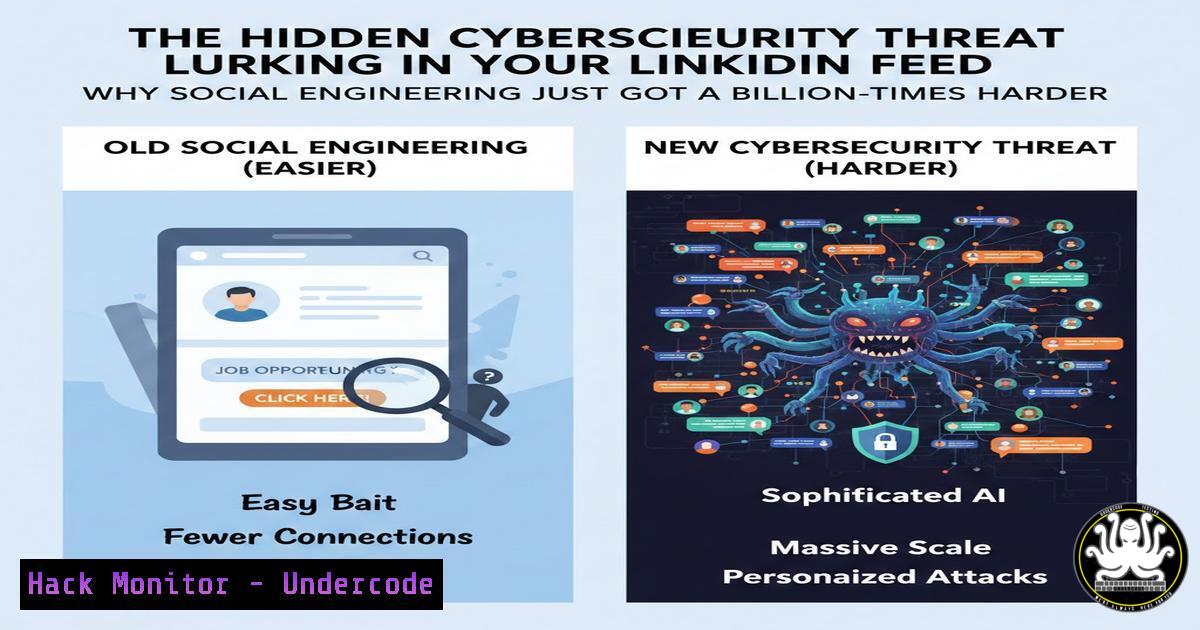
The celebratory post from a prominent cybersecurity professional amassing 5 million views reveals a new attack vector: the weaponization of trust and authority within professional networks. This analysis dissects how adversaries can exploit congratulatory threads and high-engagement content to launch sophisticated social engineering and reconnaissance campaigns, bypassing traditional technical defenses by targeting human psychology.
Learning Objectives:
- Understand how public engagement data is harvested for targeted social engineering.
- Learn to identify signs of reconnaissance activity within professional network interactions.
- Implement technical controls to reduce OSINT (Open-Source Intelligence) exposure from social media.
You Should Know:
1. Reconnaissance Through Congratulatory Engagement
The comment section of a high-visibility post is a goldmine for attackers. Each congratulatory comment from professionals like “Security Researcher, Microsoft” or “SOC Analyst” provides verified job titles, affiliations, and skill sets. Attackers automate the collection of this data to build highly targeted phishing campaigns.
Step-by-step guide explaining what this does and how to use it.
The Threat: An attacker uses a simple script to scrape the post’s comments, extracting commenter names, headlines, and employers. This data is cross-referenced with other breaches (e.g., LinkedIn data dumps) to find email addresses and build a profile.
Mitigation Command (Linux – for defenders testing their exposure): Use `whois` and `theHarvester` to see how much of your corporate email structure is already public. This helps assess risk.
 Install theHarvester (Kali Linux pre-installed)
 sudo apt install theHarvester -y
 Search for emails related to your domain from LinkedIn
theHarvester -d yourcompany.com -b linkedin
Action: Sanitize your public social media headline. Avoid precise, searchable titles like “Lead for AWS Security at FinTech Corp.” Use broader terms like “Security Lead in Financial Services.”
2. Weaponizing “Trusted” Connections for Phishing
The original poster (Day Johnson) is a trusted figure. An attacker could create a fake profile impersonating “Day J0hnson” (with a zero) and use that fabricated authority to send connection requests or malicious messages to the individuals who commented, significantly increasing the success rate of the attack.
Step-by-step guide explaining what this does and how to use it.
The Threat: A fake profile messages a commenter: “Hey, thanks for the comment on my 5M views post! Check out this link to my new tool…” The link hosts malware or a credential-harvesting page.
Mitigation Technique (For Individuals): Always verify the profile URL and check for the LinkedIn blue “Premium” or “Verified” badge (though not foolproof). Hover over the name to see the custom URL. A real profile often has a simplified URL (e.g., linkedin.com/in/dayjohnson).
Mitigation Technique (For Enterprises): Implement a DNS security solution or web proxy to block newly registered domains (NRDs) which are commonly used in such impersonation attacks.
3. Exploiting Embedded Links & “Visit My Website”
The post includes a “Visit my website” link. If compromised via a supply-chain attack or credential theft, this trusted website could be used to host drive-by downloads or redirect to exploit kits, targeting visitors who are cybersecurity professionals—a high-value target for APTs.
Step-by-step guide explaining what this does and how to use it.
The Threat: The creator’s website, cyberwox[.]com, is assumed safe. If its CMS is hacked, JavaScript malware could be injected to exploit browser vulnerabilities.
Defensive Command (Windows/Mac/Linux): Use command-line tools to check a website’s historical record and SSL health before visiting for research.
 Check SSL certificate validity and details
openssl s_client -connect cyberwox.com:443 -servername cyberwox.com 2>/dev/null | openssl x509 -noout -dates -issuer
 Use curl to fetch headers and check for insecure redirections
curl -I https://cyberwox.com
Action: Browse with JavaScript disabled for unknown sites or use a hardened browser profile for professional research.
4. Skillset Mapping for Advanced Persistent Threats (APTs)
The comments list specific skills: “TryHackMe Top 1%”, “HTB967”, “AWS Certified Security – Specialty”. An APT group could use this to tailor exploits. Knowing a target is deep into AWS Security, they might craft a phishing email impersonating AWS Security Hub with a zero-day payload.
Step-by-step guide explaining what this does and how to use it.
The Threat: Adversaries build a skills database from profiles. An email with the subject “Action Required: Critical Vulnerability in your AWS IAM Configuration” is sent to all targets identified as AWS-certified.
Mitigation – Email Header Analysis (For SOC Analysts): If a suspicious email slips through, analyze its headers.
 Save the raw email as 'suspicious.eml' and use grep to find key headers
grep -i "from:|return-path:|received:|dkim-signature:" suspicious.eml
Look for mismatches between `From:` and `Return-Path:` headers.
5. The “Follow” Button as a Persistence Mechanism
By following a high-profile individual, an attacker’s fake profile gains persistent access to all their public updates and the engaged community. This provides a continuous stream of new targets and current trends to exploit.
Step-by-step guide explaining what this does and how to use it.
The Threat: The fake profile becomes a passive intelligence-gathering node within the target community.
Mitigation (Platform-Level): High-profile individuals should regularly audit their follower list for suspicious accounts (e.g., few connections, stock photos, auto-generated names). Consider making follower lists private in LinkedIn settings.
Pro Tip: Use a separate, minimal social media profile for engaging with public communities, distinct from your primary professional profile.
What Undercode Say:
- Trust is the New Vulnerability. The most sophisticated firewall is irrelevant if an employee clicks a link from a perceived trusted colleague. Security awareness training must evolve to cover the nuanced threats within professional networks, not just generic phishing.
- Your Congratulations Are Data Points. Every public interaction is a data point in a corpus used to profile you and your organization. Adopting a principle of minimal disclosure—being mindful of what you confirm about your role and technologies—is a critical defensive habit.
The future of social engineering lies in hyper-personalization powered by AI and aggregated OSINT. We predict a rise in AI-driven impersonation attacks, where deepfake audio or video snippets, sourced from public conference talks or podcasts, are used in conjunction with these highly detailed professional profiles to create utterly convincing fraudulent approaches. The defense will shift from detecting malicious links to verifying human identity through out-of-band, pre-established channels, especially for high-value actions or information requests.
▶️ Related Video (74% Match):
🎯Let’s Practice For Free:
IT/Security Reporter URL:
Reported By: Activity 7413276153408368641 – Hackers Feeds
Extra Hub: Undercode MoN
Basic Verification: Pass ✅


