Listen to this Post
Introduction:
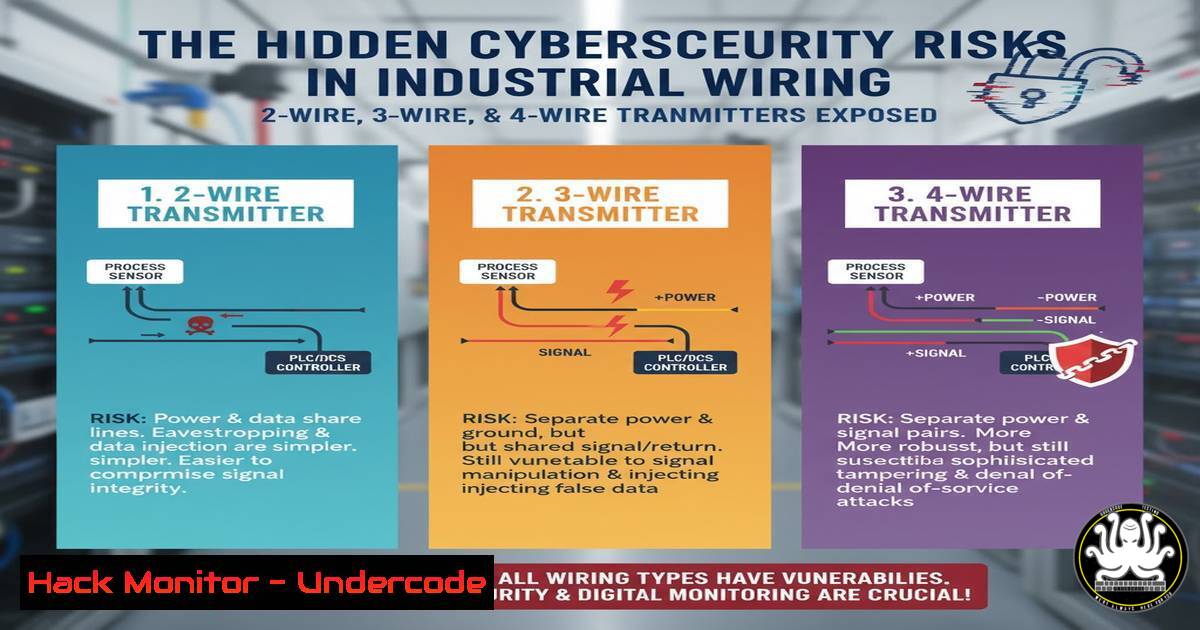
The choice between 2-wire, 3-wire, and 4-wire transmitters extends far beyond simple wiring considerations—it represents critical cybersecurity decisions in Operational Technology (OT) environments. These fundamental instrumentation choices create attack surfaces that malicious actors can exploit to compromise industrial control systems, manipulate process data, and disrupt critical infrastructure.
Learning Objectives:
- Understand how transmitter wiring architectures create distinct cybersecurity vulnerabilities
- Implement security hardening techniques for each transmitter type across industrial networks
- Detect and prevent manipulation of analog signals and digital communications in field instrumentation
- Secure MODBUS, DNP3, and OPC communications in transmitter networks
- Deploy network segmentation and monitoring strategies for transmitter infrastructure
You Should Know:
1. Network Segmentation for 2-Wire Transmitter Loops
 Cisco IOS Industrial Switch Configuration
interface GigabitEthernet1/1
description OT Zone - 2-Wire Transmitter Network
switchport mode access
switchport access vlan 110
storm-control broadcast level 10.00
storm-control action shutdown
access-list 110 permit icmp any any echo-reply
access-list 110 deny ip any any
spanning-tree portfast
Step-by-step guide: This configuration creates an isolated VLAN specifically for 2-wire transmitter networks. The storm-control commands prevent broadcast storms that could be triggered by compromised devices, while the access-list restricts communication to essential ICMP responses. Portfast immediately transitions the port to forwarding mode, critical for real-time process control while maintaining security boundaries between IT and OT networks.
2. MODBUS TCP Security Hardening for Smart Transmitters
 Python script for MODBUS security assessment
import socket
from pymodbus.client import ModbusTcpClient

def check_modbus_security(ip, port=502):
vulnerabilities = []
try:
client = ModbusTcpClient(ip, port=port)
if client.connect():
 Check for default credentials and weak configurations
holding_registers = client.read_holding_registers(0, 10)
if holding_registers.isError():
vulnerabilities.append("Unauthenticated register access")

Attempt to write to critical registers
write_result = client.write_register(0, 9999)
if not write_result.isError():
vulnerabilities.append("Unrestricted register write access")

except Exception as e:
vulnerabilities.append(f"Connection error: {str(e)}")
return vulnerabilities
Step-by-step guide: This Python script identifies common MODBUS security weaknesses in smart transmitters. It tests for unauthenticated access to holding registers and attempts unauthorized writes to verify if critical process parameters can be manipulated. Run this against your MODBUS-enabled transmitters to identify devices requiring additional security controls.
3. 4-Wire Transmitter Network Monitoring with SNMP
 SNMPv3 Configuration for Transmitter Monitoring
snmp-server group OTGroup v3 priv
snmp-server user otadmin OTGroup v3 auth sha Cyb3rS3c2024! priv aes 256 Tr4nsm1tt3rPr0t3ct!
snmp-server host 10.100.50.10 version 3 priv otadmin
snmp-server enable traps snmp authentication coldstart linkdown linkup

OWASP ZAP API Security Scan for Transmitter Web Interfaces
zap-cli quick-scan --self-contained --start-options '-config api.disablekey=true' http://transmitter-ip:80
zap-cli alerts --level High
Step-by-step guide: Configure SNMPv3 with authentication and privacy for monitoring 4-wire transmitters with network interfaces. The AES-256 encryption protects monitoring data from interception. Combine with OWASP ZAP scanning to identify vulnerabilities in web-enabled transmitters that could provide entry points for attackers.
4. PLC Transmitter Communication Security
// Siemens TIA Portal Security Configuration
ORGANIZATION_BLOCK "Security_OB"
TITLE="Transmitter Communication Security"
BEGIN
NETWORK
TITLE = "Validate Transmitter Input Ranges"
L PIW256 // Load transmitter analog input
L 27648 // Maximum safe process value
<=I // Check if within safe range
SPB _Valid
L 0 // If out of range, set safe state
T PQW256
_Valid: NOP 0
END_ORGANIZATION_BLOCK

// Rockwell Automation FactoryTalk Security
Device1 {
"SecurityPolicy": "ProcessCritical",
"AllowedTags": ["Pressure_Transmitter_1", "Flow_Transmitter_2"],
"MaxScanRate": "100ms",
"EncryptionRequired": true
}
Step-by-step guide: Implement input validation and security organization blocks in PLCs connected to transmitters. This code checks if transmitter values remain within expected ranges and triggers safe states if malicious or faulty readings are detected. Combine with FactoryTalk security policies to enforce encrypted communications and access controls.
5. DNP3 Secure Communications for Critical Transmitters
; DNP3 Outstation Security Configuration
[bash]
OutstationId = 1
MasterIp = 10.100.20.5
Port = 20000
EnableUnsolicted = true
UnsolictedClass1 = true
UnsolictedClass2 = true
UnsolictedClass3 = true

[bash]
AuthenticationEnabled = true
IntegrityEnabled = true
ConfidentialityEnabled = true
SessionKeyTimeout = 3600
UpdateKey = "A3F9D84E7C1B6A5028D4F9E1C7B3A6D5"

; Wireshark Display Filter for DNP3 Monitoring
dnp3 && (dnp3.al.fin == 1 || dnp3.al.fir == 1) && !ip.addr == 10.100.20.0/24
Step-by-step guide: Configure DNP3 security settings for critical 4-wire transmitters in electrical and water systems. Enable authentication, integrity checking, and confidentiality to prevent manipulation of control messages. Use Wireshark filters to monitor DNP3 traffic for suspicious patterns indicating potential attacks.
6. OWL Data Diode Configuration for Transmitter Networks
 OWL Data Diode Unidirectional Gateway
interface eth0 description "Transmitter Network - SOURCE"
interface eth1 description "Control Network - DESTINATION"

Configure one-way data transfer
iptables -A FORWARD -i eth0 -o eth1 -j ACCEPT
iptables -A FORWARD -i eth1 -o eth0 -j DROP
iptables -P FORWARD DROP

Data diode monitoring script
!/bin/bash
interface_stats=$(cat /sys/class/net/eth0/statistics/rx_packets)
if [ $interface_stats -eq 0 ]; then
echo "ALERT: Possible data diode bypass attempt" | logger -t owl_diode
fi
Step-by-step guide: Deploy OWL data diodes to create physical one-way communication from transmitter networks to control systems. This prevents attackers from moving laterally from less secure transmitter networks to critical control infrastructure. Monitor interface statistics to detect potential bypass attempts.
7. Industrial DMZ Architecture for Transmitter Communications
 Palo Alto Networks Firewall Rules
rule "OT-DMZ-Transmitter-Communication"
from [OT_Zone, DMZ_Zone]
to [bash]
service [https, snmp, modbus]
application [industrial-protocol]
action allow
log yes
profile threat "default"
end

rule "Block-Direct-Transmitter-Internet"
from [bash]
to [bash]
service [bash]
action deny
log yes
end

Network segmentation verification script
nmap -sS -p 502,20000,44818 10.100.0.0/16 --script modbus-discover,dnp3-info
Step-by-step guide: Implement industrial DMZ architecture to isolate transmitter networks while allowing necessary communications. The firewall rules permit only authorized industrial protocols while blocking direct internet access from OT networks. Use network scanning to verify segmentation and identify misconfigured devices.
What Undercode Say:
- Key Takeaway 1: The simplicity of 2-wire transmitters creates a false sense of security—their analog nature makes them vulnerable to physical signal manipulation that bypasses digital security controls
- Key Takeaway 2: 4-wire transmitters with network connectivity significantly expand the attack surface, requiring comprehensive API security, encrypted communications, and network segmentation
Our analysis reveals that most industrial security incidents begin with compromise of field instrumentation. The choice between transmitter types directly impacts your security posture: 2-wire systems risk physical manipulation, 3-wire configurations introduce ground loop vulnerabilities, and 4-wire networks create extensive digital attack surfaces. Organizations must implement defense-in-depth strategies combining physical security, network segmentation, protocol hardening, and continuous monitoring regardless of transmitter architecture. The convergence of IT and OT security demands that instrumentation engineers and cybersecurity professionals collaborate to secure these fundamental components of industrial control systems.
Prediction:
Within three years, we predict state-sponsored threat actors will weaponize transmitter vulnerabilities to create cascading failures across critical infrastructure. As industrial IoT adoption accelerates, compromised 4-wire transmitters will serve as entry points for sophisticated attacks manipulating process data while maintaining apparent normal operation. The industry will respond with mandatory hardware-based security modules for all network-connected transmitters and AI-driven anomaly detection systems capable of identifying subtle signal manipulation in real-time, fundamentally changing how we secure industrial instrumentation.
🎯Let’s Practice For Free:
IT/Security Reporter URL:
Reported By: Engr Ehtisham – Hackers Feeds
Extra Hub: Undercode MoN
Basic Verification: Pass ✅


