Listen to this Post
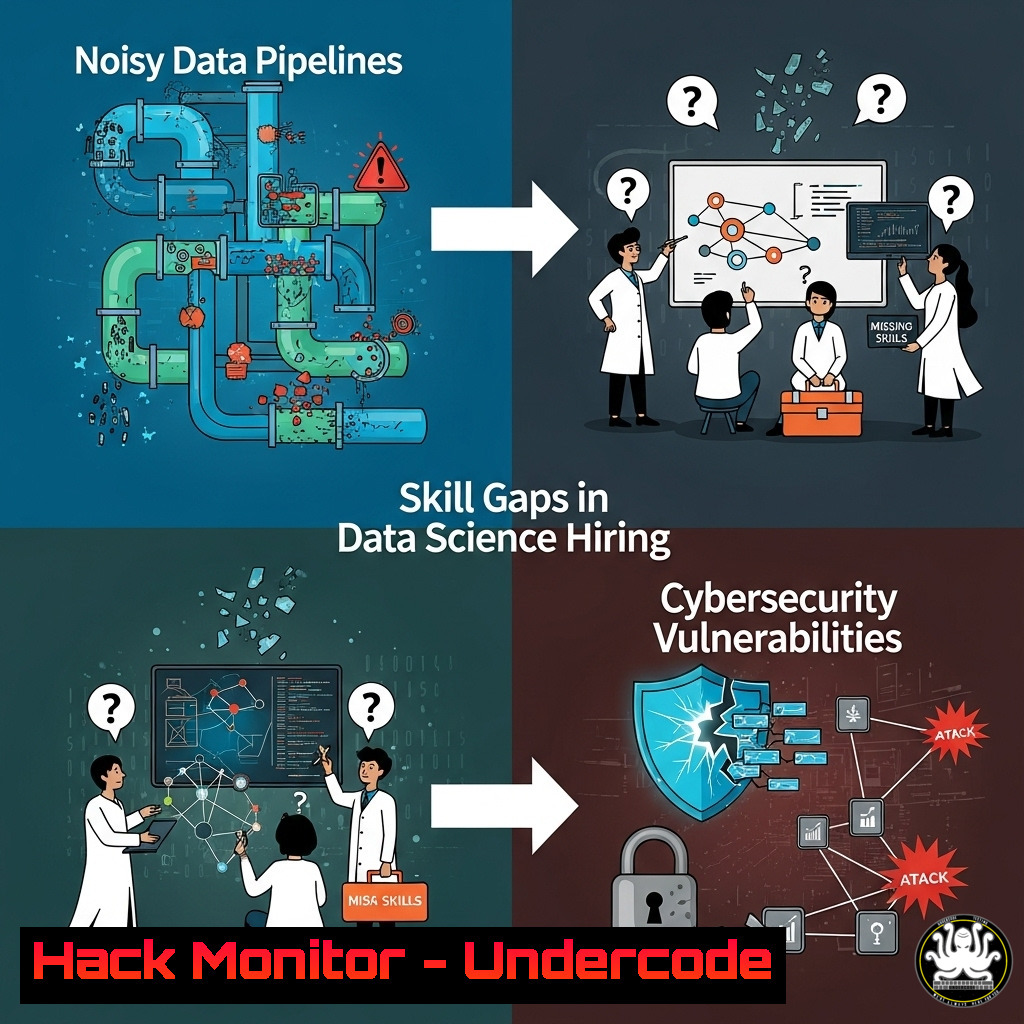
Introduction:
The chaotic hiring process for elite data scientists, as detailed by a global headhunter, is not merely a recruitment challenge; it represents a profound and often overlooked cybersecurity and data governance risk. Organizations desperately seeking talent capable of extracting insights from messy, incomplete data are inadvertently creating attack surfaces through rushed vetting and misaligned skills, leaving sensitive datasets and models exposed to internal and external threats.
Learning Objectives:
- Understand how noisy recruitment pipelines directly lead to insecure data handling practices and increased insider threat risk.
- Identify the critical cybersecurity skills beyond statistical modeling that data scientists must possess to protect organizational assets.
- Learn to implement technical safeguards and auditing procedures to secure the data science workflow from ingestion to insight.
You Should Know:
1. Securing the Data Ingestion Pipeline
The first vulnerability lies in how data is collected and handled. Data scientists working with noisy, incomplete datasets often bypass secure channels.
 Create a secure, encrypted directory for raw data ingestion
mkdir -m 700 ~/secure_data_lake
chown $(whoami):$(whoami) ~/secure_data_lake
sudo find /path/to/raw_data -type f -exec gpg -c --cipher-algo AES256 {} \; -exec shred -u {} \;
mv /path/to/raw_data/.gpg ~/secure_data_lake/
This series of commands creates a user-only accessible directory, finds all raw data files, encrypts them using GPG’s strong AES256 encryption, securely deletes the originals with shred, and moves the encrypted versions to the secure location. This prevents plaintext exposure of sensitive or poorly vetted datasets.
2. Auditing Data Access and Model Changes
Lack of proper validation and testing sensitivity can mask malicious activity. Implementing strict auditing is crucial.
 Linux auditd rules for monitoring model and data access
sudo nano /etc/audit/audit.rules
 Add the following rules:
-w /path/to/production_models -p rwa -k production_models
-w /path/to/sensitive_datasets -p rwa -k sensitive_data
-a always,exit -F arch=b64 -S execve -k model_execution
These auditd rules monitor all read, write, and attribute changes (-p rwa) to the specified model and data directories, tagging events with a key for easy searching. The final rule logs all program executions, crucial for tracking model runs. View logs with sudo ausearch -k model_execution.
3. Validating Data Integrity to Prevent Leakage
Data leakage often stems from insecure data handling. Use checksums to validate data integrity before and after processing.
 Generate SHA256 checksums for all files in a dataset directory
find /dataset/ -type f -exec sha256sum {} \; > /secure_location/dataset_manifest.sha256
 Later, verify integrity to detect any tampering or corruption
sha256sum -c /secure_location/dataset_manifest.sha256
This process creates a cryptographic manifest of all files. Any change to a file—whether from corruption, error, or tampering—will cause the verification check to fail, alerting the scientist to a potential integrity issue before it compromises the model.
4. Hardening the Jupyter/IPython Notebook Environment
Data science environments like Jupyter are common attack vectors if not properly secured.
 Generate a secure Jupyter config with password and TLS
jupyter notebook --generate-config
python -c "from notebook.auth import passwd; print(passwd())"  Enter a strong password
echo "c.NotebookApp.ip = 'localhost'" >> ~/.jupyter/jupyter_notebook_config.py
echo "c.NotebookApp.certfile = '/path/to/mycert.pem'" >> ~/.jupyter/jupyter_notebook_config.py
echo "c.NotebookApp.keyfile = '/path/to/mykey.key'" >> ~/.jupyter/jupyter_notebook_config.py
This configures Jupyter to only listen on localhost, requires a hashed password for access, and enables TLS encryption for all communications, preventing unauthorized network access and eavesdropping on data and model workflows.
- Implementing Role-Based Access Control (RBAC) in Windows for Data Science
On Windows-based data science workstations, precise RBAC is vital.PowerShell: Create a new security group for data scientists New-ADGroup -Name "DataScientists" -GroupScope Global -Description "Users with access to sensitive datasets" Apply a filesystem ACL to a data directory $acl = Get-Acl \server\sensitive_data $accessRule = New-Object System.Security.AccessControl.FileSystemAccessRule("DataScientists","ReadAndExecute","Allow") $acl.SetAccessRule($accessRule) $acl | Set-Acl \server\sensitive_dataThis PowerShell script creates an Active Directory group and applies a filesystem Access Control List (ACL) to grant that group specific read-and-execute permissions to a data directory, enforcing the principle of least privilege.
6. Sanitizing Unstructured Data to Prevent Injection Attacks
Working with unstructured data like survey responses or ad copy is a prime vector for injection attacks.
 Python code to sanitize text input using whitelisting
import re

def sanitize_input(raw_text):
 Define a whitelist of acceptable characters (alphanumeric, basic punctuation, space)
whitelist_pattern = r'[^a-zA-Z0-9\s.,!?]'
 Remove any non-whitelisted characters
sanitized_text = re.sub(whitelist_pattern, '', raw_text)
 Limit string length to prevent buffer overflow-type issues
return sanitized_text[:1000]  Limit to 1000 characters

Example usage
user_input = get_survey_response()
safe_input = sanitize_input(user_input)
This function strips out any non-standard characters and truncates the string length, mitigating risks of script injection, command injection, or buffer overflow exploits hidden within seemingly benign text data.
7. Containerizing Models for Secure and Reproducible Execution
Deploying models without isolation risks compromising the entire system.
 Dockerfile example for a secure, minimal Python model environment
FROM python:3.9-slim
WORKDIR /app
COPY requirements.txt .
RUN pip install --no-cache-dir -r requirements.txt && \
useradd --create-home --shell /bin/bash modelrunner
USER modelrunner
COPY --chown=modelrunner:modelrunner . .
CMD ["python", "run_model.py"]
Build with `docker build -t secure-model .` and run with docker run --rm -v $(pwd)/data:/app/data:ro secure-model. This creates an isolated environment running as a non-root user, with the host data directory mounted as read-only, significantly limiting the blast radius of a compromised model or script.
What Undercode Say:
- The core issue is a fundamental misalignment between the statistical skills being hired for and the operational security practices required to handle data responsibly. A data scientist who can build a robust model from noisy data but then leaves that data in an unencrypted S3 bucket is a liability.
- The recruitment process itself is a social engineering goldmine. The detailed skill list published on LinkedIn is a blueprint for attackers to craft convincing phishing campaigns targeting these specific, in-demand professionals.
- The solution is ‘SecDevOps for Data Science’: mandating security proficiency as a core requirement for any role handling sensitive data, not an afterthought. This includes secure coding, access control, encryption, and auditing.
The hiring post reveals a critical blind spot. The focus is exclusively on statistical prowess and business acumen, with zero mention of data security, privacy, or governance. This creates a scenario where the most talented data scientist, hired for their ability to find signals in chaos, becomes the single point of failure for a massive data breach. Their need for broad access to messy data directly conflicts with security principles of least privilege and data minimization. Organizations must bridge this gap by embedding security training into data science onboarding and integrating security tools directly into their workflow.
Prediction:
Within the next 18-24 months, a major data breach will be publicly traced back to a compromised data science environment, directly resulting from the skills gap highlighted in this hiring post. The root cause will not be a sophisticated external attack, but rather inadequate access controls, poor credential hygiene, and unmonitored data exfiltration from a powerful analytics workstation belonging to a data scientist who was never trained on security protocols. This will force a industry-wide reckoning, making cybersecurity certifications and proven secure-handling experience non-negotiable requirements for data science roles, on par with statistical and modeling expertise.
🎯Let’s Practice For Free:
IT/Security Reporter URL:
Reported By: Lyalltimmons Marketinganalytics – Hackers Feeds
Extra Hub: Undercode MoN
Basic Verification: Pass ✅


