Listen to this Post
Introduction:
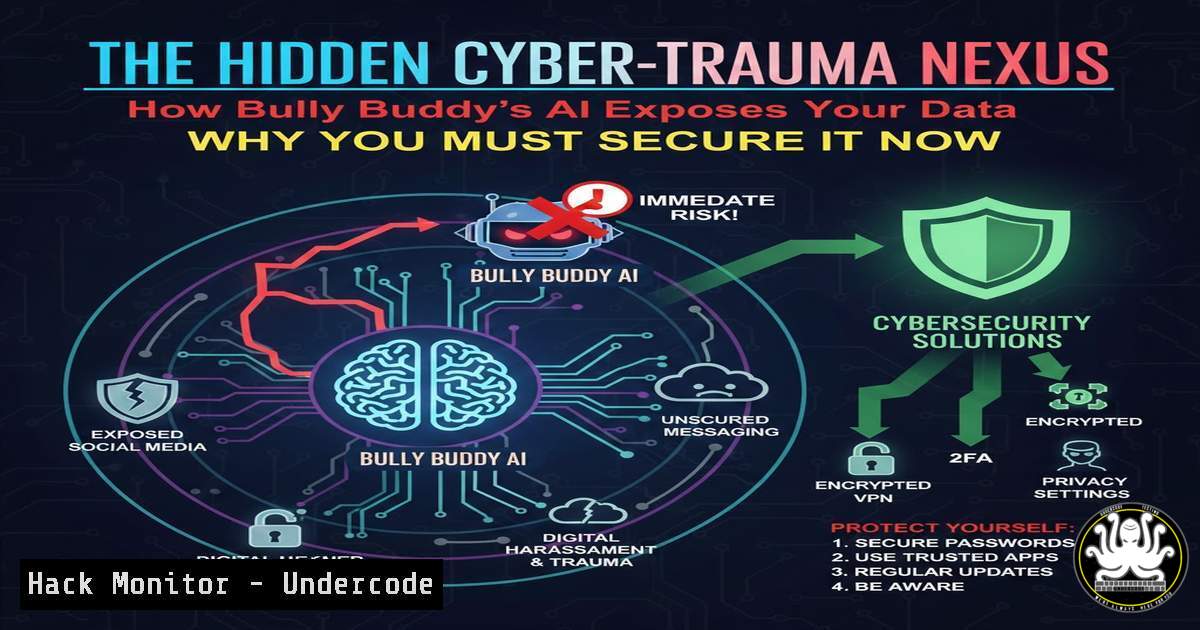
In the digital age, psychological warfare has merged with cyber vulnerabilities. Bully Buddy, an AI platform designed to combat gaslighting by being a “Reality Anchor,” handles intensely sensitive personal narratives and trauma data. This convergence of mental health support and technology creates a high-value target for cyber attacks, where a breach would constitute a severe secondary trauma for users. Understanding the technical architecture required to protect such a platform is not just about IT security—it’s an ethical imperative to prevent the weaponization of personal truth.
Learning Objectives:
- Decrypt the technical stack and data flow of a sensitive AI application like Bully Buddy to identify critical vulnerabilities.
- Implement advanced encryption and anonymization techniques to protect user data both at rest and in transit.
- Harden API endpoints and configure secure cloud infrastructure to defend against sophisticated social engineering and injection attacks.
- Deconstructing the Data Pipeline: From User Input to “Reality Anchor”
The core function of Bully Buddy is to ingest unstructured, emotional user text, structure it, and provide validation. This pipeline is a goldmine for attackers seeking personal data.
Step-by-step guide explaining what this does and how to use it.
A typical data pipeline involves a web frontend, an API gateway, processing logic, and a database. Each point is vulnerable.
1. Frontend Input Validation (Client-Side): Before data leaves the user’s browser, validate it to prevent basic injection. This is a first layer of defense, but never trusted.
// Example: Sanitizing user input in a web form before submission
function sanitizeInput(input) {
const div = document.createElement('div');
div.textContent = input; // Automatically escapes HTML
return div.innerHTML;
}
// Always pair with server-side validation
2. Secure API Transmission: Data must be encrypted using TLS 1.3. Use commands to verify the security of your connection.
 Linux/macOS: Use openssl to check a server's TLS certificate and protocol
openssl s_client -connect bullybuddyai.com:443 -tls1_3
 Look for "Verify return code: 0 (ok)" and the protocol used
3. Server-Side Sanitization & Structuring: The AI processing backend must cleanse input again. For a Linux-based server, use log monitoring to detect tampering attempts.
 Monitor application logs for suspicious patterns (e.g., SQL or shell commands)
tail -f /var/log/bullybuddy/app.log | grep -E "(SELECT.FROM|UNION|;--|<\?php)"
2. Implementing Military-Grade Encryption & Anonymization
Bully Buddy’s “Privacy First Approach” promises “heavily encrypted data.” This requires more than just database encryption.
Step-by-step guide explaining what this does and how to use it.
1. Encryption at Rest: Use industry-standard AES-256 encryption. For database fields containing extreme sensitivities, consider application-level encryption before storage.
 Linux: Using GPG to symmetrically encrypt a file containing simulated user data before storage
echo "User's confidential journal entry..." > user_journal.txt
gpg --symmetric --cipher-algo AES256 --output user_journal.txt.gpg user_journal.txt
 The file 'user_journal.txt.gpg' is now encrypted. The original should be securely wiped.
shred -u user_journal.txt
2. Anonymization Techniques: True anonymization for potential data analysis requires destroying the link to the user. Use hashing with a unique, discardable salt per entry.
 Python example: Creating a one-way, anonymized hash of a user identifier for analytics
import hashlib
import os
user_id = "user_12345"
salt = os.urandom(32)  Generate a random salt
 Create a hash that cannot be reversed to find the user_id
anonymized_hash = hashlib.pbkdf2_hmac('sha256', user_id.encode(), salt, 100000)
 Store only 'anonymized_hash' and discard 'salt' after use to make data permanently anonymous.
- Hardening the API: The Gateway Against Emotional Manipulation Attacks
The API is the bridge between the user and the AI. Attackers will use it for data exfiltration or to poison the AI model.
Step-by-step guide explaining what this does and how to use it.
1. Strict Rate Limiting: Prevent brute-force and denial-of-service attacks that could silence a victim’s “voice.”
 Example using nginx configuration to limit requests
 Within your /etc/nginx/nginx.conf or site configuration:
http {
limit_req_zone $binary_remote_addr zone=api_limit:10m rate=10r/m;
server {
location /api/v1/chat {
limit_req zone=api_limit burst=20 nodelay;
proxy_pass http://ai_backend;
}
}
}
 This limits to 10 requests per minute per IP, with a burst of 20.
2. Input Validation & Schema Enforcement: Every API request must be validated against a strict schema. Use tools like JSON Schema.
3. Windows Server Analogy: If hosting on Windows IIS, configure Request Filtering to block suspicious strings.
 PowerShell: Add a request filtering rule to block common SQL injection patterns
Add-WebConfigurationProperty -pspath 'IIS:\' -filter "system.webServer/security/requestFiltering/denyStrings" -name "." -value @{string="SELECT"; denyQueryString="true"}
4. Securing Cloud Infrastructure & Containerized Backends
Platforms like Bully Buddy often use cloud providers (AWS, Azure, GCP) and containers (Docker, Kubernetes). Misconfiguration is the 1 risk.
Step-by-step guide explaining what this does and how to use it.
1. Principle of Least Privilege for Cloud Roles: Never use root/administrator accounts for applications.
 AWS CLI example: Create a policy for a logging service that only allows writing logs.
 Policy Document (write-log-only.json):
 {
 "Version": "2012-10-17",
 "Statement": [{ "Effect": "Allow", "Action": "logs:PutLogEvents", "Resource": "" }]
 }
aws iam create-policy --policy-name WriteLogOnly --policy-document file://write-log-only.json
2. Scanning Container Images for Vulnerabilities: Before deployment, scan your Docker images.
 Use Trivy, an open-source vulnerability scanner
trivy image --severity HIGH,CRITICAL your_container_registry/bullybuddy-ai:latest
 Integrate this scan into your CI/CD pipeline to block vulnerable builds.
3. Secrets Management: Never hardcode API keys or database passwords. Use secrets managers.
 Kubernetes: Mount a secret as a file in a pod
 kubectl create secret generic db-secret --from-literal=password='S3cr3tP@ss!'
 Then reference it in your pod YAML under spec.volumes and spec.containers.volumeMounts
- Building an “Ethical AI” Firewall: Auditing for Bias and Manipulation
The promise of “non-bias” requires technical enforcement. A malicious actor could attempt to retrain or manipulate the AI to deliver harmful “validation.”
Step-by-step guide explaining what this does and how to use it.
1. Model Integrity Checks: Use cryptographic hashing to ensure the AI model in production has not been tampered with.
 Generate a hash of your model file and store it securely
sha256sum ./ai_models/bullybuddy_core_model.pkl > model.sha256
 Create a cron job to regularly verify the running model against this hash
echo "0 /6    sha256sum -c /app/secure/model.sha256 >> /var/log/model_integrity.log" | crontab -
2. Input/Output Logging for Audit (Anonymized): Log all AI interactions for periodic bias auditing, ensuring logs are anonymized as in Section 2.
3. Continuous Penetration Testing: Schedule regular penetration tests, specifically simulating an attacker trying to manipulate the AI’s responses or extract training data.
What Undercode Say:
- Key Takeaway 1: The most profound vulnerability in systems like Bully Buddy is not a software bug, but the psychological trust bond between user and AI. A breach here doesn’t just leak data; it shatters a “Reality Anchor,” causing tangible harm. Security must be designed with this trauma-aware lens.
- Key Takeaway 2: The “Privacy First” and “Ethical AI” claims are marketing terms until proven by architecture. Real security requires provable, technical implementations—like zero-trust networks, immutable audit logs, and reproducible model audits—that can be independently verified. Without this, the platform itself risks becoming an institutionalized form of the gaslighting it seeks to combat.
Prediction:
The future of cyber attacks will increasingly target the “psychological integrity” of platforms like Bully Buddy. We will see the rise of Advanced Persistent Manipulation (APM) campaigns, where attackers subtly poison AI training data over time to skew its responses, or launch highly personalized spear-phishing against users based on extracted emotional data. The next major breach may not be a credit card dump, but the leak of millions of intimate trauma journals, followed by extortion. Consequently, cybersecurity and AI ethics will legally converge, leading to new regulatory frameworks that mandate “psychological safety by design” with the same rigor as financial data protection. Platforms that fail to implement the hardened, transparent technical controls outlined above will not only fail—they will become instruments of the very abuse they were built to stop.
▶️ Related Video (72% Match):
🎯Let’s Practice For Free:
IT/Security Reporter URL:
Reported By: Jesstoft Neurodiversity – Hackers Feeds
Extra Hub: Undercode MoN
Basic Verification: Pass ✅


