Listen to this Post
Introduction:
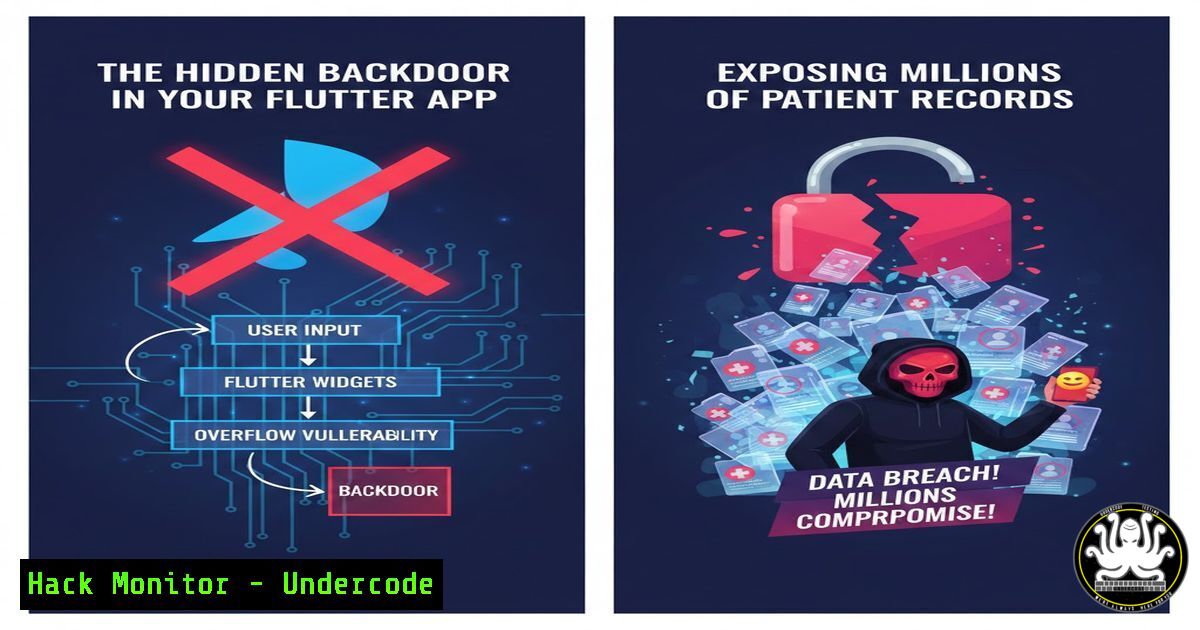
In the rapid development of healthcare applications, the focus often leans heavily towards feature-rich UI and user experience, overshadowing the critical infrastructure of cybersecurity. A developer’s showcase of a Flutter-based medical appointment app highlights common technical achievements and an equally common, glaring oversight: frontend overflow issues that subtly hint at deeper, systemic backend security vulnerabilities. This analysis deconstructs the healthcare app stack to expose the potential attack vectors in data flow, API integrations, and state management that could turn a sleek appointment booker into a data breach headline.
Learning Objectives:
- Understand the critical cybersecurity risks specific to healthcare mobile applications built with cross-platform frameworks like Flutter.
- Learn to implement secure coding practices, data encryption, and API hardening to protect sensitive Protected Health Information (PHI).
- Develop a security-first checklist for the SDLC (Software Development Life Cycle) of medical applications, covering from local state management to cloud backend configurations.
You Should Know:
- The Illusion of Security: Modular Architecture Without Secure Foundations
The post highlights a “modular folder structure” which promotes code organization but does not equate to security. A clean separation ofmodels,UI, and `widgets` is useless if authentication logic is leaked in client-side code or if database models lack input sanitization.
Step‑by‑step guide:
Risk: Sensitive configuration files (e.g., firebase_options.dart, API keys) being committed to public version control.
Mitigation: Use environment variables and secure configuration management.
Linux/macOS: `export FIREBASE_API_KEY=”your_key_here”` and reference it in your Dart code using `String apiKey = String.fromEnvironment(‘FIREBASE_API_KEY’);`
Windows (PowerShell): `$env:FIREBASE_API_KEY=”your_key_here”`
Tool Configuration: Use the `flutter_dotenv` package. Create a `.env` file (add it to .gitignore), load it in main.dart, and access secrets via dotenv.env['KEY'].
- Data in Transit and at Rest: Securing Patient Profiles and Appointments
“Patient profiles & secure appointment booking” and “in-app medical check forms” imply the handling of PHI. Data must be encrypted both during transmission (TLS) and while stored locally on the device or in the cloud.
Step‑by‑step guide:
Encryption at Rest: Use platform-specific secure storage, not plain shared_preferences.
For Flutter, employ the `flutter_secure_storage` package which uses Keychain (iOS) and Keystore (Android).
Example Code:
import 'package:flutter_secure_storage/flutter_secure_storage.dart';
final storage = FlutterSecureStorage();
await storage.write(key: 'patient_record_123', value: encryptedJsonString);
Encryption in Transit: Enforce certificate pinning in your Dart HTTP client (e.g., `dio` or http) to prevent Man-in-the-Middle (MiTM) attacks, especially crucial for public Wi-Fi networks used by patients.
- The API Gateway: Your Most Vulnerable Attack Surface
The mention of “APIs” and “Firebase” is a major red flag if not hardened. Unprotected APIs are the primary vector for data exfiltration. This includes Firebase Firestore/Firebase Realtime Database rules and custom backend endpoints.
Step‑by‑step guide:
Firebase Hardening: Never use public read/write rules. Implement role-based and attribute-based access control.
Example Firestore Security Rule:
rules_version = '2';
service cloud.firestore {
match /databases/{database}/documents {
match /appointments/{appointment} {
allow read, write: if request.auth != null &&
request.auth.uid == resource.data.patientId; // Patient can only access their own
}
match /doctors/{doctor} {
allow read: if request.auth != null;
allow write: if request.auth != null && request.auth.token.isAdmin == true;
}
}
}
Backend API Security: For custom Node.js/Python backends, always validate and sanitize input, implement rate-limiting, and use JWT tokens with short expiration times.
4. State Management: Where Session Hijacking Lives
“State management for appointments and patient data” is a core feature. Improper session handling can lead to authentication bypass and privilege escalation.
Step‑by‑step guide:
Secure Token Storage: As mentioned, use `FlutterSecureStorage`.
Token Refresh Logic: Implement automatic token refresh before expiry to maintain security without compromising UX. Never store refresh tokens client-side in plaintext.
State Sanitization: Ensure that when a user logs out, all state variables in memory (e.g., in Provider, Bloc, or Riverpod) are comprehensively cleared.
5. The Third-Party Integration Trap: Telehealth and EHR
The developer’s openness to “collaboration on integrations (telehealth, EHR, analytics)” introduces significant supply-chain risk. Every integrated SDK is a potential source of vulnerability.
Step‑by‑step guide:
Vendor Security Assessment: Before integrating any third-party SDK (e.g., for video calls, charting), conduct a basic security questionnaire. Ask about their data encryption standards, compliance (HIPAA/GDPR), and vulnerability disclosure history.
Sandboxing: Run third-party services in isolated environments or containers if possible. For cloud functions (e.g., Firebase Cloud Functions), ensure each function has the minimum necessary IAM permissions.
Continuous Monitoring: Use SAST (Static Application Security Testing) tools like `flutter analyze` with custom security rules and SCA (Software Composition Analysis) tools to scan dependencies for known vulnerabilities (e.g., dart pub outdated).
- From UI Overflow to Buffer Overflow: A Security Analogy
The comment “tora sa overflow kr rha hy” (it’s overflowing a bit) about the UI is a poignant metaphor. A frontend layout overflow is visible; a buffer overflow in a native C/C++ plugin or improper string handling in data parsing is not and can lead to remote code execution.
Step‑by‑step guide:
Input Validation & Sanitization: Treat all user input in forms (pre-visit check-ins) as hostile. Use robust validation libraries and sanitize data before processing or storing.
Dart Example:
final sanitizer = HtmlEscape(); // For preventing XSS if rendering HTML
String cleanInput = sanitizer.convert(userInput);
// Also, use regex for validating formats like phone numbers, IDs.
Secure Coding Practices: When writing platform channels or using FFI (Foreign Function Interface) to call native code, rigorously validate all arguments passed across the boundary to prevent classic buffer overflow attacks.
- The Compliance Framework: Building for HIPAA/GDPR from Day One
The “healthcare-appropriate” design must extend to a “security-appropriate” and “compliance-appropriate” architecture.
Step‑by‑step guide:
Data Mapping & Audit Trails: Document every data field (PHI) collected, its storage location, and its access log. Firebase offers audit logging for Cloud Firestore. This is crucial for compliance.
Breach Response Plan: Have a documented plan. Know how to identify, contain, and report a data breach as required by law.
Penetration Testing: Before launch, engage ethical hackers to perform penetration testing on the application. Use automated vulnerability scanners as part of the CI/CD pipeline.
What Undercode Say:
A Beautiful UI is Not a Security Feature: The primary focus on “calm, accessible UI” and visual overflow fixes distracts from the silent, inherent risks in data flow and API design that are not visually apparent.
The Developer’s Mindset is the First Firewall: The post reflects a builder’s mindset focused on features and collaboration. For healthcare tech, this must pivot to a defender’s mindset, prioritizing threat modeling, secure defaults, and assuming all networks are hostile.
Analysis: The showcased application embodies the modern agile development paradox: shipping functional software rapidly while security remains a retrofitted afterthought. The technical stack (Flutter, Firebase) is capable of high security but is also perilous if misconfigured. Each highlighted feature—booking, profiles, forms—is a data lifecycle that must be protected from creation to deletion. The feedback on “overflow” is ironically apt; security overflow—where data leaks beyond its intended boundaries—is the real threat. The industry must move towards where “secure by design” is as fundamental as a “modular folder structure.”
Prediction:
The convergence of healthcare digitization and sophisticated cyber-attacks, notably ransomware targeting healthcare providers, will force regulatory bodies to enact stricter technical standards for health apps. Mere compliance checklists will be insufficient. In the next 3-5 years, we predict mandatory independent security certification (similar to SOC 2 Type II but for mobile health apps), the widespread adoption of zero-trust architecture within mobile app microservices, and the use of blockchain-like immutable audit trails for PHI access becoming standard. Developers who cannot translate “clean UI” into “clean, secure code” will face not just technical debt, but legal and reputational ruin.
▶️ Related Video (72% Match):
🎯Let’s Practice For Free:
IT/Security Reporter URL:
Reported By: Muhammad Assadullah – Hackers Feeds
Extra Hub: Undercode MoN
Basic Verification: Pass ✅


