Listen to this Post
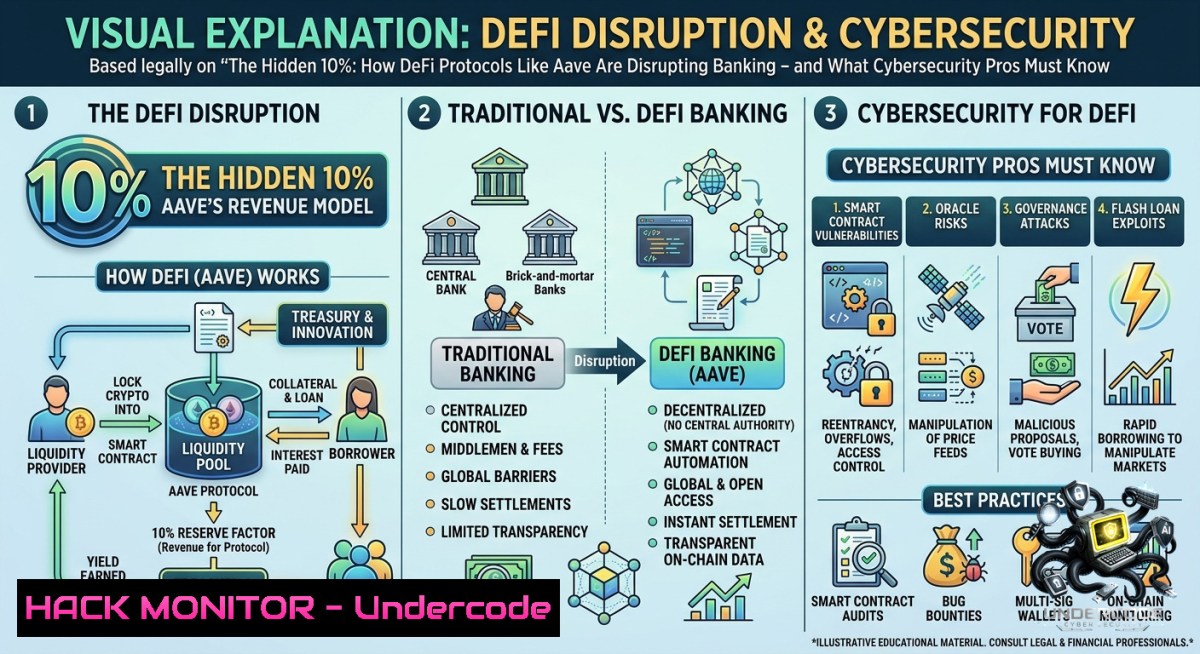
Introduction:
Decentralized Finance (DeFi) protocols such as Aave eliminate traditional financial intermediaries by automating lending and borrowing via smart contracts. While these systems can offer substantially higher yields on stablecoins like USDC (up to 10% APY vs. a bank’s 0.5%), they introduce unique cybersecurity risks: smart contract vulnerabilities, oracle manipulation, and private key exposure. Understanding these risks is essential for IT security professionals, cloud engineers, and AI-driven threat detection specialists who audit or build on blockchain rails.
Learning Objectives:
– Identify security gaps in centralized vs. decentralized lending models and assess attack surfaces in DeFi integrations like Brighty App + Aave.
– Execute Linux/Windows command-line tools to inspect smart contract bytecode, query blockchain RPC endpoints, and simulate yield-related transactions.
– Apply cloud hardening and API security measures to protect applications that interface with DeFi protocols against common exploits (reentrancy, flash loan attacks).
You Should Know:
1. Auditing Smart Contract Permissions with Cast (Foundry) and Slither
The core of Aave’s yield generation lies in its LendingPool and aToken smart contracts. Before trusting any DeFi integration, security analysts should verify contract ownership, upgradeability patterns, and approval mechanisms.
What this does: Extracts on-chain bytecode and detects known vulnerabilities using static analysis.
How to use it (Linux/macOS):
 Install Foundry (includes cast)
curl -L https://foundry.paradigm.xyz | bash
foundryup

 Query Aave v3 USDC pool on Ethereum mainnet (example address)
cast call 0x87870Bca3F3fD6335C3F4ce8392D69350B4fA4E2 "getReserveData(address)" 0xA0b86991c6218b36c1d19D4a2e9Eb0cE3606eB48 --rpc-url https://mainnet.infura.io/v3/YOUR_PROJECT_ID

 Run Slither static analysis on a cloned Aave repo
git clone https://github.com/aave/aave-v3-core
cd aave-v3-core
slither . --print human-summary
Windows (WSL2 recommended):
wsl --install -d Ubuntu
 then follow Linux commands inside WSL
2. Simulating Flash Loan Attacks and Rate Manipulation
DeFi yields are not risk‑free; attackers borrow millions within a single block to manipulate reserves. Use Python and web3.py to simulate a flash loan on a testnet and observe state changes.
What this does: Demonstrates how an adversary could artificially inflate borrow APY or drain a pool if price oracles are misconfigured.
Step‑by‑step guide:
– Install Python 3.9+, then `pip install web3 requests`.
– Connect to Goerli or Sepolia testnet via Alchemy/Infura.
– Use a pre‑deployed mock Aave pool contract (e.g., from a bug bounty template).
– Execute a flash loan callback that triggers a reentrancy attempt; monitor transaction traces.
from web3 import Web3
w3 = Web3(Web3.HTTPProvider('https://eth-sepolia.g.alchemy.com/v2/KEY'))
 Simplified flash loan simulation – see Aave developer docs for full payload
flashloan_tx = {
'to': '0xMOCK_AAVE_POOL',
'data': '0x...',  encoded flashLoanSimple()
}
print("Simulated flash loan gas estimate:", w3.eth.estimate_gas(flashloan_tx))
– On Windows, use Git Bash or WSL for same environment.
3. Hardening API Gateways That Relay DeFi Transactions
Mobile apps like Brighty must sign and broadcast user transactions. An exposed API key or misconfigured WebSocket endpoint can lead to fund theft. Secure your cloud backend using these commands.
Linux (hardening Nginx reverse proxy with rate limiting):
sudo apt install nginx -y
sudo nano /etc/nginx/sites-available/defi-proxy
 Add: limit_req_zone $binary_remote_addr zone=deflimit:10m rate=5r/s;
sudo nginx -t && sudo systemctl restart nginx
Windows (PowerShell – restrict inbound RPC to specific IPs):
New-1etFirewallRule -DisplayName "BlockPublicRPC" -Direction Inbound -Protocol TCP -LocalPort 8545 -Action Block
 Then add allow rule for your cloud provider's IP range
Cloud hardening (AWS CLI – enforce VPC endpoint policies):
aws ec2 create-vpc-endpoint --vpc-id vpc-xxx --service-1ame com.amazonaws.region.ecr.api --policy-document '{"Statement":[{"Effect":"Deny","Action":"","Resource":"","Condition":{"StringNotEquals":{"aws:SourceVpc":"vpc-xxx"}}}]}'
4. Detecting Anomalous Yield Arbitrage Using AI (Isolation Forest)
Lending protocols generate predictable APY curves; spikes or dips may indicate an ongoing exploit. Train an unsupervised anomaly detector on historical reserve data.
What this does: Flags atypical reserve utilization rates that could precede a bank run or oracle attack.
Step‑by‑step (Python on any OS):
import pandas as pd
from sklearn.ensemble import IsolationForest
 Fetch Aave USDC utilization rate from TheGraph (GraphQL)
 Assume df has columns: timestamp, utilization_rate
model = IsolationForest(contamination=0.01)
df['anomaly'] = model.fit_predict(df[['utilization_rate']])
print(df[df['anomaly'] == -1])  suspicious intervals
– For Windows, same Python script works in native command prompt.
5. Securing the User’s Private Key on Mobile and Web
Brighty integrates Aave, but the wallet that holds the private key (or a recovered passphrase) is the ultimate attack vector. Use hardware wallet guidelines and OS‑level secure enclaves.
Linux (store seed phrase with GPG and LUKS):
echo "your seed phrase" | gpg --symmetric --cipher-algo AES256 --output seed.gpg
sudo cryptsetup luksFormat --type luks2 /dev/sdb
sudo cryptsetup open /dev/sdb secure
sudo mount /dev/mapper/secure /mnt/secure
Windows (BitLocker + PowerShell credential vault):
Manage-bde -on C: -UsedSpaceOnly -RecoveryPassword
$cred = Get-Credential | Export-Clixml -Path "C:\vault\seed.xml"
 Then decrypt only when needed
6. Monitoring Aave’s Oracle (Chainlink) for Manipulation Attempts
DeFi yields rely on accurate price feeds. A stale or manipulated oracle can lead to catastrophic liquidation or yield miscalculation. Set up a cron job to compare on‑chain price with a trusted off‑chain reference.
Linux (bash script using curl and jq):
!/bin/bash
CHAINLINK_PRICE=$(cast call 0x5f4eC3Df9cbd43714FE2740f5E3616155c5b8419 "latestAnswer()" --rpc-url $RPC | cast to-dec)
TRADEFI_PRICE=$(curl -s "https://min-api.cryptocompare.com/data/price?fsym=ETH&tsyms=USD" | jq '.USD')
DIFF=$(echo "scale=4; ($CHAINLINK_PRICE - $TRADEFI_PRICE)/$TRADEFI_PRICE  100" | bc)
if (( $(echo "$DIFF > 2.0" | bc -l) )); then
echo "Oracle deviation alert: $DIFF%"
fi
– Add to crontab (`crontab -e`) for every 5 minutes.
What Undercode Say:
– Key Takeaway 1: The 0.5% vs. 10% gap is not free lunch – DeFi yields carry smart contract risk, oracle dependency, and liquidation exposure that banks actively mitigate.
– Key Takeaway 2: Security professionals must extend traditional IT audits to on‑chain transaction analysis, static code scanning, and real‑time anomaly detection because a single reentrancy bug can wipe out years of interest.
Analysis: The Brighty + Aave model exemplifies how traditional fintech and DeFi converge. However, most IT teams lack blockchain security training – they know firewalls but not `cast` or `slither`. The real vulnerability isn’t the interest rate spread; it’s the unverified smart contract that controls user funds. Until organizations adopt rigorous CI/CD pipelines for smart contracts (with fuzzing and formal verification), and until end‑user wallets enforce multi‑factor transaction signing, the “different rules” include much higher risk of total loss. The article’s missing piece: no mention of insurance (like Nexus Mutual) or worst‑case scenario (contract pause, governance attack). From a training perspective, every DeFi developer should practice on testnets with adversarial challenges.
Expected Output:
Prediction:
+1 Increased demand for hybrid cybersecurity roles that combine blockchain forensics with traditional cloud security – training courses on Web3 security will become mandatory for mid‑level IT certs.
-1 Without standardized real‑time monitoring for DeFi integrations, a major Aave‑connected neobank will suffer a $100M+ exploit within 18 months, eroding retail confidence in “up to 10% APY” claims.
▶️ Related Video (72% Match):
🎯Let’s Practice For Free:
🎓 Live Courses & Certifications:
[Join Undercode Academy for Verified Certifications](https://undercode.co.uk/certifications/)
🚀 Request a Custom Project:
Secure, high-velocity infrastructure and disruptive technological engineering. Contact our engineering team for high-tier development and proprietary systems:
[[email protected]](mailto:[email protected])
💎 Smart Architecture | 🛡️ Secure by Design | ⭐ Trusted by Thousands
IT/Security Reporter URL:
Reported By: [Your Bank](https://www.linkedin.com/posts/your-bank-pays-you-05-to-hold-your-money-share-7469741996698652672-40LI/) – Hackers Feeds
Extra Hub: Undercode MoN
Basic Verification: Pass ✅
🔐JOIN OUR CYBER WORLD [ CVE News • HackMonitor • UndercodeNews ]
[💬 Whatsapp](https://undercode.help/whatsapp) | [💬 Telegram](https://t.me/UndercodeCommunity)
📢 Follow UndercodeTesting & Stay Tuned:
[𝕏 formerly Twitter 🐦](https://x.com/undercodeupdate) | [@ Threads](https://www.threads.net/@undercodetesting) | [🔗 Linkedin](https://www.linkedin.com/company/undercodetesting/) | [🦋BlueSky](https://bsky.app/profile/undercode.bsky.social)


