
Listen to this Post
Introduction:
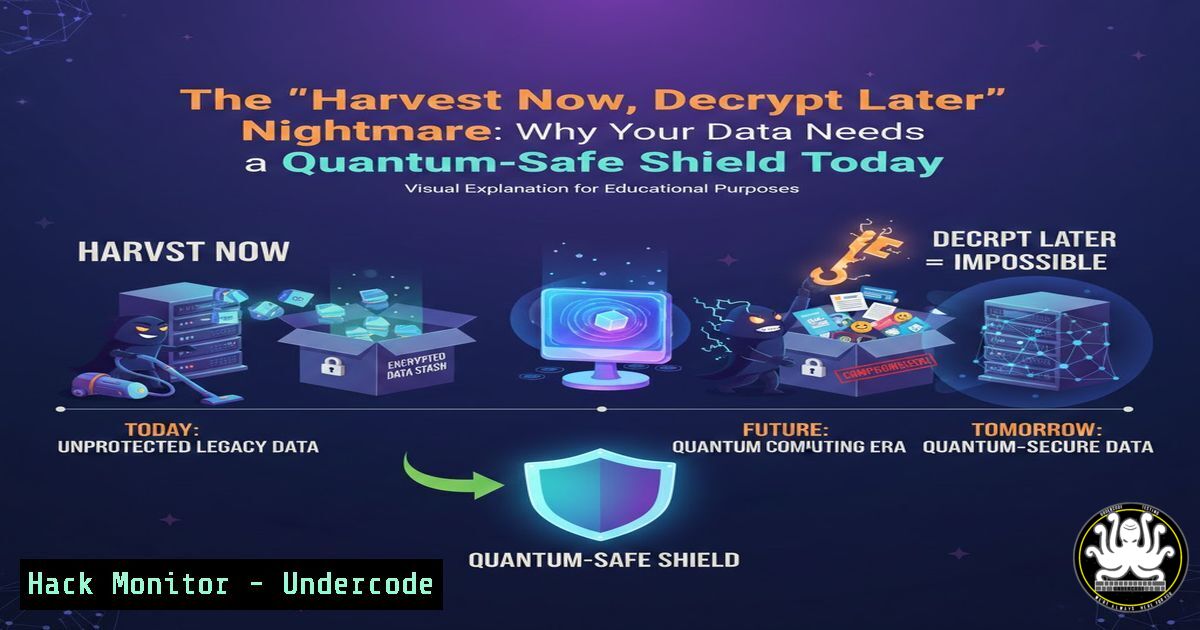
The conversation around post-quantum cryptography (PQC) is often dominated by long-term migration strategies and future algorithm standards. However, this focus overlooks a critical vulnerability that exists in the present: “Harvest Now, Decrypt Later” (HNDL) attacks. Adversaries are already intercepting and storing encrypted sensitive data, waiting for the day quantum computing breaks current encryption. To mitigate this immediate risk, organizations must deploy a practical “quantum-safe shield”—an enforcement layer that protects data today without waiting for a complete architectural overhaul.
Learning Objectives:
- Understand the urgency of the “Harvest Now, Decrypt Later” threat and why migration plans alone are insufficient.
- Learn the architectural principles of a “quantum-safe shield” that provides crypto-agility across legacy and cloud environments.
- Gain practical knowledge of implementing hybrid encryption and zero-trust segmentation to protect data in transit and at rest against future quantum decryption.
You Should Know:
1. The Architecture of a Quantum-Safe Shield
The core concept of a quantum-safe shield is to create an independent enforcement layer that wraps around existing infrastructure. Instead of rewriting applications to use new cryptographic algorithms (a multi-year effort), we insert a proxy or gateway that handles the quantum-safe encryption on behalf of the legacy systems.
Step‑by‑step guide to setting up a simple reverse proxy with hybrid encryption (using OpenSSL and a hypothetical PQC library):
This example demonstrates how to terminate TLS 1.3 (current standard) and re-encrypt the traffic with a hybrid scheme (classical + PQC) for internal transmission.
1. Generate Hybrid Certificates:
On your Linux shield gateway (e.g., Ubuntu 22.04), generate a traditional RSA key and a CRYSTALS-Kyber (a PQC KEM) key pair.
 Install liboqs and openssl (example for development)
 git clone https://github.com/open-quantum-safe/openssl.git
 cd openssl && ./Configure && make && sudo make install

Generate a classical EC key
openssl ecparam -name prime256v1 -genkey -out classical.key

Generate a Kyber key (using oqsprovider or oqs-openssl)
 Assume a binary 'oqskeygen' exists for demonstration
oqskeygen --kem kyber768 --priv kyber.key --pub kyber.pub

Combine into a hybrid certificate request (complex - usually handled by library)
 For practical purposes, a proxy like Envoy with BoringSSL and OQS integration can be configured.
What this does: This creates the cryptographic material needed for the shield to perform hybrid key exchanges, ensuring that even if one algorithm is broken, the other protects the session.
- Configure the Shield Proxy (NGINX with OQS patch):
Edit your NGINX configuration to listen for incoming traffic and proxy it to the internal legacy server using hybrid crypto.server { listen 443 ssl; server_name api.legacyapp.com; Classical certificates ssl_certificate /etc/ssl/certs/classical.crt; ssl_certificate_key /etc/ssl/private/classical.key; Enable PQC KEMs (if supported by compiled module) ssl_ecdh_curve X25519:kyber768:X25519Kyber768Draft00; ssl_ciphers 'ECDHE+KEM:...'; Hypothetical cipher string</p></li> </ol> <p>location / { Forward traffic to the legacy app, potentially re-encrypting with classical TLS proxy_pass https://internal.legacy.server:8443; proxy_ssl_verify off; } }What this does: The shield accepts connections from the outside world using the strongest available crypto (hybrid). It then forwards the decrypted traffic to the internal legacy server over standard TLS, effectively isolating the legacy system from direct quantum threats.
2. Implementing Crypto-Agility in API Gateways
APIs are a primary vector for sensitive data exfiltration. A quantum-safe shield must be crypto-agile, meaning it can swap out algorithms as standards evolve (e.g., from Kyber to a different finalist) without touching the API code itself.
Step‑by‑step guide to hardening an API gateway (using Kong or AWS API Gateway with Lambda):
- Identify Sensitive Payloads: Map your APIs to find those handling PII, financial data, or intellectual property. These are the high-risk endpoints for HNDL attacks.
2. Deploy a Sidecar Proxy (Service Mesh):
Inject a sidecar proxy (like Envoy or Linkerd) next to your API pod/instance.
Command (Kubernetes): `kubectl annotate pod
sidecar-injector/auto-inject=true` 3. Configure mTLS with PQC:
Configure the service mesh to enforce mutual TLS between services using a hybrid cipher suite.
Istio Configuration Example (YAML):
apiVersion: security.istio.io/v1beta1
kind: PeerAuthentication
metadata:
name: default
namespace: your-namespace
spec:
mtls:
mode: STRICT
 The underlying Envoy proxy must be compiled with OQS support
 to negotiate PQC algorithms like Kyber for the TLS handshake.
What this does: It ensures that east-west traffic (service-to-service) is encrypted with quantum-resistant algorithms. An attacker who breaches the network perimeter cannot silently capture internal API traffic for future decryption because the traffic is already protected by the shield.
- Protecting Legacy Systems with Hardware Security Modules (HSMs)
Legacy mainframes or outdated database systems cannot run PQC algorithms. A hardware-based shield can intercept and re-encrypt data as it leaves these systems.
Step‑by‑step guide for database encryption using an HSM with PQC capabilities:
- Place HSM in Data Path: Configure your database (e.g., Oracle, MySQL) to use Transparent Data Encryption (TDE) that points to an external PKCS11 provider. However, instead of a standard HSM, use one that supports hybrid algorithms.
2. Configure Key Wrapping:
The Database Master Key (DMK) is stored in the HSM. When the HSM exports the key for backup or replication, wrap it using a hybrid KEM.
Conceptual HSM Command:
 From the HSM admin console
hsm key wrap --key-id "master-db-key" \
--wrap-algorithm "AES256-GCM" \
--pqc-kem "kyber-1024" \
--output wrapped_key.bin
What this does: The database itself is unaware of the quantum-safe wrapping. The HSM acts as the shield, ensuring that when data is backed up to a tape or cloud storage (a prime target for HNDL attackers), the encryption key protecting that data is itself protected by a quantum-safe algorithm. Even if the backup is stolen today, the wrapped key cannot be unwrapped without breaking Kyber.
4. Zero Trust Segmentation for Quantum Risk
The shield concept aligns perfectly with Zero Trust. By assuming the network is hostile and the attacker is already harvesting data, micro-segmentation limits the blast radius.
Step‑by‑step guide to implementing micro-segmentation with quantum-safe considerations:
1. Create Network Policies (Kubernetes):
Isolate the “crown jewel” database containing encrypted user data.
apiVersion: networking.k8s.io/v1
kind: NetworkPolicy
metadata:
name: db-shield
spec:
podSelector:
matchLabels:
app: postgres-db
policyTypes:
- Ingress
ingress:
- from:
- podSelector:
matchLabels:
app: api-server  Only allow API servers
ports:
- protocol: TCP
port: 5432
What this does: Even if an attacker compromises a web server, they cannot directly access the database to steal encrypted data. They would have to compromise the specific API server path, giving the shield (monitoring/logging) more chances to detect the exfiltration attempt.
2. Host-Level Firewalling (Windows):
Use PowerShell to restrict database port access to specific IPs only.
New-NetFirewallRule -DisplayName "Protect SQL from lateral movement" -Direction Inbound -LocalPort 1433 -Protocol TCP -Action Block -RemoteAddress "Any"
New-NetFirewallRule -DisplayName "Allow only App Server" -Direction Inbound -LocalPort 1433 -Protocol TCP -Action Allow -RemoteAddress "192.168.1.100"
What this does: This prevents rogue processes on the network from reaching the database port, ensuring that the only way to interact with the data is through the authorized application logic, which is (ideally) fronted by the quantum-safe shield.
5. Monitoring for “Harvest Now” Activities
Defense is not just about encryption; it’s also about detection. Security teams must assume data is being harvested and look for anomalies.
Step‑by‑step guide to detecting suspicious large data transfers (Linux):
Use `tcpdump` and `tshark` to analyze traffic patterns leaving sensitive subnets.
1. Capture Traffic:
sudo tcpdump -i eth0 -s 0 -w capture.pcap host sensitive.db.internal and not host backup.server
What this does: Captures all traffic from the database server that isn’t destined for the authorized backup server—potential exfiltration.
2. Analyze for Large Flows (tshark):
tshark -r capture.pcap -q -z conv,ip | sort -k 6 -nr | head -10
What this does: Sorts network conversations by the total bytes transferred. An unusually large data flow to an unknown external IP could indicate that an attacker is harvesting the encrypted data now, before they have the quantum key to decrypt it. This triggers an incident response to rotate keys or isolate the segment.
What Undercode Say:
- Key Takeaway 1: The “Harvest Now, Decrypt Later” threat transforms data encryption from a future compliance issue into a present-day risk management crisis. Waiting for NIST final standards means your current data backups are already potential liabilities.
- Key Takeaway 2: A “quantum-safe shield” is not about replacing infrastructure but about augmenting it. By deploying crypto-agile gateways, HSMs, and strict micro-segmentation, organizations can achieve a defense-in-depth posture that protects data against both current and future cryptographic threats, allowing legacy migrations to proceed on a safe, non-emergency timeline.
The approach outlined here—focusing on a parallel protection layer rather than a “rip and replace” migration—is the only viable path for large enterprises. It acknowledges that while algorithms may change, the business need to protect sensitive data is constant. By implementing these hybrid solutions today, security teams can effectively neutralize the strategic advantage of nation-state actors engaged in massive data harvesting campaigns.
Prediction:
Within the next three years, regulatory bodies will begin mandating “future-proof encryption” for specific sectors (finance, healthcare, defense). This will move beyond simple algorithm recommendations and require proof of crypto-agility—the demonstrable ability to rotate cryptographic primitives without application downtime. Consequently, the market for “quantum-safe shield” appliances and proxies will explode, merging with the Zero Trust Network Access (ZTNA) market. Organizations that fail to adopt this shielding strategy will face a “Cryptographic Y2K” scenario, where their legacy data becomes a ticking time bomb for future decryption, leading to massive class-action lawsuits and geopolitical fallout when previously stolen secrets are finally revealed.
▶️ Related Video (80% Match):
🎯Let’s Practice For Free:
IT/Security Reporter URL:
Reported By: Billrfraser Pqc – Hackers Feeds
Extra Hub: Undercode MoN
Basic Verification: Pass ✅🔐JOIN OUR CYBER WORLD [ CVE News • HackMonitor • UndercodeNews ]
📢 Follow UndercodeTesting & Stay Tuned:


