Listen to this Post
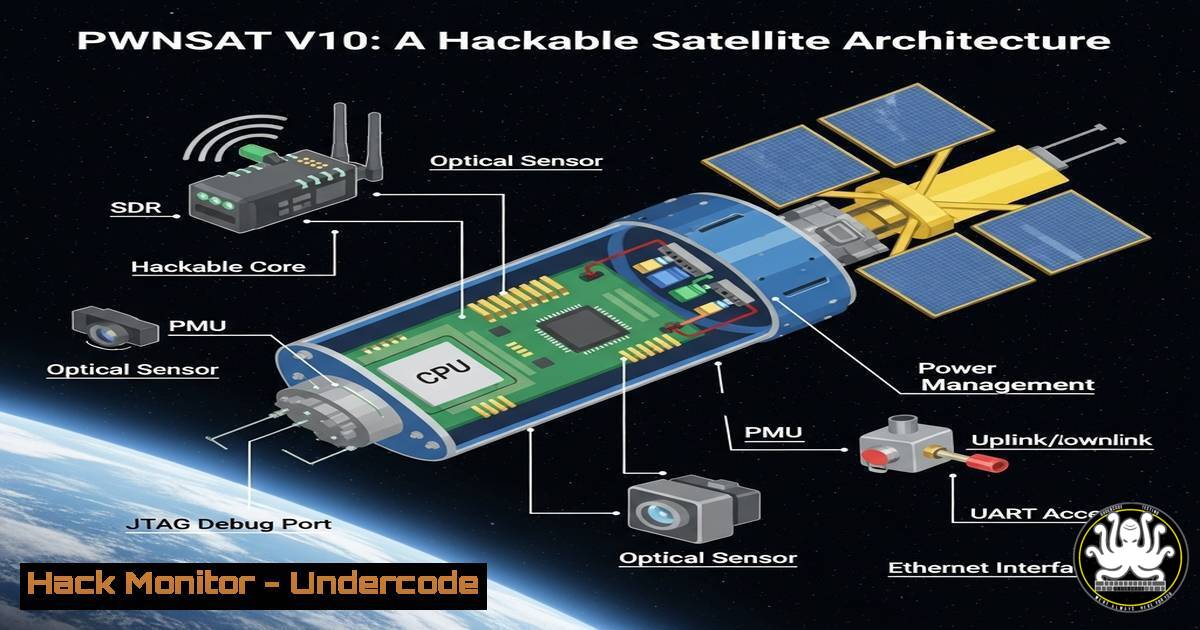
Introduction:
The final frontier of cybersecurity is no longer terrestrial; it’s orbital. The recent unveiling of PWNSAT V1.0, a CubeSat intentionally built with vulnerabilities, marks a paradigm shift in aerospace security, moving offensive research from theoretical models to practical, hands-on orbital laboratories. This initiative democratizes access to a critical field, allowing security professionals to train on real-world attack vectors without the astronomical cost or risk to operational missions.
Learning Objectives:
- Understand the core components and attack surfaces of a CubeSat and its ground station.
- Learn practical command-line techniques for analyzing satellite communication and firmware.
- Develop a methodology for conducting offensive security assessments on aerospace systems.
You Should Know:
1. Intercepting Satellite Telemetry with GNU Radio
$ grc // Launches GNU Radio Companion graphical tool

$ rtl_sdr -f 437000000 -s 2000000 -g 40 capture.dat` // Captures SDR data from an RTL-SDR dongle centered on 437 MHz with a 2 MHz sample rate and 40 dB gain.
Satellites communicate over specific radio frequencies, often in the UHF band. Using a cheap Software-Defined Radio (SDR) dongle and software like GNU Radio, you can intercept these transmissions. The `rtl_sdr` command tunes your SDR to a target frequency (e.g., 437 MHz, a common amateur satellite band) and captures the raw IQ data to a file. This data can then be decoded using tools like `gr-satellites` or a custom GNU Radio flowgraph to extract the telemetry data stream, which often contains sensitive operational data.
2. Analyzing Firmware for Embedded Vulnerabilities
$ binwalk -Me satellite_firmware.bin` // Automatically extracts (-e) recursively (-M) all discovered filesystems from the firmware.

$ strings -n 10 firmware_partition.bin | grep -i "password|backdoor|admin"

// Searches for human-readable strings of 10+ characters and filters for common hardcoded credential indicators.
CubeSat onboard computers (OBCs) run on embedded firmware, often based on Linux. The first step in analyzing this firmware is extraction. `Binwalk` is a powerful tool that automatically carves out and decompresses embedded filesystems, kernel images, and bootloaders. Once extracted, the `strings` command can be used to scan binary sections for hardcoded passwords, API keys, or hidden backdoor commands left in the code by developers, a common vulnerability in embedded systems.
3. Fuzzing Ground Station Communication Protocols
$ git clone https://github.com/zmap/ztag && cd tag`
`$ python3 ztag_transforms satellite --protocol=custom --template=packet_template.xml --target=192.168.10.50:14580` // Uses a custom protocol template to fuzz a ground station IP and port.
Ground station software receives data via specific protocols like CSP or AX.25. Fuzzing involves sending malformed or semi-malformed data to the ground station’s listening port to trigger crashes and uncover vulnerabilities like buffer overflows. The `ztag` tool, part of the ZMap project, allows you to define a protocol template (structure of a valid data packet) and then automatically mutate its fields to generate test cases, helping to identify flaws in the parser before attackers do.
4. Hardening the Linux-based Onboard Computer
$ sudo apt install grsecurity` // Installs the grsecurity kernel patches (on supported systems).

$ sudo sysctl -w kernel.kptr_restrict=2 kernel.dmesg_restrict=1 kernel.perf_event_paranoid=2
// Hardens kernel runtime settings to restrict information leakage.
The satellite’s OBC is a prime target. Hardening its Linux OS is critical. Applying security patches like `grsecurity` provides advanced kernel hardening features like Role-Based Access Control (RBAC) and kernel stack-smashing protection. The `sysctl` commands further lock down the runtime environment by restricting access to kernel memory addresses and dmesg logs, making it significantly harder for an attacker to perform reconnaissance and privilege escalation if they gain initial access.
5. Exploiting a Weak SSH Configuration
$ nmap -sV -p 22 --script ssh2-enum-algos 192.168.1.100
// Scans a target to enumerate supported SSH algorithms and ciphers.
$ ssh -oKexAlgorithms=diffie-hellman-group1-sha1 -c 3des-cbc [email protected]
// Forces a connection using weak, deprecated algorithms.
Many legacy or poorly configured systems support weak cryptographic algorithms for backward compatibility. An attacker can use `nmap` to probe the ground station’s SSH service for support of deprecated algorithms like SHA-1 or weak ciphers like 3DES. If found, the `ssh` client can be forced to use these weak algorithms to establish a connection, potentially allowing an attacker to decrypt traffic or exploit vulnerabilities in the old algorithms that have been removed from modern secure configurations.
6. Detecting Unauthorized Processes on the OBC
`$ docker run –pid=host –net=host –privileged -v /:/host aquasec/tracee:latest` // Runs the Tracee eBPF runtime security tool, mounting host OS filesystems to detect malicious behavior.
‘$ ps aux –forest` // Shows all running processes in a hierarchical tree view.
Continuous monitoring of the satellite’s onboard processes is vital. While `ps aux` provides a static snapshot, modern tools like `Tracee` use eBPF to hook into the kernel and provide real-time detection of suspicious behavior, like unexpected binary execution or privilege escalation attempts, directly on the OBC. This allows for near real-time anomaly detection and response, even in a resource-constrained environment.
- Simulating a Command Injection Attack on the Ground Station
Vulnerable Python code snippet in ground station software:

<h2 style="color:yellow;">os.system("ping -c 4 " + user_supplied_ip_address)
</li> </ol> $ python3 exploit.py --target 192.168.1.15 --cmd "rm -rf /critical/"` // Hypothetical exploit script injecting a destructive command.
A common vulnerability in ground station software is improper sanitization of user input used in system commands. The Python code snippet shows a classic command injection flaw where the `user_supplied_ip_address` is concatenated directly into a system command. An attacker could supply an IP like
8.8.8.8; rm -rf /critical/, causing the system to execute the `ping` command followed by the destructive `rm` command. This highlights the critical need for input validation and using subprocess modules with proper argument sanitization.What Undercode Say:
- The accessibility of offensive space security training is no longer a bottleneck; the hardware is.
- Off-the-shelf components (COTS) create a massive, shared attack surface across the entire aerospace industry.
PWNSAT V1.0 is not just a teaching tool; it is a stark warning. By proving that a intentionally vulnerable satellite can be built and operated, the team highlights how the commercial space revolution’s reliance on Commercial Off-The-Shelf (COTS) technology—cheap, ubiquitous, and often insecure components—has created a systemic risk. The same microcontrollers, radios, and Linux distributions used in this lab are already in orbit on critical missions. The attack vectors practiced here—command injection in ground software, hardcoded secrets in firmware, weak radio encryption—are not theoretical. They are the low-hanging fruit that nation-state and criminal actors will inevitably harvest. This project forces the entire industry to move from security through obscurity to security by validated design.
Prediction:
Within the next 18-24 months, the first major public satellite compromise will be reported, not due to a sophisticated zero-day, but because of basic misconfigurations and known vulnerabilities in its ground segment or onboard software, mirroring the early days of enterprise IT breaches. PWNSAT V1.0 will be seen as the canonical proof-of-concept that paved the way for both attackers and defenders, ultimately leading to mandated cybersecurity frameworks for commercial satellite operators akin to those in critical terrestrial infrastructure.
🎯Let’s Practice For Free:
IT/Security Reporter URL:
Reported By: Romel Marin – Hackers Feeds
Extra Hub: Undercode MoN
Basic Verification: Pass ✅🔐JOIN OUR CYBER WORLD [ CVE News • HackMonitor • UndercodeNews ]
📢 Follow UndercodeTesting & Stay Tuned:


