
Listen to this Post
Introduction:
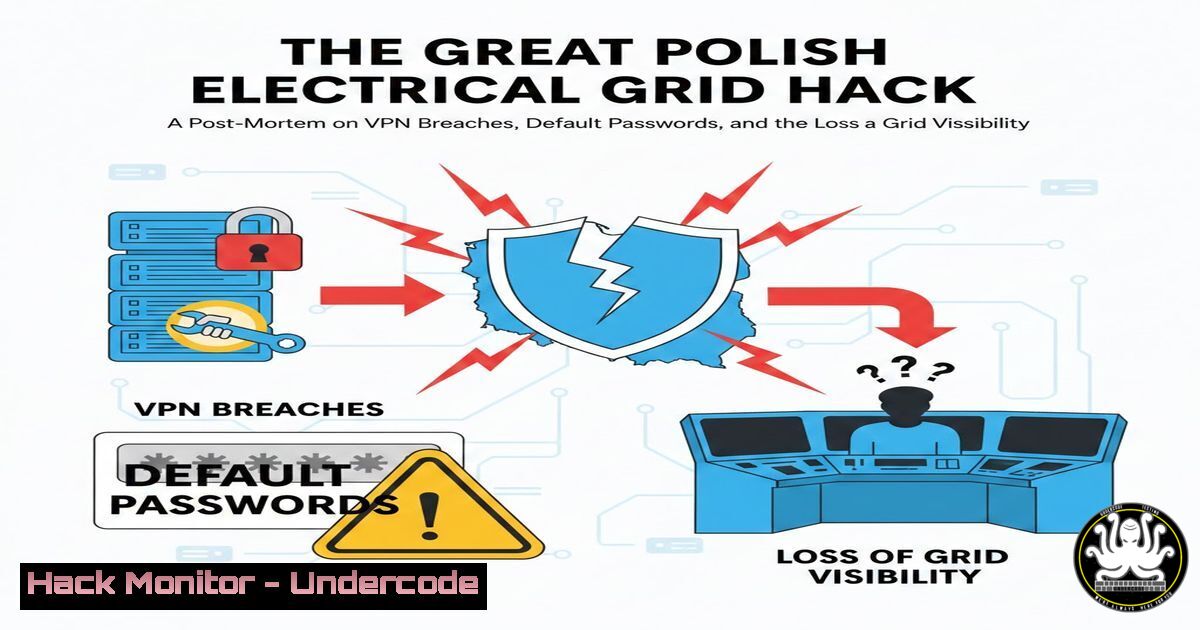
In a stark reminder of the vulnerabilities plaguing critical infrastructure, a recent cyberattack on Polish electrical substations highlighted how basic security hygiene failures can lead to a complete loss of operational control. While the incident did not result in a blackout, attackers leveraged stolen VPN credentials and default device passwords to reset industrial controllers, effectively blinding grid operators. This analysis dissects the attack vectors, provides technical mitigation commands, and outlines steps to harden Operational Technology (OT) environments against similar intrusions.
Learning Objectives:
- Understand the attack chain involving VPN compromise and credential reuse in OT networks.
- Learn how to audit and secure remote access gateways against MFA bypasses.
- Identify default credential vulnerabilities in Industrial Control Systems (ICS) like RTUs and IEDs.
- Implement network segmentation and logging best practices to prevent lateral movement and evidence destruction.
You Should Know:
1. VPN Gateway Hardening and MFA Enforcement
The initial access vector in the Polish attack was the compromise of VPN credentials without Multi-Factor Authentication (MFA) protection. Attackers likely used password spraying or credential stuffing to gain entry.
To secure VPN gateways in an OT context, strict configuration is required. For a Linux-based VPN server (e.g., OpenVPN or WireGuard), you must enforce certificate-based authentication in addition to credentials.
 On OpenVPN server, enforce client certificates and TLS:
 Edit server.conf to require TLS and client certificates
echo "tls-auth ta.key 1" >> /etc/openvpn/server.conf
echo "client-cert-not-required no" >> /etc/openvpn/server.conf  Ensure certs are required
systemctl restart openvpn@server

For WireGuard, use pre-shared keys (PSK) in addition to public keys to add a layer of obfuscation.
 Generate a PSK for a peer:
wg genpsk > peer1.psk
 Add the PSK to the peer configuration in wg0.conf
For Windows-based VPN solutions (like RRAS or DirectAccess), integration with Azure MFA or RADIUS is critical.
– Step 1: Install the Network Policy Server (NPS) role on Windows Server.
– Step 2: Configure the VPN server to use RADIUS authentication pointing to the NPS server.
– Step 3: On the NPS server, install the Microsoft MFA extension and create a policy requiring phone verification for all OT user groups.
- Auditing and Eliminating Default Credentials in the OT Environment
The attack succeeded because firewalls, RTUs (Remote Terminal Units), and IEDs (Intelligent Electronic Devices) were still using factory-default usernames and passwords. Attackers used these to reset devices to factory configurations.
A comprehensive audit using credential-checking scripts is essential. For Linux-based engineering workstations used to manage PLCs, you can use `sshpass` and `cracklib-check` to test for weak password policies, though physical inventory is best.
To check for default SSH credentials on network devices (if you have a trusted baseline list):
 Use a tool like 'sshpass' to test a single device for default creds (e.g., user: admin, pass: admin)
sshpass -p 'admin' ssh -o StrictHostKeyChecking=no [email protected]
 For a sweep of the subnet (use with extreme caution in OT to avoid lockouts)
for ip in $(seq 1 254); do
sshpass -p 'default' ssh -o ConnectTimeout=3 [email protected].$ip "exit" && echo "Host 192.168.1.$ip vulnerable"
done
For Windows-based HMI (Human-Machine Interface) stations, a PowerShell script can check local accounts against a list of banned default passwords:
 Check local users for empty passwords or well-known defaults
Get-LocalUser | Where-Object {$_.PasswordRequired -eq $false}
 Use net user to attempt to change common defaults (simulation only)
 net user administrator NewStrongPassword123! /domain
The remediation is strict: change credentials during commissioning and store them in a hardened password vault like CyberArk or HashiCorp Vault.
- Preventing Factory Reset Attacks via Access Control Lists (ACLs)
The attackers reset firewalls, RTUs, and IEDs to default configurations. This is often done via protocols like Telnet, SNMP, or proprietary vendor commands. To prevent this, network-level access must be restricted.
On Cisco IOS switches/routers managing OT traffic, implement VLANs and ACLs to block unauthorized management traffic:
! Create an ACL to allow management only from the Engineering Workstation (EWS)
access-list 100 permit tcp host 10.10.10.50 host 192.168.1.1 eq 22
access-list 100 permit udp host 10.10.10.50 host 192.168.1.1 eq 161
access-list 100 deny ip any any log
! Apply to the interface facing the RTU
interface GigabitEthernet0/1
ip access-group 100 in
For Linux-based systems acting as firewalls (iptables), restrict access to the device’s management interface:
 Allow SSH only from the jumpbox (IP 10.10.10.50)
iptables -A INPUT -p tcp --dport 22 -s 10.10.10.50 -j ACCEPT
iptables -A INPUT -p tcp --dport 22 -j DROP
 Log other attempts
iptables -A INPUT -p tcp --dport 23 -j LOG --log-prefix "TELNET_ATTEMPT: "
4. Network Segmentation: Defending the “Crown Jewels”
The attackers pivoted from the IT VPN to the OT substations due to flat network architecture. Strict segmentation is required using firewalls or unidirectional gateways.
On a Palo Alto Networks firewall, create rules that explicitly deny IT-to-OT traffic by default, allowing only specific protocols (like MODBUS or DNP3) via Application-Based policies.
– Step 1: Create Address Objects for “IT_Subnet” and “OT_Substation_Subnet”.
– Step 2: Create a rule: Source = IT_Subnet, Destination = OT_Substation_Subnet, Application = “modbus-tcp”, Action = Allow.
– Step 3: Create a rule below it: Source = Any, Destination = OT_Substation_Subnet, Action = Deny.
For Linux-based bridges, use `ebtables` to filter Layer 2 traffic and prevent ARP spoofing or unauthorized MAC addresses from jumping segments:
 Prevent a MAC address from the IT side from sending traffic to the OT side
ebtables -A FORWARD -s ! 00:11:22:33:44:55 -i eth0 -o eth1 -j DROP
5. Ensuring Log Integrity and Tamper-Proof Forensics
The attackers “cleared traces by destroying evidences.” To mitigate this, logs must be sent to a remote, immutable syslog server immediately.
Configure Windows Event Logs to forward to a SIEM:
 Configure Windows Event Collector or use winrm
wecutil qc /q
 Use AuditPol to enable detailed logging on critical servers
auditpol /set /subcategory:"Process Creation" /success:enable /failure:enable
Configure Linux syslog (rsyslog) to forward to a remote server and prevent local deletion:
 In /etc/rsyslog.conf, add a line to forward all logs to a central server
. @192.168.100.10:514  For UDP
. @@192.168.100.10:514  For TCP

Harden local logs (chattr) to prevent deletion, even by root
sudo chattr +a /var/log/messages
sudo chattr +a /var/log/secure
Also, enable sudo command logging to track who resets what:
 In /etc/sudoers, add:
Defaults log_output
Defaults!/usr/bin/reboot !log_output  Don't log reboot commands if needed
What Undercode Say:
- Loss of Visibility is the New Blackout: The primary damage was not physical destruction but the loss of situational awareness. When attackers reset devices to default, operators went blind. Defending visibility is as critical as defending power flow.
- The “Default” Vulnerability Persists: Despite decades of warnings, default credentials remain the Achilles’ heel of OT. Automated scanning for default passwords on RTUs and IEDs should be a monthly compliance check, not a yearly formality.
- MFA is Non-Negotiable for OT Access: The reliance on VPNs without MFA is an open invitation. Any remote access path to a substation must be treated as a direct line to the grid, requiring hardware tokens or biometrics.
Prediction:
The Polish attack is a precursor to more destructive campaigns. As renewable energy sources proliferate, the number of smaller, less secure substations connected to the grid will increase exponentially. Future attacks will likely combine the “loss of visibility” tactic seen here with synchronized physical switching commands, aiming to create real-time instability rather than just an outage. We will see a rise in “hybrid” attacks that blend IT credential theft with OT protocol manipulation to cause cascading equipment failures.
▶️ Related Video (70% Match):
🎯Let’s Practice For Free:
IT/Security Reporter URL:
Reported By: Ianleroyarakel Ot – Hackers Feeds
Extra Hub: Undercode MoN
Basic Verification: Pass ✅


