
Listen to this Post
Introduction:
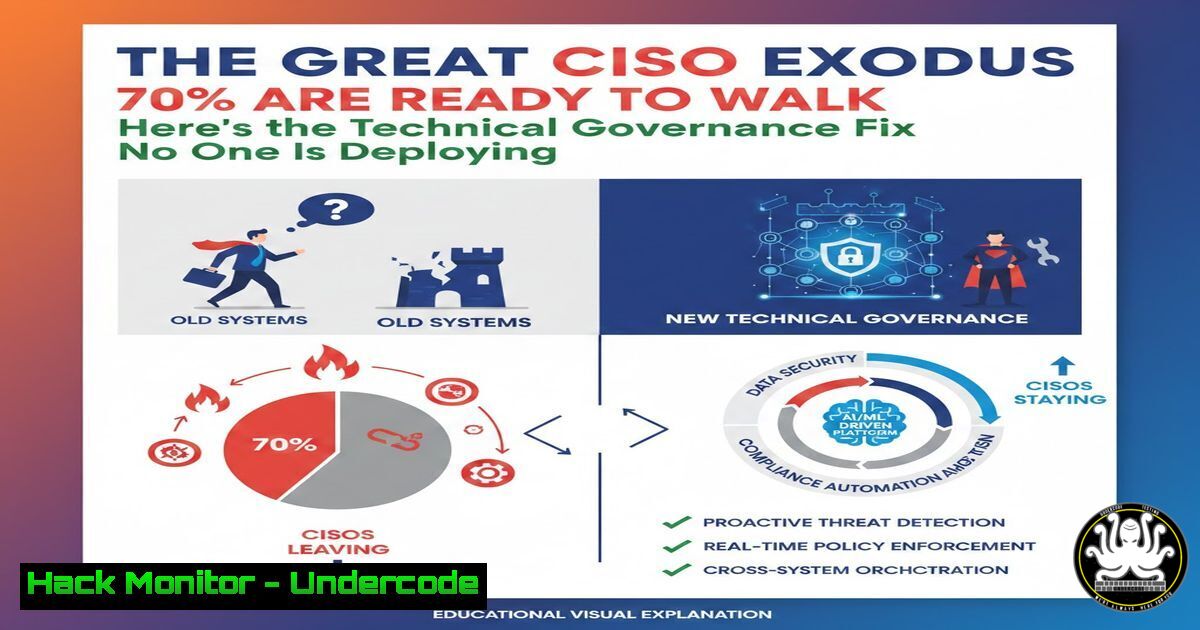
Nearly three-quarters of Chief Information Security Officers are quietly preparing their exit. This isn’t a talent shortage—it’s a structural collapse. CISOs are handed the accountability for cloud breaches, API exploits, and zero‑day vulnerabilities, yet they are denied the authority to enforce essential hardening, configure detection pipelines, or mandate identity segmentation. The gap between responsibility and control has become an active attack surface. Closing it requires more than empathy; it demands the systematic deployment of technical governance controls that shift security from a reactive burden to an enforced architectural layer.
Learning Objectives:
- Implement Role‑Based Access Control (RBAC) and Infrastructure as Code (IaC) guardrails that hard-code security authority into cloud environments.
- Deploy SIEM logic and endpoint detection rules that provide CISOs with autonomous, board‑ready visibility without cross‑functional friction.
- Automate incident response playbooks that execute containment measures independent of manual IT approval chains.
You Should Know:
1. Authority‑by‑Code: Enforcing CISO Mandates Through Immutable Infrastructure
When a CISO cannot block a misconfigured S3 bucket because they lack change approval rights, the organisation is already breached. The only sustainable fix is to embed security policy directly into the deployment pipeline—removing the human approval bottleneck.
Step‑by‑step guide to enforce S3 encryption using AWS Service Control Policies (SCP):
 Create an SCP that denies creation of unencrypted S3 buckets
aws organizations create-policy \
--name "DenyUnencryptedS3" \
--description "Prevents S3 buckets without encryption" \
--content '{
"Version": "2012-10-17",
"Statement": [
{
"Effect": "Deny",
"Action": "s3:CreateBucket",
"Resource": "",
"Condition": {
"Null": {
"s3:x-amz-server-side-encryption": "true"
}
}
}
]
}' \
--type "SERVICE_CONTROL_POLICY"
What this does: This policy automatically blocks any attempt to create an unencrypted S3 bucket across all accounts in the AWS Organisation. The CISO does not need to argue with developers; the cloud control plane enforces the mandate. Apply it via:
aws organizations attach-policy \
--policy-id p-example123 \
--target-id ou-example-123456
- Zero‑Trust Logging: SIEM Pipelines That Don’t Require Permission Slips
Many CISOs report that obtaining firewall logs or cloud trail data requires months of negotiation with network or platform teams. A self‑service logging architecture restores authority via data autonomy.
Step‑by‑step: Deploy a centralized, immutable logging sink on Azure using Policy and Event Hubs:
 Azure CLI: Create Event Hubs namespace for log ingestion
az eventhubs namespace create `
--name "cso-logs-ns" `
--resource-group "rg-security" `
--location "westeurope" `
--sku "Standard"

Assign 'Contributor' to the CISO's managed identity
az role assignment create `
--assignee-object-id "$CISO_MI_OBJECT_ID" `
--role "Contributor" `
--scope "/subscriptions/xxxx/resourceGroups/rg-security"
Why this matters: The CISO’s identity now has write‑only access to the log sink. Platform teams cannot delete or alter the logs; the security team retains forensic integrity. Diagnostic settings for all subscriptions are pushed to this Event Hub via Azure Policy, ensuring complete visibility without recurring tickets.
- Linux Host Hardening: Autonomous Remediation for Privilege Escalation
When a critical CVE such as Dirty Pipe or Looney Tunables surfaces, waiting for IT operations to patch is a career‑limiting move. CISOs can deploy watchtower agents that enforce kernel parameters and permission boundaries locally.
Step‑by‑step: Deploy an auditd rule that alerts AND reverts unauthorized setuid changes:
 /etc/audit/rules.d/setuid-monitor.rules
-w /usr/bin/chmod -p wa -k privilege_change
-w /usr/bin/chown -p wa -k privilege_change

A companion cron script to revert non‑approved SUID binaries
!/bin/bash
 /usr/local/bin/revert_setuid.sh
find /usr -type f -perm -4000 -exec chmod u-s {} \; 2>/dev/null
find /usr -type f -perm -2000 -exec chmod g-s {} \; 2>/dev/null
Implementation: The script runs every five minutes. It strips setuid bits from binaries unless they are on an explicit CISO‑approved allowlist. This grants the security function the final say on privilege boundaries, bypassing the bottleneck of individual server access requests.
- API Security: Rate Limiting and Schema Validation as a CISO‑Controlled Middleware
API abuse is the primary vector for modern data breaches, yet security teams often lack write‑access to API gateways. Deploying an independent Web Application Firewall (WAF) or sidecar proxy gives the CISO direct authority to throttle malicious traffic.
Step‑by‑step: Deploy a Kong API gateway sidecar with global rate limiting enforced by security labels:
 kong-plugin-rate-limiting.yml
_format_version: "3.0"
plugins:
- name: rate-limiting
service: critical-api-service
config:
minute: 60
policy: local
limit_by: ip
fault_tolerant: true
hide_client_headers: false
tags: ["cso-enforced"]
Deployment command:
curl -i -X POST http://kong-admin:8001/plugins \
-H "Content-Type: application/json" \
-d '{
"name": "rate-limiting",
"service": {"name": "payment-api"},
"config": {"minute": 30, "policy": "local"},
"tags": ["cso-enforced"]
}'
Context: The tag `cso-enforced` allows the CISO to run automated reconciliation scripts that ensure these plugins remain active, even if developers attempt to remove them. This shifts authority from “ask permission” to “break glass with immediate logging.”
- Windows Domain Isolation: Scripting the Authority Gap Closed
Hybrid AD environments often leave CISOs without direct ability to isolate compromised endpoints. Using PowerShell with delegated administrative units restores this power.
Step‑by‑step: Automated workstation isolation via Microsoft Graph API:
 Connect to Graph with CISO credentials
Connect-MgGraph -Scopes "Directory.AccessAsUser.All", "DeviceManagementManagedDevices.PrivilegedOperations.All"

Isolate device immediately upon high‑severity alert
$deviceId = (Get-MgDeviceManagementManagedDevice -Filter "deviceName eq 'ATTACKED-PC01'").Id
Invoke-MgDeviceManagementManagedDeviceActivateDeviceAction `
-ManagedDeviceId $deviceId `
-Action "isolate"
Why this works: The CISO’s account is provisioned with the role `Cloud Device Administrator` scoped to a specific “Security Isolation” administrative unit. No helpdesk ticket, no change advisory board—immediate network containment executed under the CISO’s sole authority.
6. Container Security: Blocking Vulnerable Images at Admission
Developers frequently deploy containers with critical vulnerabilities. Instead of scanning after deployment, the CISO can enforce admission control policies that reject non‑compliant images before they run.
Step‑by‑step: Kyverno policy to deny images with “latest” tag or critical CVEs:
 deny-latest-tag.yaml
apiVersion: kyverno.io/v1
kind: ClusterPolicy
metadata:
name: require-image-tag
spec:
validationFailureAction: Enforce
rules:
- name: validate-image-tag
match:
resources:
kinds:
- Pod
validate:
message: "Images must use a specific tag, not 'latest'."
pattern:
spec:
containers:
- image: "!:latest"
Apply the policy:
kubectl apply -f deny-latest-tag.yaml
Impact: The CISO no longer chases developers after a `latest` deployment breaks production. The policy is enforced by Kubernetes itself. If the CISO needs to override, it requires a signed admission review, leaving a cryptographic audit trail.
- Threat Intelligence Feed Automation: Cutting Out the Intermediary
Many organisations rely on IT to update firewall threat feeds. This is a failure mode. CISOs can deploy independent threat intelligence platforms that push indicators directly to edge devices.
Step‑by‑step: Push STIX indicators to a Palo Alto firewall via XML API:
curl -k -X POST 'https://panorama.example.com/api/?type=import&category=dynamic-blocklist' \
-H 'X-PAN-KEY: LUFRPT1N...' \
-F "file=@malicious_ips.txt"
Automation: A cron job on a secure jump host pulls fresh IoCs from the CISO’s commercial feed (e.g., Recorded Future, Anomali) every ten minutes and pushes them to Panorama. This restores authority over threat detection without waiting for network teams.
What Undercode Say:
- Key Takeaway 1: The CISO burnout crisis is a failure of technical architecture, not individual resilience. Authority must be translated into machine‑enforceable policies—RBAC, SCPs, admission controllers, and immutable logs—that execute security decisions without human intermediation.
- Key Takeaway 2: Training courses that teach “influencing without authority” are treating the symptom. The solution is infrastructure as code that constitutionally embeds security power into the deployment pipeline, making compliance the path of least resistance rather than a negotiation.
The conversation in the original post reveals a profession exhausted by structural friction. Paul Jacques noted that management courses teach us to never separate responsibility from authority; yet organisations routinely do this to CISOs. Jeremiah Dighomanor’s call for solidarity is essential, but solidarity without systemic redesign only delays the departure. The commands and configurations outlined above are not technical exercises—they are the new governance documents. When a CISO can block an S3 bucket, isolate a machine, or reject a vulnerable container without sending an email, the role becomes sustainable. Until then, the exodus will continue.
Prediction:
Within three years, the CISO role will bifurcate. One track will remain the traditional “advisor” role, reporting to CIOs, continuing the current burnout trajectory. The other track—the “vCISO with Enforcement”—will emerge as a distinct engineering leadership position, directly accountable to the board and equipped with the technical authority to configure cloud guardrails, API gateways, and endpoint controls. Organisations that fail to adopt this model will face both regulatory sanctions and the complete evaporation of experienced security leadership. The future CISO will not ask for permission; they will deploy a policy.
▶️ Related Video (74% Match):
🎯Let’s Practice For Free:
IT/Security Reporter URL:
Reported By: Mikkellindblom Nearly – Hackers Feeds
Extra Hub: Undercode MoN
Basic Verification: Pass ✅


