
Listen to this Post
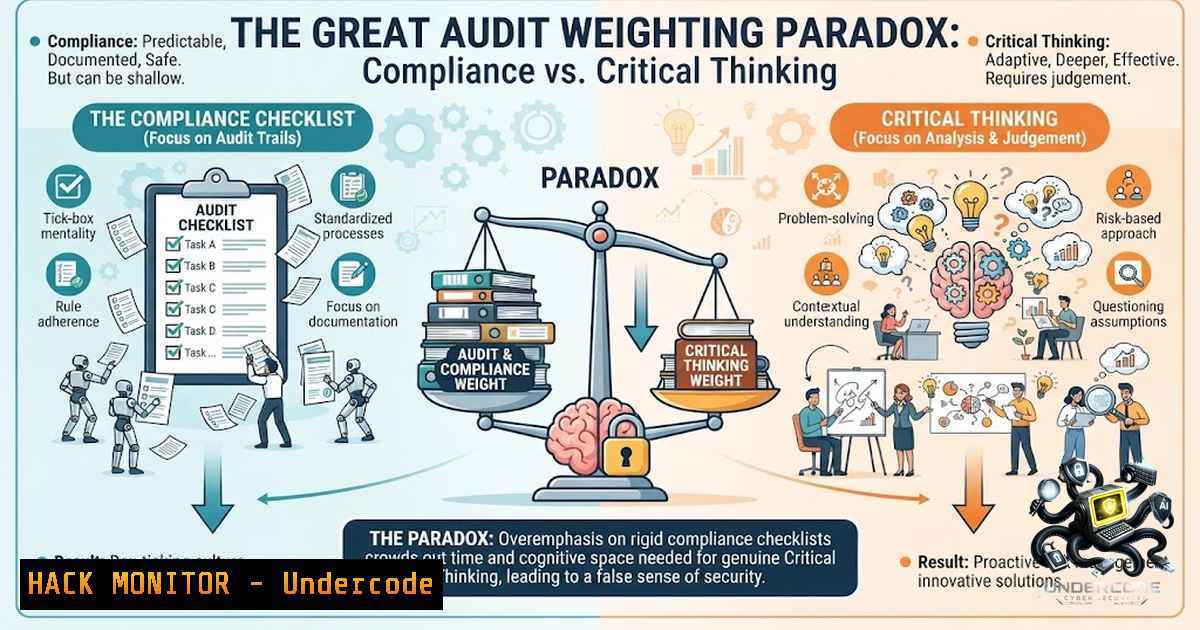 In the high-stakes world of cybersecurity and IT governance, auditors are often viewed as the gatekeepers of compliance. However, a fundamental flaw exists in how audit findings are evaluated: treating a missing training signature with the same severity as a critical control failure in a production environment. This article challenges the “one-size-fits-all” approach to audit scoring, proposing a dynamic risk-based methodology that aligns with Zero Trust principles and operational resilience. We will dissect how to move from static checklists to intelligent weighting systems that mirror the nuance of an experienced professional’s judgment, ensuring that security investments are directed where they matter most.
Learning Objectives
- Objective 1: Understand the limitations of equal weighting in audit frameworks and the necessity of contextual risk scoring.
- Objective 2: Learn to implement a weighted scoring model using practical IT, Linux, and Windows command-line tools to automate risk assessment.
- Objective 3: Develop a transparent “Audit Judgment Matrix” that balances objectivity with professional expertise, applicable to ISO 9001, SOC 2, and NIST CSF frameworks.
- The Risk-Weighted Audit Framework: Moving Beyond Severity Scores
The core issue raised by Mazen Al Arsalani is the implicit assumption that all “Nonconformities” are created equal. In IT security, a missing signature on a training log is a “Low” severity administrative issue; however, the absence of Multi-Factor Authentication (MFA) on a Domain Admin account is a “Critical” vulnerability. Yet, many audit checklists score them both as a “1” or “0” in a pass/fail column. We need to introduce a Weighted Severity Index (WSI) .
This guide implements a scoring matrix where factors are assigned dynamic coefficients: Severity (S), Recurrence (R), Process Criticality (C), and Control Effectiveness (E) . The formula is: Risk Score = (S 1.5) + (R 1.2) + (C 1.0) – (E 0.8) . Higher scores indicate audit findings that require immediate remediation.
To operationalize this, an auditor must extract objective data regarding these factors. For instance, to assess “Process Criticality,” we can query a system’s dependency tree. On a Linux server (if using a CMDB API), we could use `curl` to fetch asset criticality:
curl -s -H "Authorization: Bearer $API_TOKEN" "https://cmdb.internal/api/ci/$(hostname)" | jq '.criticality_score'
In Windows environments, leveraging PowerShell to query the Service Principal Name (SPN) or Active Directory attributes to check if a system is a “Domain Controller” (critical) vs. a “Print Server” (non-critical) helps determine weighting:
 Check if the server is a Domain Controller (Critical)
if ((Get-WmiObject Win32_ComputerSystem).DomainRole -eq 5) { $Criticality = 5 } else { $Criticality = 1 }
2. Automating Recurrence: Detecting Repeated Failures
Mazen points out that a finding identified for the “third consecutive audit” carries more weight than a first-time occurrence. This is a massive red flag in cybersecurity—it signifies a systemic failure in the management review or corrective action process. Instead of manually sifting through past reports, security teams can automate this using SIEM (Security Information and Event Management) queries or logging tools.
To implement automated recurrence detection, we can write a Python script that cross-references current findings against a historical SQLite database. If a finding’s hash (based on description or CVE ID) matches a previous audit, the script increments the Recurrence Multiplier.
Step-by-step recurrence logging:
- Generate a Finding Hash: On a Windows Machine, use `Get-FileHash` on the exported audit log, or use `certutil -hashfile audit_log.csv SHA256` to create unique IDs for issues.
- Query History: Use `sqlite3` to query past issues.
SELECT COUNT() FROM previous_findings WHERE hash = 'XYZ123';
- Adjust Weight: If count > 2, increase the recurrence factor by 50%. This transforms a simple administrative gap into a “High” risk item indicating leadership inertia.
3. Quantitative Impact Analysis: The “What If” Scenario
To assess the “Impact” factor objectively, auditors must move away from subjective adjectives like “High” or “Low.” In IT, impact is measured by MTD (Maximum Tolerable Downtime) and RTO (Recovery Time Objective) . A control failure impacting a system with a 4-hour RTO should be weighted higher than one impacting a 72-hour RTO system.
We can integrate a simple CLI (Command Line Interface) impact calculator. The script prompts the auditor for the RTO and security budget loss.
Linux Bash Example:
!/bin/bash
echo "Enter RTO in hours:"
read rto
if [ $rto -lt 4 ]; then
IMPACT_SCORE=10
elif [ $rto -lt 24 ]; then
IMPACT_SCORE=5
else
IMPACT_SCORE=1
fi
echo "Impact Weight: $IMPACT_SCORE"
This moves the audit from a simple tick-box exercise to a business continuity perspective. If a process directly affects product quality (as in Mazen’s example), the “Impact” on revenue must be translated into technical metrics—such as the number of API calls that would fail. For instance, if an audit reveals a misconfigured Kubernetes ingress, the impact can be measured by the potential 503 error rate, which can be checked via kubectl get ingress -o wide.
4. Control Effectiveness: Testing, Not Just Checking
Mazen touches on “Control effectiveness.” In IT, checking for a policy is insufficient; the auditor must test if the control works. Static weighting fails here because a firewall rule exists (control exists) but may be ineffective.
To weight this factor appropriately, run penetration testing or firewall validation commands:
– Linux: `nmap -sS -p 22
– Windows: `Test-1etConnection -Port 3389
If a control fails the “effectiveness test,” the weighting for that finding should automatically double. This is where Python scripts can integrate with `nmap` or `nc` and output a “Control Efficacy Score.”
5. Addressing the “Audit Stage” Weighting
Mazen correctly distinguishes between a Stage 1 audit (documentation review) and a Recertification audit (mature system). During a Recertification audit, the tolerance for “recurrence” and “severity” should be zero. In DevOps, this aligns with the “Shift-Left” philosophy: errors found in production (Recertification) are exponentially more expensive than those found in development (Stage 1).
Implementation Guide:
- Stage 1: Focus on Existence. Weighting: Existence (80%), Effectiveness (20%).
- Recertification: Focus on Resilience. Weighting: Effectiveness (50%), Recurrence (30%), Impact (20%).
You can automate this weighting in your GRC (Governance, Risk, and Compliance) tool using a simple environment variable check:
 Set the Audit Phase variable
export AUDIT_PHASE="RECERT"
if [ "$AUDIT_PHASE" == "RECERT" ]; then
export RECURRENCE_MULTIPLIER=2.0
fi
6. Building the “Audit Judgment Matrix” in Excel/Python
To standardize this, create a matrix where the Auditor inputs the finding and the system calculates the risk score.
Python Implementation Snippet:
def calculate_audit_weight(severity, recurrence, impact, control_eff):
 Base score out of 10
base = (severity + recurrence + impact) / 3
 If control_eff is low (0), multiply risk; if high (1), reduce risk
if control_eff < 0.3:
return base  2.0
elif control_eff > 0.8:
return base  0.5
else:
return base
This “structured methodology” allows less experienced auditors to understand why a finding gets a critical status, preserving the professional judgment that Mazen mentions while removing the randomness of individual subjectivity.
- The Incident Response Parallel: Applying Weighting to Remediation
Finally, the weighting mechanism isn’t just for the report; it dictates the response time. If an issue is “High” weight, the SLA (Service Level Agreement) for closure is strict. Auditors can integrate this with Jira or ServiceNow APIs to auto-assign priority.
Jira Automation using `curl`:
curl -X PUT -H "Authorization: Bearer $JIRA_TOKEN" \
--data '{"fields":{"priority":{"name":"Critical"}}}' \
"https://jira.company.com/rest/api/2/issue/AUDIT-123"
This ensures that the weighted audit factors directly trigger operational workflows.
What Undercode Say:
- Key Takeaway 1: “Unweighted checklists are a liability. They misallocate resources by treating administrative oversights with the same urgency as exploitable system vulnerabilities.”
- Key Takeaway 2: “The debate between objectivity and judgment is a false dichotomy. We must instrument our audits with APIs and CLI tools to quantify ‘Impact’ and ‘Process Criticality’ before the auditor even enters the room.”
Analysis:
Mazen Al Arsalani’s reflection highlights the maturity gap in the audit profession. In the context of AI and Cloud Security, this issue becomes even more acute. An “AI bias” nonconformity is not the same as a “password policy” violation; the former could result in regulatory fines (EU AI Act), while the latter is a known remediation path. The weighting must reflect the velocity of remediation and legal liability.
Experienced auditors often weigh “Process Criticality” the highest (as Mazen implies with the product quality example). However, the trend is moving towards Dynamic Weighting—a system that learns from previous breaches. If a misconfiguration led to a breach in the industry last quarter, that specific CVE (Common Vulnerabilities and Exposures) pattern should automatically weigh heavier in the audit scoring. The goal is not to remove the auditor but to give them the data to make a better, more auditable decision.
Prediction:
- +1: Weighted audit scoring will soon be integrated with SOAR (Security Orchestration, Automation, and Response) tools. This will allow for automated remediation, where high-weight findings trigger an automatic rollback or isolation of the asset, reducing MTTR (Mean Time to Remediate) by up to 60%.
- -1: The lack of standardization in weighting algorithms could lead to “Audit Shopping,” where organizations choose auditors with lighter weighting systems to pass certifications easier, diluting the value of ISO 9001 and SOC 2 trust marks.
▶️ Related Video (82% Match):
🎯Let’s Practice For Free:
🎓 Live Courses & Certifications:
Join Undercode Academy for Verified Certifications
🚀 Request a Custom Project:
Secure, high-velocity infrastructure and disruptive technological engineering. Contact our engineering team for high-tier development and proprietary systems:
[email protected]
💎 Smart Architecture | 🛡️ Secure by Design | ⭐ Trusted by Thousands
IT/Security Reporter URL:
Reported By: Mazen Al – Hackers Feeds
Extra Hub: Undercode MoN
Basic Verification: Pass ✅


