Listen to this Post
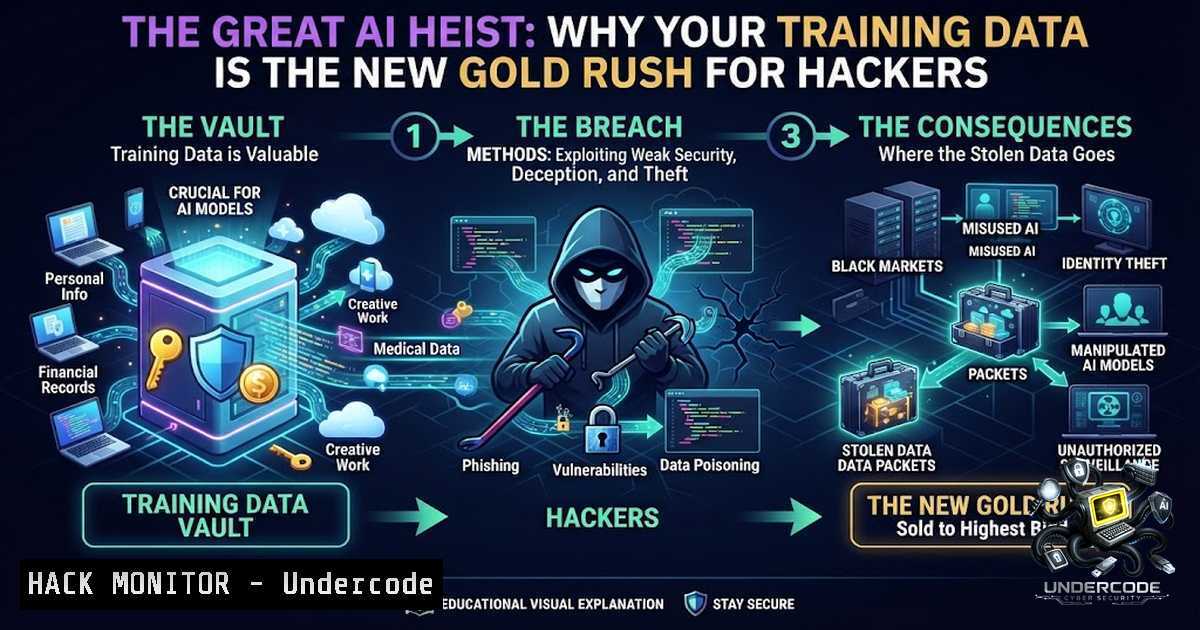
Introduction:
The democratization of Artificial Intelligence has led to an unprecedented surge in data sharing, with developers and researchers openly publishing datasets, model weights, and fine-tuning scripts on platforms like GitHub and Hugging Face. However, this open-source utopia has a dark underbelly: the rampant exposure of sensitive credentials, proprietary logic, and personally identifiable information (PII) within these shared assets. As AI adoption accelerates, the attack surface expands exponentially, shifting the cybersecurity paradigm from securing perimeters to securing the very data that fuels intelligence.
Learning Objectives:
- Understand the specific risks associated with sharing AI training datasets and model configuration files.
- Learn how to identify and extract sensitive information (secrets, API keys, internal paths) from publicly available repositories.
- Implement proactive security measures, including automated secret scanning and secure data sanitization pipelines for machine learning operations (MLOps).
You Should Know:
1. The Anatomy of an AI Data Leak
The core issue lies not in the AI algorithms themselves, but in the collateral data included in the rush to production. When data scientists share their work, they often push entire project directories to version control. These directories frequently contain `.env` files for environment variables, `config.json` with cloud storage keys, and cached datasets that include user metadata.
Step‑by‑step guide to identifying exposed secrets in a repository:
– Clone the target repository: git clone https://github.com/target-org/ai-model.git`grep -Eo ‘(http|https)://[^”]+’ ./ | grep -E ‘key=|token=|secret=’`
- Navigate to the directory and use `grep` to search for common patterns:
`grep -rnw . -e 'AKIA' -e 'sk-' -e '--BEGIN RSA PRIVATE KEY--'`
- `-r` for recursive search, `-1` for line numbers, `-w` for whole words.
- Extract all URLs containing sensitive parameters:
<h2 style="color: yellow;">
– For Windows (PowerShell): `Select-String -Path .\ -Pattern “AKIA|sk-|api_key”`
2. Hardening the MLOps Pipeline with Automated Secret Scanning
To prevent leaks, organizations must shift left and integrate security into their continuous integration/continuous deployment (CI/CD) pipelines. Tools like TruffleHog and GitLeaks can scan every commit for high-entropy strings.
Step‑by‑step guide to implement a pre-commit secret scanner:
- Install TruffleHog (Linux/macOS): `pip install trufflehog`
– Run a scan against your local repository: `trufflehog filesystem –directory=./ai-project –json`
– Integrate with pre-commit hooks: Create a file.pre-commit-config.yaml:repos:</li> <li>repo: https://github.com/trufflesecurity/trufflehog rev: v3.63.7 hooks:</li> <li>id: trufflehog args: [--1o-verification, --json]
- Install the hook: `pre-commit install`
– Windows alternative: Use Docker to run TruffleHog: `docker run -v %cd%:/data trufflesecurity/trufflehog:latest filesystem –directory=/data`
3. Securing API Keys in Jupyter Notebooks
Jupyter Notebooks are the bane of security teams. They are often shared as static files (.ipynb) that contain output cells displaying raw API responses, including tokens. Furthermore, the `%env` magic command often loads secrets in plaintext.
Step‑by‑step guide to sanitize Jupyter Notebooks:
- Use `python-dotenv` to manage variables: Load secrets from a `.env` file that is strictly excluded from version control via
.gitignore. - Clear output cells programmatically before commits: Run `jupyter nbconvert –clear-output –inplace .ipynb` to strip all output data, which often contains tokens.
- Implement a notebook linter to detect hardcoded credentials: Utilize tools like `nbqa` (Notebook Quality Assurance) with
bandit:
`nbqa bandit your_notebook.ipynb -r`
- Cloud Service Misconfigurations Exposed via AI Model Cards
Model cards and README files frequently contain instructions for deployment, which include AWS CLI commands or Azure login strings. Attackers can extract these to identify the organization’s cloud architecture and potentially brute-force remaining endpoints.
Step‑by‑step guide to harden cloud environment variables:
- Remove direct keys from command examples. Instead, use placeholders like `AWS_ACCESS_KEY_ID=
` in documentation. - Audit IAM policies for least privilege. Use AWS CLI to check if a user has excessive permissions:
`aws iam list-attached-user-policies –user-1ame DataScientistUser`
`aws iam get-policy-version –policy-arn arn:aws:iam::aws:policy/AdministratorAccess –version-id v1`
- If you find S3 bucket names in the code, verify the bucket ACL: `aws s3api get-bucket-acl –bucket exposed-ai-data`
- Exploitation: How Attackers Abuse Exposed Hugging Face Tokens
Hugging Face tokens grant write access to model repositories. An attacker who steals this token can upload malicious models (backdoored weights) or replace the existing model with a compromised version, leading to a supply chain attack that affects all downstream consumers.
Step‑by‑step guide to mitigate token exposure:
- Rotate tokens immediately: Revoke the compromised token via the Hugging Face settings dashboard.
- Monitor Hugging Face activity logs for unauthorized pushes.
- Set up GitHub Actions to scan for Hugging Face tokens:
</li>
<li>name: Check for HF Tokens
run: |
if grep -r "hf_" .; then
echo "HF Token Found! Failing build..."
exit 1
fi
6. Data Poisoning: Sanitizing Input Datasets
Beyond credentials, shared datasets are vulnerable to “poisoning.” Adversaries can inject corrupted samples into public datasets, causing models to misclassify or backdoor specific triggers.
Step‑by‑step guide to validate dataset integrity:
- Hash the dataset: Generate a SHA-256 checksum of the raw data and publish it separately.
`shasum -a 256 ./training_data.csv > checksum.txt`
- Implement schema validation using `pydantic` to ensure no unexpected fields (which could contain exploits) are present.
- When downloading public datasets, verify the checksum: `shasum -c checksum.txt`
7. Zero Trust Architecture for AI Inference Endpoints
The final line of defense is the inference endpoint itself. Attackers who gain credentials often target the `/predict` endpoint to perform “Model Inversion” attacks, extracting sensitive training data by querying the API.
Step‑by‑step guide to harden the API endpoint:
- Implement rate limiting using `nginx` or `cloudflare` to prevent massive scraping.
- Validate input types strictly using FastAPI or Flask-RESTful to prevent injection of malicious payloads.
- Set up mTLS (Mutual TLS) between the client and the server to ensure only authenticated services communicate.
- Generate a client certificate: `openssl req -1ew -key client.key -out client.csr`
– Configure the server to require client certificates in thenginx.conf:
`ssl_verify_client on;`
`ssl_client_certificate /etc/ssl/certs/ca-certificates.crt;`
What Undercode Say:
- Key Takeaway 1: The sharing culture in AI is a double-edged sword; while it accelerates innovation, it abandons fundamental security hygiene, moving sensitive data out of controlled data centers and into publicly accessible archives.
- Key Takeaway 2: Security in AI must evolve from reactive patching to proactive secret scanning and sanitization, treating the MLOps pipeline with the same rigor as traditional software development.
Prediction:
- +1 The widespread adoption of automated secret scanning tools will drastically reduce accidental exposures, making it riskier for adversaries to rely on credential harvesting as a primary attack vector.
- -1 The complexity of modern AI pipelines will lead to an increase in supply chain attacks, where attackers compromise not the model but the data pipelines that feed it, creating a “trust drought” in the open-source AI community.
- -1 As AI models become more valuable, nation-state actors will shift from hacking systems to infiltrating the workstations of data scientists, targeting the “human element” of security rather than the code itself.
- +1 Emerging standards like SLSA (Supply-chain Levels for Software Artifacts) will eventually extend to AI models, providing a verifiable provenance that will help organizations distinguish between legitimate and backdoored weights.
- -1 Despite technical controls, the lack of security awareness among data scientists will remain the critical vulnerability, as they prioritize model accuracy over secrets management.
▶️ Related Video (78% Match):
🎯Let’s Practice For Free:
🎓 Live Courses & Certifications:
Join Undercode Academy for Verified Certifications
🚀 Request a Custom Project:
Secure, high-velocity infrastructure and disruptive technological engineering. Contact our engineering team for high-tier development and proprietary systems:
[email protected]
💎 Smart Architecture | 🛡️ Secure by Design | ⭐ Trusted by Thousands
IT/Security Reporter URL:
Reported By: Usman Shahbaz71 – Hackers Feeds
Extra Hub: Undercode MoN
Basic Verification: Pass ✅


