Listen to this Post
Introduction:
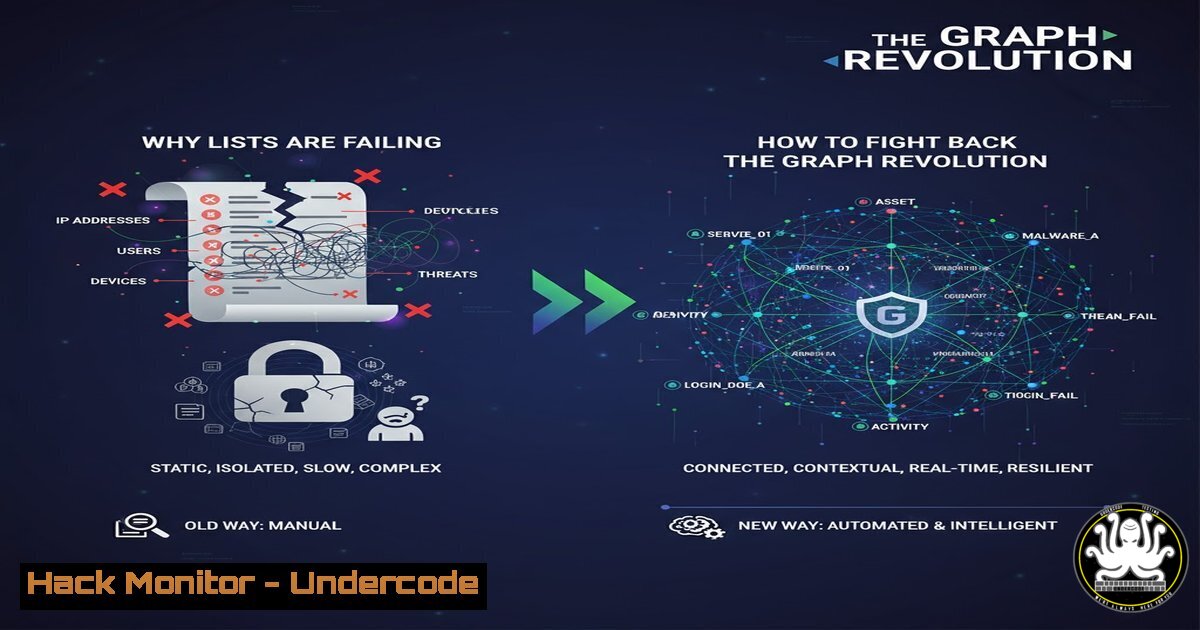
Modern detection engineering has become obsessed with precision at the cost of perspective, creating a dangerous gap between how defenders and attackers view a network. While security teams chase atomic alerts with minimal false positives, adversaries operate by building context and exploiting relationships between identities, devices, and permissions. This article explores how shifting from a list-based to a graph-based mindset is critical for restoring situational awareness and building effective defenses.
Learning Objectives:
- Understand the fundamental limitations of atomic, list-based detection strategies.
- Learn how to model your environment using graph-based principles to reveal attack paths.
- Acquire practical commands and techniques to begin implementing context-aware detection.
You Should Know:
1. From Atomic Alerts to Attack Graphs
The core failure of traditional detection is its focus on isolated events. Attackers don’t operate in a vacuum; they move along paths of relationships. Understanding these paths requires modeling your environment as a graph.
Verified Command: BloodHound Python Ingestor
 Run the BloodHound Python ingestor to collect Azure AD data
python3 azurehound.py -u <a href="mailto:user@tenant.com">user@tenant.com</a> -p <password> -c <tenant_id> --zip
Step-by-step guide:
This command uses the BloodHound AzureHound ingestor to collect relationship data from your Azure AD environment. It authenticates with a user account, connects to the specified tenant, and outputs the collected data into a compressed file. This data can then be imported into BloodHound to visualize attack paths, such as which users have permissions to access critical assets or can grant themselves higher privileges. The power lies not in the individual permissions, but in the chains of relationships that these permissions create.
2. Mapping Control Relationships with PowerShell
Understanding what an identity can control is fundamental to graph-based security. This PowerShell script helps map local administrative rights, a key relationship in lateral movement.
Verified Command: PowerView’s Get-NetLocalGroupMember
 Use PowerView to enumerate local administrators on a remote machine
Get-NetLocalGroupMember -ComputerName "SERVER01" -GroupName "Administrators" | Select-Object ComputerName, AccountName, IsGroup, IsDomain
Step-by-step guide:
This PowerView cmdlet queries the specified computer (“SERVER01”) and lists all members of the local “Administrators” group. The critical insight is identifying whether these accounts are domain users or groups. A domain user in a local admin group across multiple workstations creates a powerful control relationship for an attacker. By running this across your network, you can build a graph of which identities control which resources, revealing paths for privilege escalation and lateral movement.
3. Detecting Anomalous Session Creation
Atomic detection might flag all rare Kerberos ticket requests. Context-aware detection asks: “Does this session create a new, dangerous control relationship?”
Verified Command: Windows Security Audit Log Query
 Query Windows Security logs for Kerberos service ticket requests (Event ID 4769) with specific parameters
Get-WinEvent -FilterHashtable @{LogName='Security'; ID=4769} | Where-Object { $<em>.Properties[bash].Value -eq "0x40810000" -and $</em>.Properties[bash].Value -like "admin" } | Select-Object TimeCreated, @{Name='Client';Expression={$<em>.Properties[bash].Value}}, @{Name='Service';Expression={$</em>.Properties[bash].Value}}, @{Name='TicketOptions';Expression={$_.Properties[bash].Value}}
Step-by-step guide:
This command filters Security Event ID 4769 (Kerberos service ticket requested) for tickets that are forwardable and encryped (Ticket Options ‘0x40810000’, common for lateral movement) and where the service name contains “admin”. The context is critical: a request for a ticket to a domain controller’s admin interface from a non-admin workstation is far more suspicious than the same event from a known administrative jump server. This moves detection from “rare event” to “dangerous relationship change”.
4. Leveraging Sigma for Context-Rich Detections
Sigma rules can be written to incorporate context, moving beyond simple event matching.
Verified Code Snippet: Sigma Rule with Contextual Filters
title: Suspicious Service Installation followed by Network Connection
logsource:
product: windows
service: system
detection:
selection_svc:
EventID: 7045
ServiceName: ''
selection_net:
EventID: 5156
Image: '\services.exe'
timeframe: 5m
condition: selection_svc and selection_net and within timeframe
fields:
- CommandLine
- ServiceName
- Image
- SourceAddress
- DestAddress
falsepositives:
- Legitimate software updates
level: high
Step-by-step guide:
This Sigma rule doesn’t just look for a single event; it correlates a new service installation (Event ID 7045) with a network connection initiated by services.exe (Event ID 5156) within a 5-minute window. This pattern is highly indicative of a persistent backdoor. The rule provides contextual fields to help the analyst quickly understand the relationship between the service installation and the subsequent network call, turning two separate events into a single, high-fidelity narrative.
5. Cloud Identity Graph Analysis with AWS CLI
In cloud environments, identity and access management (IAM) relationships are the new attack graph.
Verified Command: AWS IAM Policy Simulation
 Simulate what actions an IAM entity can perform on critical resources
aws iam simulate-custom-policy \
--policy-input-list file://policy.json \
--action-names "s3:GetObject" "iam:CreateAccessKey" \
--resource-arns "arn:aws:s3:::secret-bucket/" "arn:aws:iam::123456789012:user/"
Step-by-step guide:
This AWS CLI command simulates whether the permissions defined in `policy.json` allow the actions `s3:GetObject` and `iam:CreateAccessKey` on specified resources. This is a proactive way to model attack paths in your cloud environment. By testing various policies against critical resources, you can discover unexpected relationships, such as a low-privilege role that can read from a sensitive S3 bucket or create new access keys for other users, revealing privilege escalation paths.
6. KQL Query for Process Chain Anomalies
Atomic detection might flag `rundll32.exe` everywhere. Context-aware detection in Azure Sentinel looks for anomalous parent-child relationships.
Verified Command: Kusto Query Language (KQL) Process Chain
SecurityEvent
| where EventID == 4688
| where NewProcessName endswith "rundll32.exe"
| join kind=inner (
SecurityEvent
| where EventID == 4688
| project ParentProcessName, ParentProcessId, TimeGenerated
) on $left.ProcessId == $right.ParentProcessId
| where ParentProcessName !endswith "explorer.exe"
| summarize count() by ParentProcessName, NewProcessName
| where count_ > 5
Step-by-step guide:
This KQL query joins process creation events (Event ID 4688) to find instances where `rundll32.exe` is spawned by processes other than the normal explorer.exe. It then summarizes these anomalous parent-child relationships, highlighting patterns that might indicate script-based exploitation or living-off-the-land binary (LOLBin) abuse. The power is in correlating the process relationship, not just the presence of a single binary.
7. Building a Simple Graph with Network Logs
Even without specialized tools, you can apply graph thinking to existing data.
Verified Command: Zeek (Bro) Conn Log Analysis with Bash
 Extract unique internal-to-internal connection pairs from Zeek conn.log
cat conn.log | zeek-cut id.orig_h id.resp_h | grep "192.168" | sort | uniq -c | sort -nr | head -20
Step-by-step guide:
This command pipeline processes Zeek (formerly Bro) connection logs to extract and count the most frequent internal-to-internal IP address connections. The result is a simple graph of which hosts commonly communicate with which other hosts. A sudden appearance of a new connection between two previously unconnected internal systems, especially from a compromised host to a domain controller, represents a potentially critical lateral movement event that would be invisible in atomic detection.
What Undercode Say:
- Defenders Must Become Cartographers, Not Stamp Collectors: The fundamental shift required is from collecting isolated security events to mapping the terrain of your digital environment—the relationships, trust paths, and access chains that attackers actually exploit.
- Precision Without Context Creates Alert Fatigue: The industry’s obsession with low-false-positive, atomic alerts has backfired, creating an overwhelming volume of “accurate” but meaningless notifications that drown analysts in data while providing no understanding.
The analysis suggests that the cybersecurity industry has over-indexed on left-brain thinking—the detail-oriented, analytical processing that excels at isolating signals from noise. While this is necessary, it’s insufficient without the right-brain capacity to synthesize these details into a coherent narrative. The comment “Defenders think in lists. Attackers think in graphs” perfectly captures this asymmetry. Until detection engineering embraces graph-based modeling and contextual analysis, defenders will continue to be overwhelmed by precise but meaningless alerts while attackers move freely through the relationship gaps in our understanding. The solution isn’t to abandon precision, but to frame it within the environmental context that gives it meaning.
Prediction:
The adoption of graph-based detection methodologies will become the new dividing line between effective and ineffective security programs within the next three years. Organizations that fail to make this transition will face increasingly sophisticated attacks that exploit their contextual blindness, while those that embrace graph thinking will achieve a fundamental shift from reactive alert-triaging to proactive threat-understanding. This will eventually lead to the development of AI-powered security graphs that can automatically reason about attack paths and predict adversary movement, fundamentally changing the defender’s advantage.
🎯Let’s Practice For Free:
IT/Security Reporter URL:
Reported By: Jaredcatkinson Modern – Hackers Feeds
Extra Hub: Undercode MoN
Basic Verification: Pass ✅


