Listen to this Post
Introduction:
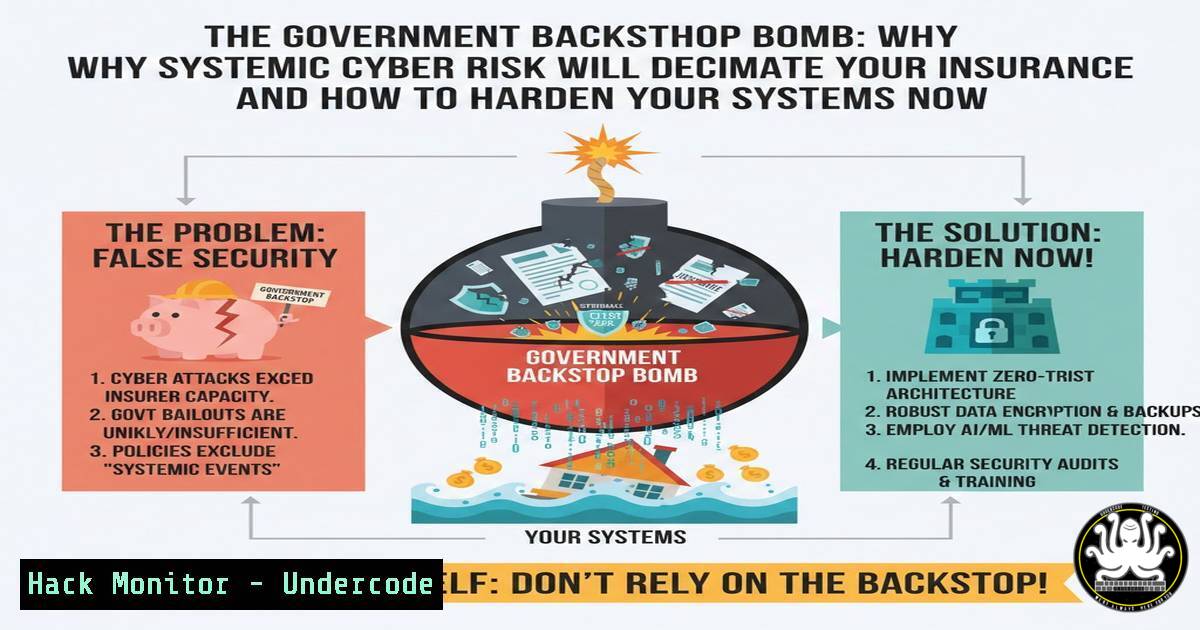
The escalating debate between insurance veterans reveals a terrifying fissure in the digital age’s safety net: systemic cyber risk. As experts clash over whether the government must become the ultimate financial backstop for catastrophic, cascading cyber events, one truth emerges—traditional insurance models are breaking. This article dissects the technical and policy battlefield, translating high-stakes arguments into actionable security hardening for IT professionals who will be on the front lines when a systemic attack hits.
Learning Objectives:
- Understand the technical characteristics that define an uninsurable “systemic” cyber risk.
- Learn the security configurations and monitoring strategies that align with evolving cyber insurance requirements.
- Implement immediate hardening steps for cloud, network, and API security to mitigate cascading failure scenarios.
You Should Know:
- Defining the Beast: What Makes a Risk “Systemic” and Technically Uninsurable?
A systemic cyber risk is not a single data breach. It’s a cascading failure propagated through interdependencies, like a zero-day vulnerability in a ubiquitous cloud hypervisor (e.g., VMware ESXi) or a critical compromise in a widely used software library (e.g., log4j). Insurers cannot model the maximum probable loss because the incident scales non-linearly across countless organizations simultaneously.
Step‑by‑step guide explaining what this does and how to use it.
Action: Map Your Critical Dependencies.
You cannot mitigate an unseen risk. Use these commands to inventory software and cloud dependencies that could become systemic vectors.
Linux (using `apt` & `pip`):
 List all installed packages and versions
dpkg-query -f '${Package} ${Version}\n' -W > system_packages.txt

For Python environments, list pip packages
pip list --format=freeze > python_dependencies.txt

Check for known vulnerable versions (example using grep for a hypothetical CVE)
grep -E "openssl.1.1.1-1ubuntu2.1" system_packages.txt
Windows (PowerShell):
 Get all installed software
Get-WmiObject -Class Win32_Product | Select-Object Name, Version | Export-Csv -Path installed_software.csv -NoTypeInformation

Use winget for modern package list
winget list --accept-source-agreements > winget_packages.txt
Cross-reference your lists with feeds from CISA’s Known Exploited Vulnerabilities (KEV) catalog. This initial audit is the first step in understanding your exposure to a widespread software supply chain attack.
- The Insurance-Technical Feedback Loop: How Policies Demand Hardening
As insurers grapple with systemic risk, policy applications now demand specific technical controls. Failure to implement them results in denial of coverage or exclusions. These are no longer best practices; they are the minimum bar for insurability.
Step‑by‑step guide explaining what this does and how to use it.
Action: Enforce Multi-Factor Authentication (MFA) on ALL Cloud Identities.
A single compromised cloud admin account can trigger a cascading cloud failure. Enforce MFA programmatically.
AWS CLI (Example):
 1. Check for root account MFA (Critical for insurance audits)
aws iam get-account-summary | grep "AccountMFAEnabled"

<ol>
<li>Enforce MFA for all IAM users via an IAM policy. Attach a policy like:
{
"Version": "2012-10-17",
"Statement": [{
"Sid": "BlockAccessWithoutMFA",
"Effect": "Deny",
"Action": "",
"Resource": "",
"Condition": {"BoolIfExists": {"aws:MultiFactorAuthPresent": "false"}}
}]
}
Azure (PowerShell):
 Enable Azure AD Security Defaults (enforces MFA for admins & risky sign-ins)
Connect-AzureAD
 Security defaults are enabled in the Azure AD Portal. Verify:
Get-AzureADPolicy | Where-Object {$_.Type -eq "SecureDefaults"}
3. Architecting for Containment: Segment or Be Doomed
The moral hazard argument against a government backstop hinges on poor security practices. Insurers will mandate network segmentation to prevent a single initial compromise from becoming a systemic loss within your organization.
Step‑by‑step guide explaining what this does and how to use it.
Action: Implement Zero-Trust Microsegmentation with Host-Based Firewalls.
Beyond network VLANs, enforce policies at the workload level.
Linux (using `nftables` modern replacement for `iptables`):
 Create a table and chain to drop all except explicit allows between subnets
nft add table inet filter
nft add chain inet filter input { type filter hook input priority 0\; }
nft add rule inet filter input ip saddr 10.0.1.0/24 tcp dport {22, 443} accept
nft add rule inet filter input ip saddr 10.0.2.0/24 drop
 List rules
nft list ruleset
Windows (Advanced Firewall via PowerShell):
 Create a rule to allow traffic only from a specific management subnet to port 5985 (WinRM)
New-NetFirewallRule -DisplayName "Allow_WinRM_Management" -Direction Inbound -LocalPort 5985 -Protocol TCP -Action Allow -RemoteAddress 10.0.100.0/24

Create a blocking rule for all other internal traffic to this port
New-NetFirewallRule -DisplayName "Block_Other_WinRM" -Direction Inbound -LocalPort 5985 -Protocol TCP -Action Block -RemoteAddress 10.0.0.0/8
- The API Security Imperative: The Silent Systemic Vector
Modern systemic risk flows through APIs. A compromised API key in a central identity provider (like Okta) or a vulnerable public-facing API can lead to catastrophic data exfiltration. Insurance auditors now scan for API security postures.
Step‑by‑step guide explaining what this does and how to use it.
Action: Implement API Rate Limiting and JWT Validation.
Don’t just expose an API; shield it.
Example using NGINX as an API Gateway:
 Inside your nginx configuration (e.g., /etc/nginx/nginx.conf)
http {
limit_req_zone $binary_remote_addr zone=api_per_ip:10m rate=10r/s;

server {
listen 443 ssl;
location /api/ {
 Apply rate limiting
limit_req zone=api_per_ip burst=20 nodelay;

Forward to your API server, passing validated JWT claims
proxy_set_header X-User $jwt_claim_sub;
proxy_pass http://api_backend;

Validate JWT (using nginx-jwt module or Lua script)
 This is a conceptual example
auth_jwt "API Realm" token=$http_authorization;
auth_jwt_key_file /path/to/jwt/secret;
}
}
}
Regularly fuzz your APIs with tools like OWASP ZAP to discover vulnerabilities before they become insurance claims.
- Preparing for the Inevitable: Incident Response That Meets Forensic Requirements
In a systemic event, your incident response will be scrutinized for contribution to the cascade. Insurers and potentially government responders will demand immutable logs and precise forensic timelines.
Step‑by‑step guide explaining what this does and how to use it.
Action: Configure Centralized, Immutable Logging.
Send logs to a hardened, separate SIEM or storage account where they cannot be altered by an attacker.
Linux (RSYSLOG to a remote server):
 Edit /etc/rsyslog.conf
. @192.168.1.50:514;RSYSLOG_SyslogProtocol23Format

Enable TCP for more reliability
. @@(o)192.168.1.50:514

Restart the service
systemctl restart rsyslog
Windows (Forward Events via PowerShell to a SIEM):
 Create a subscription to forward specific events (e.g., Security Event ID 4625 - failed logon)
wecutil qc /quiet  Configure WinRM on the source
 Then on the collector, create a subscription that pulls events.
Ensure your logging endpoint uses Write-Once-Read-Many (WORM) storage and is accessible only to a dedicated forensic VLAN.
What Undercode Say:
- The Insurance Shield is Cracking: The expert debate proves that for catastrophic, internet-scale events, private insurance capital is insufficient. The technical implication is that organizational resilience can no longer be outsourced to a policy; it must be built into architecture.
- Resilience is the New Premium: The path forward, whether through a public-private partnership or a full government backstop, will inextricably tie insurance eligibility to demonstrable, auditable technical controls. Your security configs directly affect your financial survivability.
Analysis: This is not a theoretical policy debate. It is a direct warning to CISOs and system architects. The security measures you implement today—dependency mapping, strict MFA, microsegmentation, API hardening, and immutable logging—are becoming the de facto requirements for operating in an interconnected economy. The market is moving towards a model where proof of technical resilience is the only way to secure both insurance and continuity in the face of a systemic shock. The “government backstop” question ultimately pressures the private sector to innovate in risk modeling and security enforcement, or be left uninsurable and exposed.
Prediction:
Within the next 3-5 years, we will witness a defining systemic cyber event—likely stemming from a cloud supply chain or critical infrastructure software vulnerability—that triggers losses exceeding $100 billion. This event will force the implementation of a hybrid financial backstop model, similar to TRIA but with critical differences. It will mandate a federally defined “Cyber Resilience Baseline” for any organization wishing to qualify for coverage. This baseline will be a living document of technical standards (enforced NIST CSF controls, mandatory SBOMs, real-time attack surface monitoring). The cybersecurity industry will pivot from selling “protection” to selling “compliance and verification” tools that automatically audit and enforce these standards, creating a new layer of mandated security technology integration.
🎯Let’s Practice For Free:
IT/Security Reporter URL:
Reported By: Barryrabkin Regarding – Hackers Feeds
Extra Hub: Undercode MoN
Basic Verification: Pass ✅


