Listen to this Post
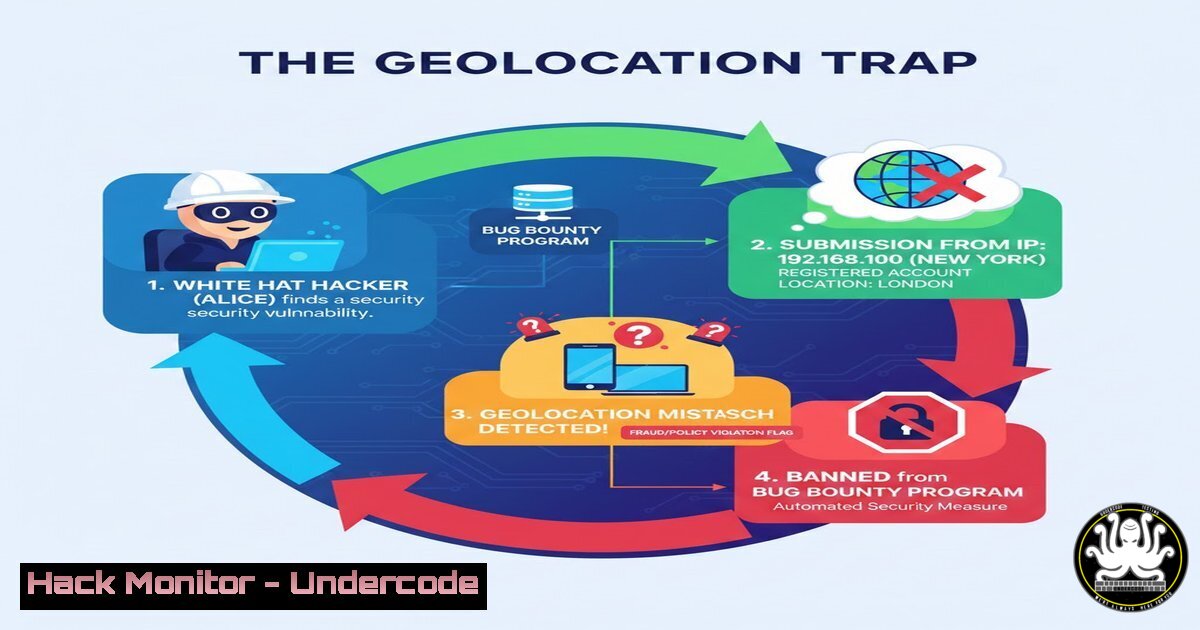
Introduction:
A cybersecurity researcher’s abrupt ban from a bug bounty program highlights critical, often overlooked tensions in ethical hacking. The dismissal, citing anomalous geolocation data and high report volume, exposes the fragile trust between security platforms and independent researchers. This incident serves as a stark case study in the technical and procedural pitfalls that can derail legitimate security work.
Learning Objectives:
- Understand how IP geolocation works and why it can be inaccurate for security verification.
- Learn best practices for ethical hackers to document and protect their activities within bug bounty programs.
- Identify strategies to maintain professional credibility and manage disputes with security platforms.
You Should Know:
1. The Myth of Precise IP Geolocation
The core accusation against the researcher was a location mismatch: his IP address reportedly resolved to Delhi while he claimed to live elsewhere. This is a common point of confusion. IP geolocation is not a GPS signal; it’s an estimation based on commercial databases that map IP address blocks to geographic regions. Internet Service Providers (ISPs) often assign dynamic IPs from a large pool, and the geographic data for these pools can be outdated, broad, or simply incorrect. Furthermore, traffic routing through major internet hubs (like Delhi or Mumbai in India) can make a user’s IP appear to originate from those cities.
Step-by-Step Guide: Investigating Your Own Digital Location
To audit and understand your own IP footprint, you can use command-line and online tools.
Check Your Public IP & Basic Geolocation:
 Linux/macOS
curl ifconfig.me
 Then, use the IP with a service like:
curl ipinfo.io/<YOUR_IP> | jq  'jq' prettifies the JSON output
 Windows PowerShell
(Invoke-WebRequest -Uri "https://ifconfig.me/ip").Content
 For geolocation (requires external module or parsing):
Invoke-RestMethod -Uri "https://ipinfo.io/" | ConvertTo-Json
Analyze Traceroute to See Pathing: A `traceroute` to the target’s domain can show if your traffic is being routed through unexpected cities or networks.
traceroute target-company.com
 Windows Command Prompt
tracert target-company.com
Interpretation: The `ipinfo.io` output provides fields like "city", "region", and `”org”` (your ISP). Compare this with your real location. Consistent, major discrepancies are worth documenting proactively if you are a security researcher.
2. Operational Security (OpSec) for Ethical Hackers
The researcher’s situation underscores the need for meticulous OpSec. Platforms may flag behavior that appears suspicious, such as accessing an account from frequently changing IPs (a common practice for researchers using VPNs or testing from different networks) without context.
Step-by-Step Guide: Documenting Your Research Session
Create an immutable log of your testing activities, timestamps, and network context.
Start a Session Log: Begin a dated log file for each target/program.
echo "=== Testing Session $(date) ===" >> session_log_20250110.txt
echo "Target: example.com Bug Bounty Program" >> session_log_20250110.txt
Record Network Context: Log your public IP and geolocation at the session’s start.
echo "Initial IP & Location:" >> session_log_20250110.txt
curl -s ipinfo.io | jq '.ip, .city, .org' >> session_log_20250110.txt
Log Commands and Tools: Record the commands you run (using `script` command or manual notes) and tools used. This can serve as evidence of your legitimate, non-malicious methodology.
 Start recording terminal session
script -f research_session.typescript
 ... perform your tests ...
 Type 'exit' to stop recording. The .typescript file contains all input/output.
3. Navigating Bug Bounty Program Rules and Limits
The second cited reason was submitting “too many” reports (around 20). While programs rarely advertise hard limits, submitting a high volume of low-quality or duplicate reports can trigger anti-spam mechanisms or manual review.
Step-by-Step Guide: Strategic Report Submission
- Scrutinize Program Scope & Rules: Before testing, meticulously read the program’s policy. Note any excluded asset types (e.g., third-party services), restricted testing techniques (e.g., DDoS, social engineering), and reporting guidelines.
- Prioritize and Consolidate Findings: Avoid submitting 20 separate low-severity issues like non-exploitable informational flaws. Instead, group related findings (e.g., multiple instances of the same vulnerability across endpoints) into a single, comprehensive report with a clear proof-of-concept.
- Pre-Submission Triage: Use a personal severity rubric. Ask: Is this vulnerability exploitable? What is the realistic impact? Is it within scope? This filters out “noise” and ensures your submissions are high-signal.
4. Securing Your Researcher Account and Assets
The total loss of access to reports, payment records, and communication channels is a devastating data loss for a freelancer.
Step-by-Step Guide: Automating Backup for Bug Bounty Platforms
Implement a system to archive your critical data from these platforms.
Browser Extension for Manual Backup: Use single-page archiver extensions.
Automated Script with Browser Automation (Advanced): For critical platforms, you can write a Python script using `selenium` to log in and scrape your submission dashboard. WARNING: Only do this if it does NOT violate the platform’s Terms of Service. Always check first.
 Example Python/Selenium skeleton for authorized personal data export.
 This is for conceptual illustration only.
from selenium import webdriver
import time

driver = webdriver.Chrome()
driver.get("https://bugbounty-platform.com/login")
 ... your login code (consider using environment variables for credentials) ...
 Navigate to "My Reports"
 Parse and save report titles, IDs, statuses, dates to a local file (e.g., CSV, JSON).
 This preserves a timestamped index of your work.
driver.quit()
5. The Escalation Path: When Communication Breaks Down
The researcher’s attempts to contact the program failed. Having a clear, professional escalation path is crucial.
Step-by-Step Guide: Structured Dispute Resolution
- Gather Evidence First: Compile all relevant data before escalating. This includes your session logs, IP geolocation proofs, clear copies of your reports, and all prior correspondence.
- Craft a Formal, Unemotional Appeal: Write a concise email or use a contact form. State facts: your account ID, the date of ban, the reasons given. Calmly present your counter-evidence (e.g., “My ISP commonly routes traffic through Delhi; here are three other geolocation services showing my correct region”).
- Escalate Within the Organization: If the standard channel fails, look for contacts in the company’s security, engineering, or legal departments on LinkedIn or company websites. A polite, evidence-based message to a human, rather than a support ticket, can sometimes break the logjam.
What Undercode Say:
- Key Takeaway 1: Technical data, especially IP geolocation, is an imperfect metric for trust and should never be the sole basis for banning a user without deeper investigation. Security platforms must employ more sophisticated fraud detection that blends technical signals with behavioral analysis of the researcher’s work quality.
- Key Takeaway 2: Ethical hackers must treat bug bounty platforms as potentially adversarial environments concerning their own access and data. Meticulous, automated personal record-keeping is not just good practice; it is essential risk management for a freelance security professional.
This incident reveals a systemic immaturity in how some platforms manage their most vital external asset: security researchers. Automated triggers (like geolocation flags or report volume) acting without human-in-the-loop review create false positives that damage trust and drain valuable talent from the ecosystem. For researchers, it underscores that their “business continuity” relies on personal data hygiene. The platforms that will succeed in attracting top-tier talent are those that build transparent, communicative, and fair review and appeal processes, recognizing that the relationship is a professional partnership, not just a transactional vulnerability pipeline.
Prediction:
This public dispute will accelerate two trends. First, it will push independent researchers towards forming more formal collectives or using intermediary platforms that offer standardized contracts, payment protection, and advocacy in disputes, reducing individual risk. Second, forward-thinking bug bounty programs will begin to adopt and transparently publish clearer “researcher rights” guidelines, standardize communication protocols, and implement secure, API-driven portals that allow researchers to export their own data. Incidents like this serve as a catalyst for the professionalization and formalization of the entire crowdsourced security industry.
▶️ Related Video (70% Match):
🎯Let’s Practice For Free:
IT/Security Reporter URL:
Reported By: Subrati Swaroop – Hackers Feeds
Extra Hub: Undercode MoN
Basic Verification: Pass ✅


