Listen to this Post
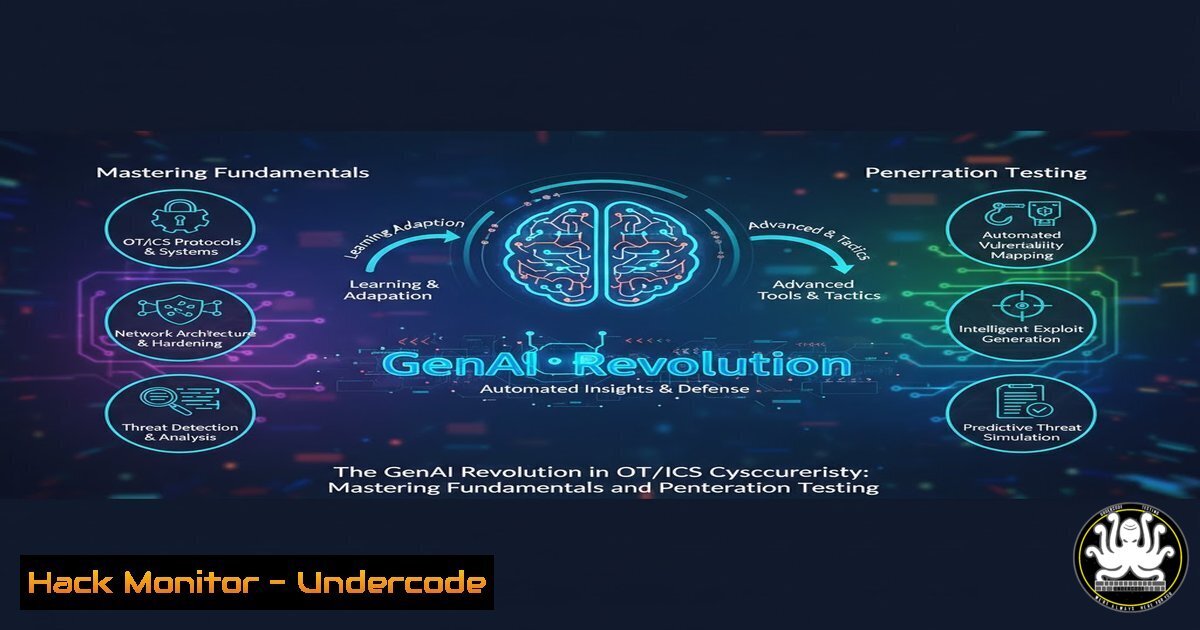
Introduction:
The convergence of Operational Technology (OT) and Industrial Control Systems (ICS) with generative AI is reshaping the cybersecurity landscape. As critical infrastructure becomes increasingly connected, the need to master both foundational security principles and advanced offensive techniques has never been more urgent. This article provides a technical deep dive into the tools and methodologies essential for securing these vital environments.
Learning Objectives:
- Understand core OT/ICS protocols and their inherent security vulnerabilities.
- Master fundamental network reconnaissance and enumeration techniques for industrial environments.
- Learn to execute and defend against common OT/ICS penetration testing exploits.
You Should Know:
1. OT/ICS Network Protocol Interception with Wireshark
`wireshark -i eth0 -k -f “tcp port 502” -Y “modbus” -w modbus_capture.pcap`
This command initiates a Wireshark capture on interface eth0, filtering specifically for Modbus TCP traffic (port 502) and saving the output to a file. Modbus is a common, often unauthenticated, protocol in ICS environments. To use it, install Wireshark, run the command from a terminal, and analyze the captured packets to map network devices, understand process logic, and identify cleartext communications.
2. Enumerating PLCs with Nmap Scripts
`nmap -sV –script modbus-discover -p 502 192.168.1.0/24`
Nmap is a powerful network discovery tool. This command performs a service version scan (-sV) on the 502/tcp port across a subnet, executing the `modbus-discover` NSE script. This script identifies Programmable Logic Controllers (PLCs) and can often pull device identification and system information, providing a critical inventory for both defenders and attackers.
3. Querying Modbus Device Information
`mbclient -m RTU -a 1 -b 9600 /dev/ttyUSB0`
Using the `mbclient` tool from the `libmodbus` utilities, this command connects to a Modbus RTU device (common in serial-based OT networks) at address 1 via a serial USB adapter. The baud rate is set to 9600. From this interactive client, you can issue function codes like `Read Holding Registers (0x03)` to read device memory and `Read Device Identification (0x2B/0x0E)` to get detailed vendor and firmware data.
4. S7Comm PLC Communication and Enumeration
`python3 s7-info.py -p 192.168.250.100`
This command runs a custom Python script targeting a Siemens S7-300/400 PLC. The S7Comm protocol is proprietary to Siemens. The script establishes a connection to the PLC (typically on TCP/102) and extracts system information, module details, and CPU status. Understanding this protocol is key to assessing the security of Siemens-dominated environments.
5. Identifying ICS-Specific Services with Nmap
`nmap -sC -sV -p 102,502,20000,44818,47808,1911,9600 10.10.10.100`
This comprehensive Nmap scan checks for a range of common OT/ICS protocols. Ports correspond to Siemens S7Comm (102), Modbus (502), Emerson DeltaV (20000), EtherNet/IP (44818), BACnet (47808), Fox (1911), and Omron FINS (9600). The `-sC` and `-sV` flags run default scripts and probe service versions, respectively, building a detailed profile of the industrial target.
6. Exploiting Modbus for Coil Manipulation
`modbus write –unit 1 192.168.1.10 0 1`
This command, using a tool like `mbpoll` or modbus-cli, writes a value of `1` (ON) to coil address `0` on a Modbus device at `192.168.1.10` with unit ID 1. Coils often control physical outputs like relays, motors, or valves. An attacker with network access can use this to directly manipulate industrial processes, demonstrating the critical risk of unprotected control commands.
7. Hardening ICS Networks with Firewall Rules
`iptables -A INPUT -s 192.168.1.0/24 -p tcp –dport 502 -j ACCEPT && iptables -A INPUT -p tcp –dport 502 -j DROP`
This Linux `iptables` command sequence creates a basic firewall rule. The first line allows Modbus TCP traffic only from the trusted OT network subnet (192.168.1.0/24). The second line drops all other incoming traffic on port 502. This is a fundamental step in implementing network segmentation, restricting control protocol access to authorized engineering workstations.
8. Detecting Anomalous ICS Traffic with Snort
`alert tcp any any -> any 502 (msg:”Modbus Exception Response”; content:”|81|”; depth:1; sid:1000001;)`
This is a rule for the Snort Intrusion Detection System. It generates an alert if it detects a Modbus TCP packet where the function code has its high bit set (hex 0x81), indicating an exception response. A surge in these alerts could signify an attacker fuzzing the PLC or sending malformed commands, triggering process faults.
9. Assessing OPC UA Server Security
`ua-console browse opc.tcp://192.168.1.50:4840`
OPC UA is the modern, service-oriented architecture for industrial data exchange. This command, using the `opcua-commander` or a similar tool, connects to an OPC UA server endpoint and browses its address space—a hierarchy of all available data nodes. Assessing the authentication and encryption configuration of this endpoint is critical, as it often exposes sensitive process data.
10. Generating AI-Powered Threat Intelligence Feeds
`python3 gen_ai_ioc.py –sector energy –protocol modbus –output ioc_list.json`
This conceptual command illustrates the use of GenAI, as mentioned in the source material. A custom script could leverage a large language model (LLM) to analyze public reports, vulnerability databases, and network traffic patterns to generate a JSON file of Indicators of Compromise (IoCs) tailored to the energy sector and the Modbus protocol, accelerating threat hunting.
What Undercode Say:
- AI is a Dual-Edged Sword in the Control Room. GenAI can rapidly generate hardening guides, analyze complex protocol captures, and create realistic training scenarios. However, it can also lower the barrier to entry for attackers, enabling them to craft sophisticated attacks against fragile OT systems with minimal prior knowledge.
- Fundamentals Trump Everything. The most advanced AI tool is useless without a deep understanding of the underlying OT protocols, physical processes, and safety implications. A mistyped Modbus command suggested by an AI could cause a shutdown or damage equipment. Human expertise remains the final and most critical control.
The integration of GenAI into OT/ICS security is inevitable. Its primary value lies in accelerating the analysis of vast datasets and automating routine tasks, freeing up human experts for complex decision-making. However, the industry must proceed with caution. Over-reliance on AI-generated code or command sequences without rigorous validation in a non-production environment introduces significant safety risks. The future will see AI-powered defensive systems that can predict and mitigate attacks in real-time, but this will be matched by AI-augmented offensive capabilities, creating a new, faster-paced battleground for critical infrastructure.
Prediction:
The proliferation of GenAI will lead to a surge in automated, targeted reconnaissance and exploit generation against OT/ICS systems within the next 18-24 months. Defenders will increasingly rely on AI-assisted Security Orchestration, Automation, and Response (SOAR) platforms to respond at machine speed. This will fundamentally shift the ICS security paradigm from periodic penetration testing to continuous, AI-driven resilience validation, making deep technical knowledge of both legacy systems and modern AI tools non-negotiable for cybersecurity professionals.
🎯Let’s Practice For Free:
IT/Security Reporter URL:
Reported By: Mikeholcomb Im – Hackers Feeds
Extra Hub: Undercode MoN
Basic Verification: Pass ✅


