Listen to this Post
Introduction:
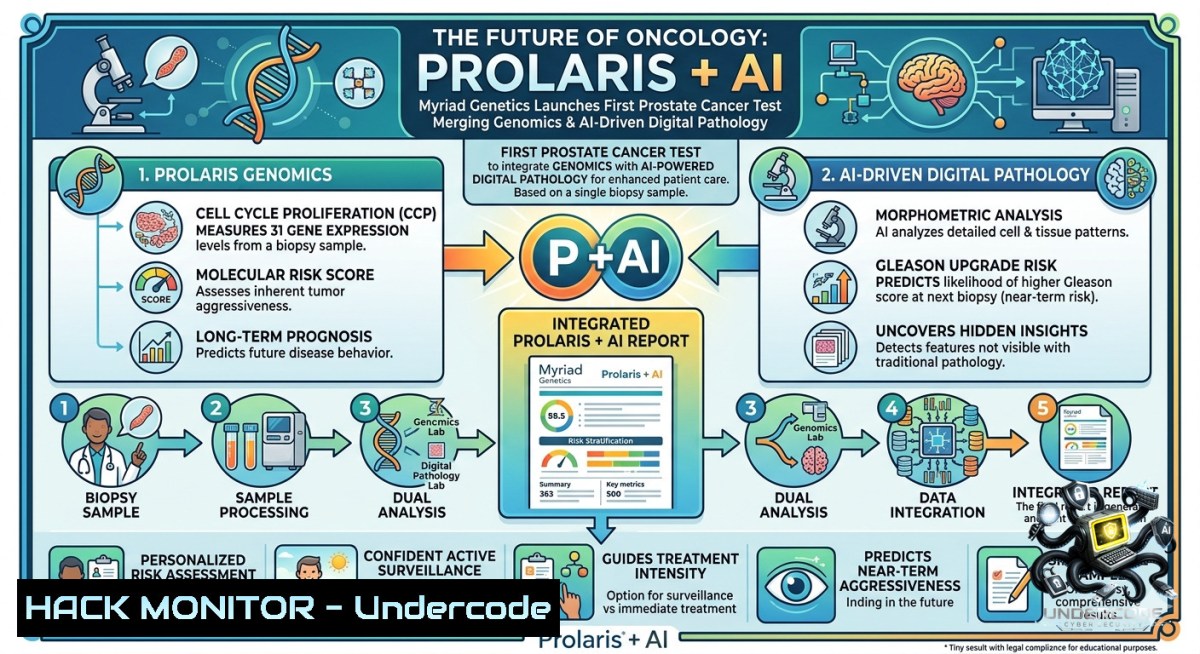
Artificial intelligence (AI) and genomics are converging to create revolutionary diagnostic tools. According to the provided LinkedIn post, Myriad Genetics has officially launched “Prolaris® + AI,” a biomarker test for prostate cancer that uniquely integrates clinical-genomic data with AI-powered digital pathology to refine patient risk stratification. This advanced approach aims to provide more precise prognoses, aiding clinicians in personalizing treatment plans and determining the suitability of active surveillance.
Learning Objectives:
- Understand the architectural components and data pipeline of a multi-modal AI diagnostic system.
- Learn how to navigate the challenges of integrating genomic sequencing data with high-resolution digital pathology images.
- Identify critical security and compliance protocols for deploying AI models in a healthcare environment.
You Should Know:
- Understanding the Multi-Modal AI Pipeline: Architecture & Data Flow
The Prolaris + AI test combines three distinct data layers: clinical parameters (PSA, Gleason score), molecular biology (RNA expression of cell-cycle progression genes), and digital pathology (AI-interpreted histopathology from biopsy slides). To replicate or understand such a pipeline, one must consider how data moves from source to analysis.
Step‑by‑step guide explaining what this does and how to use it:
– Step 1: Data Ingestion and Preprocessing: Genomics data (e.g., FASTQ files) requires alignment and quantification, while digital pathology images (e.g., SVS or TIFF whole-slide images) require normalization and tiling.
– Step 2: Feature Extraction: The genomics pipeline generates a risk score (e.g., Prolaris Cell-Cycle Progression score). Meanwhile, a vision transformer (ViT) processes pathology tiles to extract morphological features.
– Step 3: Multi-Modal Fusion: A fusion layer concatenates these distinct feature vectors into a unified representation for the downstream classifier.
– Step 4: Inference: The final model predicts outcomes such as biochemical recurrence or the likelihood of Gleason score upgrading on subsequent biopsy.
For a simulated genomics analysis on Linux, one might use:
 Install STAR aligner for RNA-seq
sudo apt-get install star
 Align reads to reference genome
STAR --genomeDir /path/to/hg38_index --readFilesIn sample_R1.fastq sample_R2.fastq --runThreadN 8

Use featureCounts for gene expression quantification
featureCounts -a annotation.gtf -o counts.txt aligned.bam
For a simulated color normalization of histopathology images using Python (Windows/Linux):
import cv2
import numpy as np
 Load a source image and a target template for Macenko normalization
source = cv2.imread('source_image.tiff')
target = cv2.imread('reference_stain.tiff')
 (Full Macenko normalization algorithm would be implemented here)
 Save normalized image for AI inference
cv2.imwrite('normalized_image.tiff', normalized_source)
- Navigating Digital Pathology Color Calibration and AI Model Reliability
A critical technical hurdle in digital pathology is the variability introduced by different slide scanners, which can bias AI models. Physical color calibration is emerging as a solution to standardize images, making AI-based cancer diagnostics more reliable across diverse clinical settings.
Step‑by‑step guide explaining what this does and how to use it:
– Step 1: Identify Scanner Variability: Before deploying a model, audit your source image data. If images come from multiple facilities with various scanners (e.g., Leica, Hamamatsu, 3DHISTECH), color inconsistencies will be present.
– Step 2: Calibrate to a Reference: Using a calibration slide (e.g., a standard reference slide like PathQA’s physical target), capture images and compute a transformation matrix to map each scanner’s color space to a common standard.
– Step 3: Benchmark Model Performance: Run inference on both uncalibrated and calibrated images. You should see a significant improvement in model calibration and diagnostic agreement, particularly in tasks like Gleason grading.
For automated calibration in a Python-based pipeline:
 Pseudocode for applying color calibration
def apply_macenko_normalization(source_img, target_img):
 Convert to optical density space
 Estimate stain matrix using singular value decomposition (SVD)
 Normalize stain concentrations
return normalized_img

normalized_ws = apply_macenko_normalization(original_ws, reference_stain)
- Securing the Genomic and Imaging Data Pipeline with Cloud Compliance
The convergence of genomics and medical imaging creates a massive data gravity problem with stringent compliance requirements (HIPAA, GDPR). Cloud environments like AWS or Google Cloud offer HIPAA-eligible services backed by Business Associate Agreements (BAAs), but security must be built into the pipeline.
Step‑by‑step guide explaining what this does and how to use it:
– Step 1: Implement End-to-End Encryption: Ensure data is encrypted at rest (using AES-256) and in transit (using TLS 1.3). For compute-in-memory scenarios, consider using confidential computing with secure enclaves (e.g., AWS Nitro Enclaves, Intel SGX) to protect data while being processed.
– Step 2: Enforce Data Governance with Access Controls: Use cloud-1ative IAM policies to enforce strict role-based access control (RBAC). Additionally, implement data lineage and geofencing to ensure data does not cross predefined geographical boundaries.
– Step 3: Audit and Harden: For a server running a DICOM (Digital Imaging and Communications in Medicine) receptor or genomics processing engine, harden the operating system by closing unnecessary ports and applying CIS benchmarks.
For auditing active network connections on your analysis server (Windows PowerShell as Admin):
 List all active TCP connections and associated processes
netstat -ano | findstr :443
 To see the process name for a PID, use:
Get-Process -Id (PID_NUMBER)
For Linux, to audit network services and firewall status:
 List all listening ports and the services behind them
sudo ss -tulnp
 Check current iptables rules for data egress filtering
sudo iptables -L -v -1
- Privacy Preservation and Model Security: Defending Against Inference Attacks
Genomic data is not de-identifiable; even anonymized sequences can be re-identified when cross-referenced with other datasets. Furthermore, trained AI models that predict cancer risk are susceptible to membership inference attacks, where an adversary can determine if a specific person’s data was used in the training set.
Step‑by‑step guide explaining what this does and how to use it:
– Step 1: Apply Differential Privacy (DP): Implement DP during the training phase. By adding calibrated noise to gradients or model parameters, you can guarantee mathematical bounds on privacy loss, preventing inference attacks.
– Step 2: Utilize Synthetic Data: Generate synthetic genomic-pathology datasets that retain the statistical properties of the real data for development and testing, without exposing protected health information.
– Step 3: Monitor for Model Inversion: Implement runtime monitoring for your deployed API. Anomalously high-frequency queries or queries that seek to exploit model confidence scores could be signs of a model inversion attack.
What Undercode Say:
- The multi-modal integration of genomics and digital pathology represents a significant leap forward, but the complexity of its technical debt and security surface area cannot be overstated.
- As AI-driven diagnostics become the standard, the reliability of the model is only as good as the standardization of its input data.
Expected Output:
Introduction:
The convergence of AI and genomics is transforming how we diagnose and treat complex diseases. As highlighted in the LinkedIn post, Myriad Genetics’ launch of Prolaris® + AI is a prime example, combining clinical parameters, independent molecular scores, and AI-interpreted digital pathology. While this offers improved patient risk assessment, it also introduces a new set of cybersecurity, privacy, and data engineering challenges that security professionals must address.
What Undercode Say:
- The security of multi-modal medical AI pipelines is an emerging field. Defending the data is no longer just about the database; it is about securing the entire ML lifecycle—from the source of the pathology slide to the inference endpoint.
- Organizations must adopt a “Privacy by Design” approach. The de-identification of genomic data is insufficient, and enterprises must invest in differential privacy and homomorphic encryption to future-proof their platforms.
Prediction:
- +1 Proliferation of Secure Multi-Modal Platforms: The success of tests like Prolaris + AI will drive a gold rush in integrated diagnostics, leading to a surge in demand for cloud security architects who specialize in HIPAA-compliant, multi-tenant ML platforms.
- -1 Increased Risk of Data Exfiltration: As digital pathology images contain rich, re-identifiable facial morphology and genomic data is permanent, healthcare AI will become a prime target for advanced persistent threats (APTs) seeking to extract high-value biological data for ransom or espionage.
- +1 Standardization of AI Validation: Regulatory pressure (e.g., from the FDA) will likely mandate rigorous physical and digital calibration standards for digital pathology, forcing a maturation of model validation tooling and reducing diagnostic variability.
- -1 Liability Shift to AI Vendors: If a model fails due to a poisoned training dataset or a misconfiguration in the secure enclave leading to a data leak, liability will rapidly shift from the healthcare provider to the AI technology vendor, sparking a new wave of cyber-insurance litigation.
▶️ Related Video (60% Match):
🎯Let’s Practice For Free:
🎓 Live Courses & Certifications:
Join Undercode Academy for Verified Certifications
🚀 Request a Custom Project:
Secure, high-velocity infrastructure and disruptive technological engineering. Contact our engineering team for high-tier development and proprietary systems:
[email protected]
💎 Smart Architecture | 🛡️ Secure by Design | ⭐ Trusted by Thousands
IT/Security Reporter URL:
Reported By: Larvol Cancerresearch – Hackers Feeds
Extra Hub: Undercode MoN
Basic Verification: Pass ✅


