Listen to this Post
Introduction:
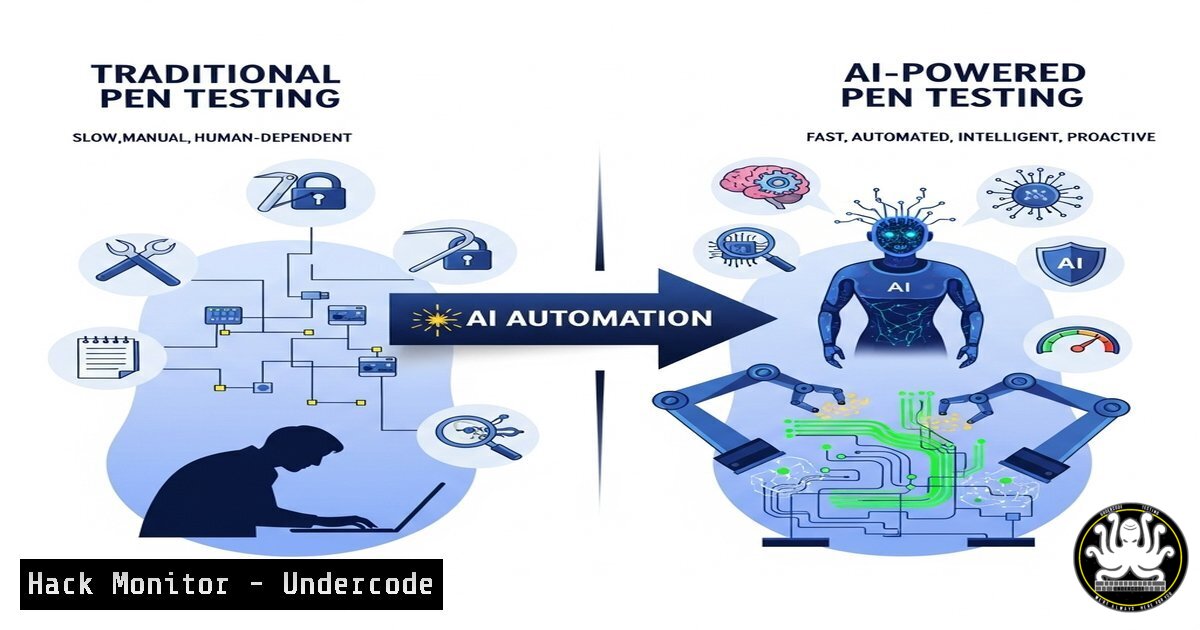
The landscape of ethical hacking is undergoing a seismic shift, moving beyond manual, time-consuming processes to a new era of AI-driven automation. This evolution is not about replacing human expertise but augmenting it, creating a powerful synergy that enables faster, deeper, and continuous security testing to protect modern digital infrastructures.
Learning Objectives:
- Understand the core pillars of automation in modern penetration testing.
- Learn practical commands and techniques for automated reconnaissance, scanning, and analysis.
- Gain insight into the future of human-AI collaboration in cybersecurity.
You Should Know:
1. Automated Network Reconnaissance with Nmap
Nmap is the quintessential tool for automated network discovery and security auditing. It efficiently replaces manual ping sweeps and port checks.
nmap -sn 192.168.1.0/24
nmap -sC -sV -O -A <target_ip>
nmap --script vuln <target_ip>
nmap -p- --min-rate 1000 <target_ip>
Step-by-step guide:
The first command performs a ping sweep to discover live hosts on the network. The second command is a comprehensive scan, running default scripts (-sC), detecting service versions (-sV), and attempting OS detection (-O). The `–script vuln` flag checks for known vulnerabilities, while `-p- –min-rate 1000` quickly scans all 65,535 ports. Automating these commands in a bash script allows for continuous network monitoring.
2. Automated Vulnerability Scanning with Nikto
Nikto automates the tedious process of web server vulnerability assessment, checking for over 6700 potentially dangerous files and programs.
nikto -h https://www.target.com
nikto -h https://www.target.com -C all -Tuning 9
nikto -h @targets.txt -Format csv -o scan_results.csv
Step-by-step guide:
The basic command (-h) scans the target host. The `-C all` option displays all cookies found, and `-Tuning 9` enables all tuning tests for maximum coverage. For large-scale operations, you can provide a list of targets in a text file (@targets.txt) and output the results to a CSV for automated reporting and analysis.
3. Automating API Security Testing with OWASP Amass
Amass performs automated network mapping and external asset discovery, crucial for uncovering a target’s attack surface, including APIs.
amass enum -passive -d target.com
amass enum -active -brute -d target.com -src
amass db -names -dir /path/to/project
Step-by-step guide:
The `enum -passive` command collects information without directly interacting with the target. The `-active` flag engages with the target for deeper discovery, and `-brute` attempts subdomain brute-forcing. The `db -names` command then lists all discovered subdomains and APIs from the project database, which can be piped into other tools for automated testing.
4. Automated Exploitation with Metasploit Framework
The Metasploit Framework allows for the automation of exploitation and post-exploitation tasks, scaling testing across numerous systems.
msfconsole -x "use auxiliary/scanner/http/http_version; set RHOSTS file:/tmp/targets.txt; set THREADS 50; run; exit"
msfconsole -q -x "search type:exploit platform:linux; use exploit/linux/http/apache_mod_cgi_bash_env_exec; set RHOSTS 10.0.0.1; run"
Step-by-step guide:
These commands launch Metasploit non-interactively. The first example automates service version scanning across a list of targets (file:/tmp/targets.txt) with 50 concurrent threads. The second command automatically searches for Linux exploits and executes a specific one. This can be integrated into CI/CD pipelines for automated regression testing.
5. Cloud Infrastructure Hardening with AWS CLI
Automating security checks in cloud environments is essential. The AWS CLI can be used to audit and harden configurations at scale.
aws iam generate-credential-report
aws iam get-credential-report --query 'Content' --output text | base64 -d > report.csv
aws securityhub get-findings --filters '{"ProductName": [{"Value": "Security Hub","Comparison": "EQUALS"}]}' --max-items 100
Step-by-step guide:
The first command generates a credential report detailing all users and their access keys. The second command decodes and saves this report for automated parsing. The third command fetches the latest findings from AWS Security Hub. Scripting these commands enables continuous compliance monitoring and automatic remediation alerts.
- Automated Log Analysis and Threat Hunting with Grep & AWK
Automating the parsing of system logs is key to 24/7 threat detection, turning manual review into real-time alerting.grep -i "failed" /var/log/auth.log | awk '{print $9}' | sort | uniq -c | sort -nr tail -f /var/log/apache2/access.log | grep --line-buffered "5[0-9][0-9]" | awk '{print $1, $9}'
Step-by-step guide:
The first command parses authentication logs for failed login attempts, extracts usernames ($9), and counts unique occurrences, instantly highlighting brute-force targets. The second command tails the web server log in real-time, buffering each line to immediately output the source IP and status code for any server errors (5xx), enabling instant detection of application attacks or scans.
7. Automating Web Application Testing with Nuclei
Nuclei uses community-powered templates to automate the detection of thousands of known vulnerabilities across web applications and infrastructure.
nuclei -u https://target.com -t cves/ -severity critical,high -o results.txt
nuclei -l targets.txt -t exposures/ -silent | notify -bulk
nuclei -update-templates
Step-by-step guide:
The `-u` flag scans a single URL, while `-l` accepts a list of targets. The `-t cves/` option runs all CVE templates, filtered by severity. The `-silent` flag outputs only findings, which can be piped into a notification tool like `notify` for instant alerts in Slack or Teams. Regularly updating templates (-update-templates) ensures your automated scans are always current.
What Undercode Say:
- Augmentation, Not Replacement: The highest-value vulnerabilities and complex attack chains still require human creativity, intuition, and context. AI excels at scaling the repetitive, allowing experts to focus on the critical.
- The 24/7 SOC is Now a Reality: Continuous automated testing closes the window of exposure dramatically, moving security from a periodic audit to an always-on state of vigilance.
The analysis from Ethiack’s CTO underscores a fundamental change: the pentester’s role is evolving from manual executor to strategic orchestrator of automated systems. The human expert defines the scope, curates the findings, and performs the sophisticated exploitation that machines cannot. This collaboration doesn’t diminish the hacker’s role; it elevates it, allowing them to secure more of the digital world with unprecedented speed and precision. The future belongs to ethical hackers who can effectively partner with AI.
Prediction:
The convergence of AI and human expertise will lead to the emergence of Autonomous Penetration Testing as a Service (APTaaS), where self-learning systems continuously probe, adapt, and exploit vulnerabilities in real-time. These systems will not only report findings but also autonomously implement temporary mitigations while awaiting human verification. This will drastically reduce the mean time to remediation (MTTR) from days to minutes, fundamentally altering the cybersecurity defense paradigm and forcing a similar evolution in offensive security tactics.
🎯Let’s Practice For Free:
IT/Security Reporter URL:
Reported By: 0xacb Ethical – Hackers Feeds
Extra Hub: Undercode MoN
Basic Verification: Pass ✅


