Listen to this Post
Introduction:
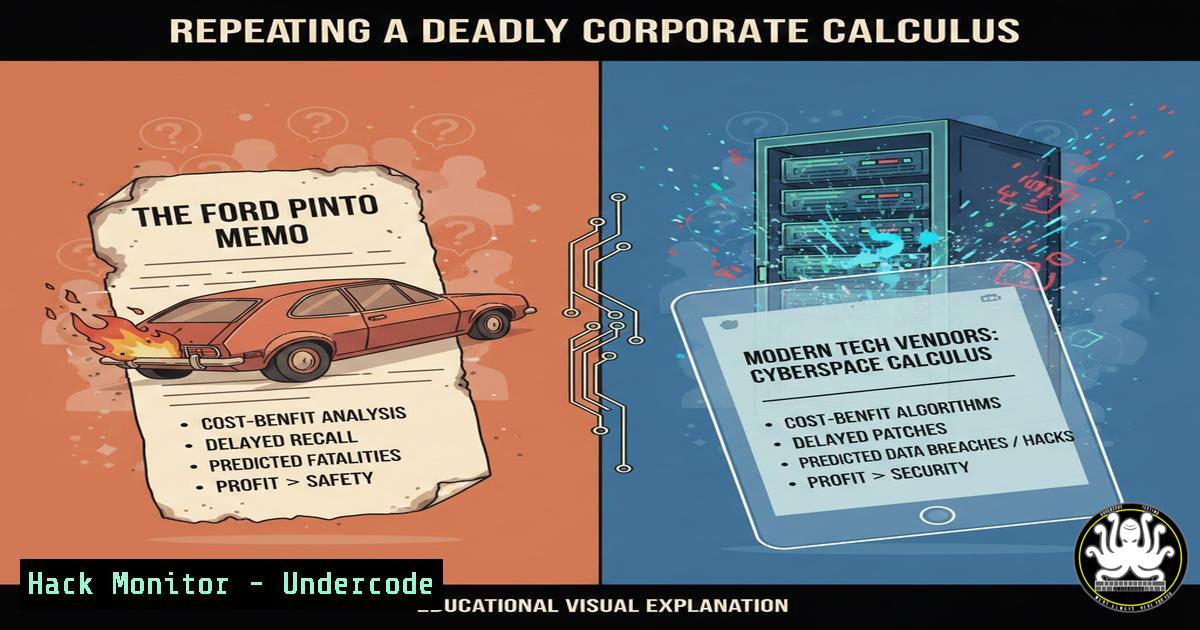
The infamous Ford Pinto memo, where cost-benefit analysis deemed it cheaper to settle lawsuits for burn-related deaths than to fix a fatal fuel tank flaw, is not a relic of the past. It is a living blueprint in the boardrooms of countless technology providers today. In the digital era, the calculus has shifted from physical safety to cybersecurity, where known vulnerabilities in software, cloud platforms, and third-party services are often tacitly accepted as “operational risk.” This article deconstructs how this profit-over-security model creates enforced, unmitigatable risks for customers and outlines the technical controls organizations can implement to defend against inherently insecure ecosystems.
Learning Objectives:
- Understand the “Pinto Memo” paradigm as applied to modern SaaS, IaaS, and software supply chain security.
- Identify technical strategies to discover, assess, and isolate risks from negligent or insecure third-party providers.
- Implement proactive hardening, monitoring, and containment measures to protect critical assets despite vendor-level vulnerabilities.
You Should Know:
- The Anatomy of an “Enforced Vulnerability”: API Gateways Left Unsecured
An enforced vulnerability is a weakness in a third-party system that you, as the customer, cannot patch or directly remediate. A prime example is a vendor’s API endpoint lacking rate limiting, authentication, or input validation.
Step‑by‑step guide explaining what this does and how to use it.
1. Discovery with `curl` and `nmap`:
First, map the vendor’s exposed API surface. Use tools like `nmap` to discover endpoints and `curl` to probe for basic misconfigurations.
 Example: Scanning for open ports on a vendor's API host
nmap -sV --script http-methods,http-security-headers -p 443,8080 api.vendor-example.com
 Example: Testing for missing authentication on an endpoint
curl -v -X GET https://api.vendor-example.com/v1/userdata
curl -v -X POST https://api.vendor-example.com/v1/userdata -d '{"test":"payload"}'
2. Assess for Common OWASP API Top 10 Flaws: Systematically test identified endpoints for broken object level authorization (BOLA), excessive data exposure, and injection. Use a tool like `kiterunner` to brute-force API routes and verbs that the vendor may have exposed unintentionally.
3. Document and Escalate: Create a formal vulnerability report for your vendor. If the flaw is a known CVE (e.g., in an open-source component they use), reference it. Your leverage is the contractual SLA and shared responsibility model.
- Containment Through Zero Trust: Segmenting the Insecure Provider
When you cannot trust a provider’s security posture, you must prevent a breach in their system from becoming a breach in yours. This is achieved through robust network segmentation and Zero Trust principles.
Step‑by‑step guide explaining what this does and how to use it.
1. Micro-Segmentation Policy Design: Treat the vendor’s IP ranges and required services as hostile. In your firewall (e.g., `iptables` on Linux, Windows Firewall with Advanced Security, or cloud-native firewalls), create rules that allow only specific, necessary traffic and deny all else.
 Example Linux iptables rule allowing ONLY HTTPS to a specific vendor IP, from a specific application server IP.
iptables -A OUTPUT -d <VENDOR_IP> -s <YOUR_APP_SERVER_IP> -p tcp --dport 443 -j ACCEPT
iptables -A OUTPUT -d <VENDOR_IP> -j DROP
2. Implement Application-Level Proxies: Use a reverse proxy (e.g., NGINX, HAProxy) or an API Gateway as a man-in-the-middle for all outbound vendor traffic. This allows for mandatory authentication injection, request shaping, and logging.
 Example NGINX snippet to proxy and add an API key header before forwarding to vendor
location /vendor-api/ {
proxy_pass https://api.vendor-example.com/;
proxy_set_header X-API-Key $internal_api_key_you_control;
}
3. Enforce Identity-Aware Access: Use a solution like OpenZiti or Tailscale to create encrypted, identity-based overlay networks. The vendor’s service would only be accessible through this tunnel, and access can be revoked instantly without relying on the vendor’s security.
3. Proactive Cloud Hardening Against Fragile Infrastructure
When your cloud provider or SaaS platform suffers a cascading failure or insecure default configuration, your resilience depends on your own hardening.
Step‑by‑step guide explaining what this does and how to use it.
1. Automate Security Benchmark Compliance: Use infrastructure-as-code (Terraform, CloudFormation) templates that embed security best practices by default. Continuously audit your deployment against the CIS Benchmarks for your cloud provider using tools like `prowler` (AWS), scoutsuite, or gcloud scc.
 Example Prowler run for critical AWS checks
./prowler -g cislevel1 -M json
2. Implement Immutable Logging & Unalterable Audits: Configure mandatory, streamed logs from all vendor integrations to a secure, isolated “audit” account that no production system or user can write to or delete. Use AWS CloudTrail logs streamed to an S3 bucket with Object Lock, or Azure Activity Logs sent to a dedicated Log Analytics workspace.
3. Prepare for Isolation: Design your architecture for a “vendor kill switch.” This means having the ability to redirect traffic, disable integrations, and maintain core functionality (even in a degraded state) if a vendor’s service is compromised or goes down. Use feature flags in your code to toggle integrations on/off without deployment.
- Exploiting the Supply Chain: A Defender’s View of Dependency Poisoning
The modern “Pinto” might be a malicious package (npm,PyPI) or a compromised library shipped by a vendor. You must see the attack surface as an attacker would.
Step‑by‑step guide explaining what this does and how to use it.
1. Software Composition Analysis (SCA): Integrate tools like OWASP Dependency-Check, Trivy, or `Snyk` directly into your CI/CD pipeline. They fail builds on critical CVEs in direct and transitive dependencies.
 Example OWASP Dependency-Check scan
dependency-check.sh --project "MyApp" --scan ./src --format HTML
2. Behavioral Analysis in Sandboxes: For high-risk vendors or dependencies, execute their code in a controlled, instrumented sandbox (e.g., a selinux/apparmor confined container, AWS Lambda isolate) to profile its behavior—network calls, file system access, spawned processes.
 Example using strace to monitor a vendor's binary/script
strace -f -e trace=network,file,process -o vendor_trace.log ./vendor_blackbox_tool
3. Digitally Sign and Verify: Enforce a policy where all internally used software and containers must be signed. Use `cosign` for container signing and `sigstore` for general artifact verification to ensure integrity from build to deployment.
- The Legal & Technical Shield: Enforcing Accountability via Contracts and Code
The final defense is translating security requirements into enforceable technical and contractual obligations.
Step‑by‑step guide explaining what this does and how to use it.
1. Embed Security Requirements in IaC: Define your security expectations as code. Use tools like OPA (Open Policy Agent)/Rego or `Checkov` to write policies that automatically reject Terraform plans which don’t mandate encryption, logging, or proper network controls for vendor resources.
2. Automate Compliance Evidence Collection: Build scripts that periodically gather proof of your vendor’s security posture (e.g., SSL/TLS certificate validity, presence of security headers, open port scans). This data becomes objective evidence for contract reviews and risk assessments.
3. Create a Vendor Security Questionnaire (VSQ) Automation Pipeline: Don’t rely on static PDFs. Use a platform like `SecurityPal` or a custom workflow to dynamically test and validate vendor claims (e.g., “Do you support TLS 1.2+?” can be validated by an automated scan).
What Undercode Say:
The Spreadsheet is the True Vulnerability: The most critical flaw in modern systems is not a line of code, but a cell in a spreadsheet where unpatched CVEs and potential breach costs are weighed against quarterly profit targets. Security teams must learn to argue in this language, quantifying cyber risk in direct financial and operational terms to counter the Pinto calculus.
Your Architecture is Your Treaty: You cannot assume partnership or goodwill. Every integration with a third party must be architected as a treaty with a potentially hostile entity—defining clear borders (segmentation), verifying all traffic (Zero Trust), and having a ready plan for severance (kill switch).
The Ford Pinto memo was a failure of ethics, enabled by a lack of immediate accountability. Today’s digital landscape, with its complex interdependencies, recreates these conditions at scale. The path forward is not hoping for vendor altruism, but architecting for vendor betrayal. By implementing the technical controls of segmentation, immutable monitoring, and supply chain verification, organizations can build systems that remain resilient even when their providers choose the path of the spreadsheet. This shifts the cost-benefit analysis, making negligence more expensive than security—the only language the memo’s authors truly understood.
Prediction:
The coming years will see a dramatic rise in “Gross Negligence” cybersecurity lawsuits and regulatory actions directly modeled on product liability law. As major breaches are increasingly traced to known, unpatched vulnerabilities in third-party services that prioritized feature velocity over security, courts and regulators will begin to treat shipped software with known critical flaws as defective products. This will catalyze a seismic shift: cybersecurity due diligence will become as legally foundational as financial auditing, and the “Pinto Memo” spreadsheet will itself become evidence of liability, forcing a top-down re-prioritization of security engineering over short-term profit.
▶️ Related Video (76% Match):
🎯Let’s Practice For Free:
IT/Security Reporter URL:
Reported By: Andy Jenkinson – Hackers Feeds
Extra Hub: Undercode MoN
Basic Verification: Pass ✅


