Listen to this Post
Introduction
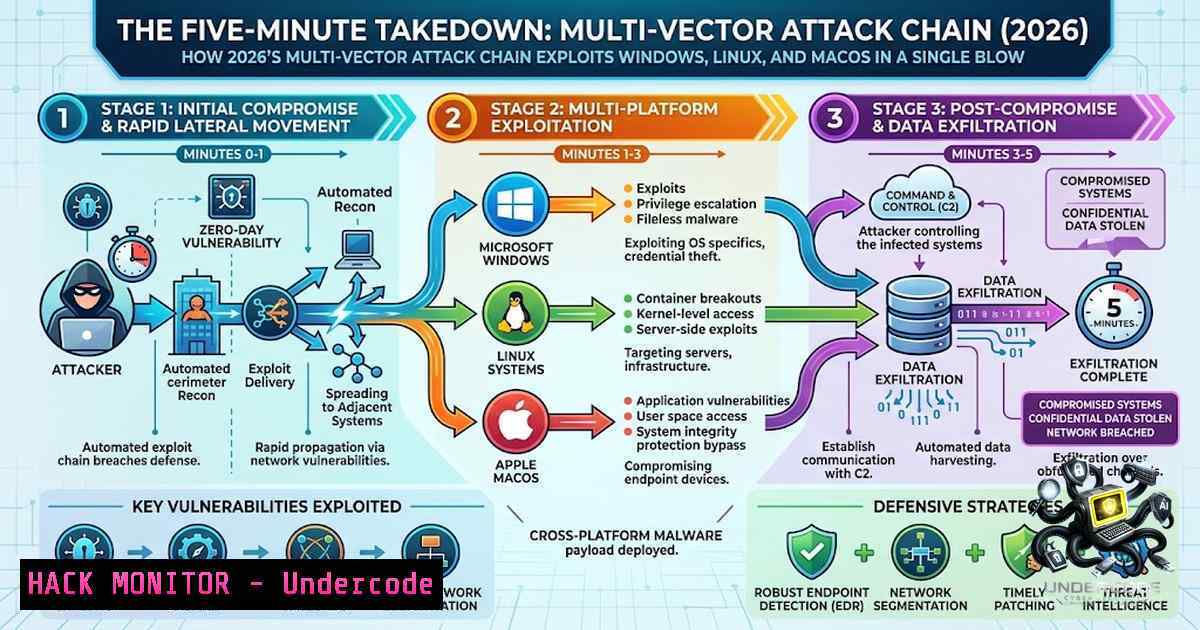
The modern enterprise attack surface is no longer defined by a single operating system or vulnerability class—it is a fractured landscape where a USB device that was never physically plugged in can compromise a fully patched Windows 11 workstation, an AI-discovered 18-year-old Linux kernel flaw can escape containers to root the host, and a zero-click email can steal 90 days of correspondence and 2FA tokens without a single click. This article dissects the full attack chain detailed in recent threat intelligence, providing security professionals with the technical depth, verified commands, and mitigation strategies required to defend against this new generation of multi-platform exploitation.
Learning Objectives
- Understand the technical mechanics behind the “Plug and Pwn” Windows USB emulation attack, the SCTPhantom Linux kernel use-after-free (CVE-2026-64564), and the Zimbra zero-click XSS vulnerability (CVE-2025-66376)
- Master the step-by-step exploitation and mitigation techniques across Windows, Linux, and enterprise email platforms
- Develop actionable defensive strategies including kernel patching, USB redirection controls, and email security hardening
You Should Know
- Plug and Pwn: The USB That Was Never Plugged In
The “Plug and Pwn” attack, presented at DEF CON 34 by researchers Alejandro Hernando and Borja Martínez, abuses Windows Plug and Play’s automatic driver installation to achieve SYSTEM-level code execution on fully updated Windows 11 systems—with no user logged in and no clicks required. The attack takes approximately five minutes from the login screen.
How It Works: When Windows detects new hardware, it automatically identifies the device, locates a matching signed driver package via Windows Update, and executes vendor-supplied installation components with NT AUTHORITY\SYSTEM privileges. The researchers used FaceDancer, an open-source USB emulation framework, to impersonate legitimate USB devices. Their physical proof-of-concept chains two vendor packages:
- Sierra Wireless — a service running as SYSTEM exposes a named pipe that permits broad access, allowing the attacker to change the target system’s DNS server.
- Sony FeliCa — the co-installer retrieves configuration data over unencrypted HTTP. By redirecting the Sony domain to an attacker-controlled server via the DNS change, the attacker provides crafted files that cause an arbitrary file write as SYSTEM.
A DLL placed in Windows System32 is later loaded through the Sierra component, resulting in SYSTEM code execution before logon. The researchers also developed NoPlug and Pwn, a remote variant that works over RDP when USB redirection is enabled, requiring no physical hardware.
Step-by-Step: Detecting and Mitigating Plug and Pwn
Detection (Windows):
 Check for unexpected PnP device installations
Get-WinEvent -LogName "Microsoft-Windows-Kernel-PnP/Configuration" |
Where-Object { $<em>.Id -eq 400 -or $</em>.Id -eq 410 } |
Select-Object TimeCreated, Message

Review driver package downloads
Get-WinEvent -LogName "Microsoft-Windows-WindowsUpdateClient/Operational" |
Where-Object { $<em>.Id -eq 19 -or $</em>.Id -eq 20 }
Mitigation:
- Disable automatic driver installation via Group Policy: `Computer Configuration → Administrative Templates → System → Device Installation → Specify search order for device driver source locations` → Set to “Do not search Windows Update”
- Disable RDP USB redirection where unnecessary: `Set-ItemProperty -Path “HKLM:\SOFTWARE\Policies\Microsoft\Windows NT\Terminal Services” -1ame “fDisableUSB” -Value 1`
3. Restrict driver installation to Administrators only via Group Policy - Monitor for unexpected driver package downloads using Windows Defender ATP or SIEM alerts
-
SCTPhantom: The 18-Year-Old Linux Kernel Bug AI Found First
On August 6, 2026, Tencent Zhuque Lab disclosed CVE-2026-64564 (dubbed “SCTPhantom”), a use-after-free vulnerability in the Linux kernel’s Stream Control Transmission Protocol (SCTP) implementation. The bug had been present in the kernel since approximately 2008 (Linux 2.6.25) and was discovered by Corvus AI, a multi-agent pipeline built specifically for kernel vulnerability research.
Technical Root Cause: The vulnerability resides in the ASCONF (Address Configuration Change) chunk handling, specifically the DEL-IP delete operation. The kernel validates the request using the packet’s source address (S), but a separate cached pointer used to select the network path relies on a different address parameter (L). Because S and L are different, DEL-IP passes the source-address check and removes transport(L). The wildcard DEL-IP then reuses the cached pointer to that transport as the path to preserve, allowing a later socket operation to dereference a stale pointer.
Exploitation Impact: A local attacker can escalate privileges to root. In containerized environments, the flaw enables container-to-host escape, bypassing kernel namespace isolation. Tencent confirmed successful exploitation on Debian 13, Ubuntu 24.04, RHEL 9, Rocky Linux 9, and OpenCloudOS. The CVSS score is 7.8 (High).
Step-by-Step: Patching and Mitigating SCTPhantom
Check if SCTP is loaded:
lsmod | grep sctp
Check your kernel version:
uname -r
Apply the patch (distribution-specific):
- Debian/Ubuntu: `sudo apt update && sudo apt upgrade linux-image-$(uname -r)`
– RHEL/Rocky 9: `sudo dnf update kernel`
– Verify patch applied: Patches backported to stable kernel branches 6.6.148, 6.12.101, 6.18.42, and 7.1.6
Interim Mitigation (if patching is delayed):
 Blacklist SCTP module
echo "blacklist sctp" | sudo tee /etc/modprobe.d/blacklist-sctp.conf
sudo modprobe -r sctp
Container-specific recommendation: Treat this as high priority—container-to-host escape means a container compromise can escalate to the underlying host without additional privilege escalation.
3. Zero-Click Email Exploitation: The Zimbra CVE-2025-66376 Campaign
Russian state-sponsored group Laundry Bear (also known as Void Blizzard) has been exploiting CVE-2025-66376, a cross-site scripting (XSS) vulnerability in Zimbra Collaboration Suite’s Classic UI. The flaw allows JavaScript embedded in specially crafted HTML emails to execute automatically when a victim views the message—requiring no clicking, no link, no interaction.
What Gets Stolen: The exploit automatically collects and exfiltrates:
– Last 90 days of emails
– Email address and password
– Global Address List (GAL)
– Two-factor authentication (2FA) scratch codes and tokens
Persistence Mechanism: The attackers enable IMAP and create an Application Passcode named “ZimbraWeb,” allowing continued access while bypassing MFA.
Step-by-Step: Detecting and Remediating Zimbra Compromise
Check Zimbra version:
su - zimbra -c "zmcontrol -v"
Patch to versions 10.1.13 or 10.0.18 (released November 2025)
Detection (review mailbox.log for compromise indicators):
 Search for suspicious activity patterns
grep -E "SearchGalRequest|GetScratchCodesRequest|CreateAppSpecificPasswordRequest" /opt/zimbra/log/mailbox.log
Revoke unauthorized Application Passcodes:
su - zimbra -c "zmprov gdp <a href="mailto:account@domain.com">account@domain.com</a>"
 Remove any suspicious passcodes, especially those named "ZimbraWeb"
su - zimbra -c "zmprov rmp <a href="mailto:account@domain.com">account@domain.com</a> <passcode_id>"
Recommended Actions:
- Update Zimbra to the latest patched version immediately
- Revoke all application passcodes and 2FA scratch keys where compromise is suspected
3. Implement phishing-resistant MFA (e.g., FIDO2/WebAuthn) where possible
- Monitor for connections to known malicious domains:
mailnalysis.com,emailanalytics.com.ua,zimbrastat.com,zimbra-metadata.com,istc-cloud.com, `zmailanalytics.com`
4. macOS Remote Exploitation: IP-Only Attack Surface
The post also references a Mac on your network taken with nothing but its IP address. Recent research highlights Remote Application Scripting (RAS) as a native macOS feature being weaponized for lateral movement. Attackers can remotely query Finder using:
osascript -e 'tell application "Finder" to get the name of every disk' eppc://user:password@target_ip
This allows remote execution and payload staging using Spotlight metadata (Finder comments).
Additionally, CVE-2026-20692 affects Apple Mail’s privacy features—“Hide IP Address” and “Block All Remote Content” may not apply to all mail content, allowing remote attackers to obtain the user’s real IP address simply by sending a malicious email.
Mitigation:
- Disable Remote Application Scripting unless explicitly required: `sudo systemsetup -setremoteappleevents off`
– Apply macOS Sequoia 15.7.5, Sonoma 14.8.5, or Tahoe 26.4 updates - Consider network segmentation to limit lateral movement vectors
- Log File Credential Exposure: The Overlooked Attack Vector
The post mentions a company’s top admin signed in as by reading one log file. This reflects a class of vulnerabilities where sensitive credentials are inadvertently logged. CVE-2025-13315 in Lynxtechnology Twonky Server allows an unauthenticated attacker to bypass web service API authentication and read a log file containing the administrator’s username and encrypted password. Similarly, CVE-2026-54652 in Frigate exposes auto-generated admin passwords and camera credentials in API log endpoints, enabling viewer-to-admin privilege escalation.
Mitigation:
- Audit all applications for sensitive data in logs
- Implement log sanitization and redaction
- Restrict access to log directories (e.g.,
chmod 640 /var/log/) - Use centralized logging with access controls and monitoring
What Undercode Say
- AI is now a first-class vulnerability discovery tool. Corvus AI found SCTPhantom; Xint Code discovered CVE-2026-31431 (“Copy Fail”) in approximately one hour. The economics of zero-day discovery have permanently shifted. Linux kernel maintainers published 432 CVEs in two days, with AI-assisted bug reports cited as a likely driver. Linus Torvalds himself noted the kernel security mailing list had become “almost entirely unmanageable” due to AI-assisted bug hunting.
-
Trusted installation paths are the new attack surface. Plug and Pwn demonstrates that signed drivers and Windows Update are not sufficient guarantees of security. The attack abuses the process of trust, not a vulnerability in a single vendor’s code. Enterprises must rethink automated installation workflows.
-
Zero-click is the new baseline. The Zimbra campaign proves that simply viewing an email in a webmail client is enough to compromise an account, steal 90 days of correspondence, and bypass MFA. Defenses must shift from “don’t click suspicious links” to “assume every email is potentially malicious at render time.”
-
Container isolation is not a security boundary. SCTPhantom’s container-to-host escape vector means containerized workloads are no safer than host processes. Defense-in-depth must include kernel hardening, not just container runtime policies.
-
Log files are goldmines. The log file credential exposure vector is often overlooked in security assessments. Organizations must treat logs as sensitive data and apply the same access controls as production credentials.
-
The multi-vector attack chain is here. The post describes a single week where Windows, Linux, macOS, and email were all compromised via different vectors. This is not a coincidence—it is the new normal. Security teams must adopt a platform-agnostic threat model.
Prediction
-
+1 AI-assisted vulnerability discovery will accelerate dramatically, with AI agents finding not just individual bugs but entire classes of vulnerabilities across kernel subsystems. The “bug drought” is over—defenders will face an unprecedented volume of disclosures.
-
+1 The Linux kernel will accelerate its adoption of memory-safe languages like Rust as a direct response to the AI-driven discovery of decades-old memory safety issues. This will create a bifurcation: legacy C code will be increasingly targeted, while Rust components will become the new secure baseline.
-
-1 The Plug and Pwn attack class will proliferate as researchers and attackers alike realize that Windows’ Plug and Play installation path is a systemic weakness, not a one-off vendor bug. Expect commodity tooling for USB emulation attacks to emerge within 12–18 months.
-
-1 Zero-click email exploits will become the preferred initial access vector for state-sponsored APT groups. The Zimbra campaign is a template—similar vulnerabilities exist in other webmail platforms and will be discovered and exploited.
-
-1 The convergence of these attack vectors means that perimeter-based security models are obsolete. An attacker can compromise a Windows workstation via USB emulation, pivot to a Linux server via SCTPhantom, and exfiltrate credentials via a zero-click email—all without ever touching a firewall. Zero Trust architectures are no longer optional; they are existential.
▶️ Related Video (74% Match):
https://www.youtube.com/watch?v=7dyf7TX-tK8
🎯Let’s Practice For Free:
🎓 Live Courses & Certifications:
Join Undercode Academy for Verified Certifications
🚀 Request a Custom Project:
Secure, high-velocity infrastructure and disruptive technological engineering. Contact our engineering team for high-tier development and proprietary systems:
[email protected]
💎 Smart Architecture | 🛡️ Secure by Design | ⭐ Trusted by Thousands
IT/Security Reporter URL:
Reported By: https://lnkd.in/p/e25x9iNZ – Hackers Feeds
Extra Hub: Undercode MoN
Basic Verification: Pass ✅


