Listen to this Post
Introduction
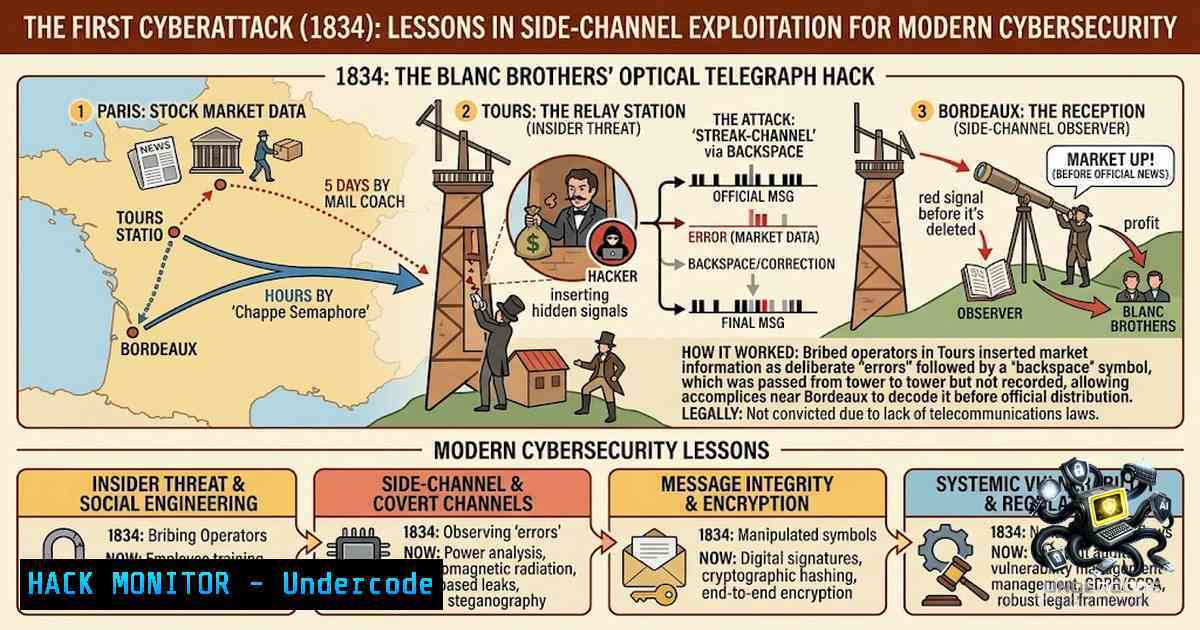
In 1834, nearly 150 years before the internet existed, two French financiers—the Blanc brothers—orchestrated what security experts now recognize as the world’s first cyberattack. They exploited the French optical telegraph system, a network of towers transmitting visual signals across the country, by bribing an operator to insert deliberate errors into government messages. These errors served as covert signals about Paris stock market movements, allowing the brothers to trade in Bordeaux days before legitimate information arrived. This historical episode reveals a timeless truth: cybersecurity is not about technology alone—it is about understanding how systems, people, and information interact, and where trust can be manipulated.
Learning Objectives
- Understand the historical origins of cyberattacks and how the Blanc brothers’ optical telegraph hack parallels modern side-channel and social engineering attacks
- Identify the six primary attack surfaces in modern systems: people, credentials, configurations, integrations, protocols, dependencies, and poorly designed processes
- Learn practical command-line techniques for auditing system trust boundaries, monitoring side channels, and implementing defense-in-depth strategies
You Should Know
- The Side-Channel Attack: From Optical Telegraph to Modern Exploitation
The Blanc brothers’ scheme was a classic side-channel attack—they exploited an unintended information leakage channel within a legitimate communication system. The optical telegraph used a codebook where operators transmitted symbols representing letters and phrases. Crucially, the encoding system included a “backspace” symbol that instructed the receiving transcriber to ignore the previous character. The brothers bribed the operator in Tours to insert a spurious character—indicating the previous day’s market movement—followed by the backspace symbol. The official message remained intact, but an accomplice with a telescope observed the extra character from a tower outside Bordeaux and relayed the financial intelligence to the Blancs.
This is functionally identical to modern side-channel attacks: timing attacks against cryptographic algorithms, cache side channels (Spectre/Meltdown), power analysis on embedded devices, or even acoustic cryptanalysis. The principle remains unchanged: find where the system leaks information unintentionally and exploit that leakage.
Modern Parallels:
- Timing Attacks: Measuring response time variations in authentication endpoints to infer valid credentials
- Cache Side Channels: Exploiting CPU cache behavior to leak sensitive data across process boundaries
- Power Analysis: Monitoring power consumption fluctuations during cryptographic operations
- Network Traffic Analysis: Inferring sensitive information from packet size, timing, or frequency patterns
Linux Command: Network Traffic Analysis for Side-Channel Detection
 Capture and analyze network traffic for anomalous patterns
sudo tcpdump -i eth0 -1n -v -s 0 -w side_channel_capture.pcap

Analyze packet timing intervals (potential timing side channel)
tshark -r side_channel_capture.pcap -T fields -e frame.time_relative -e ip.src -e ip.dst -e tcp.len | head -20

Monitor for unusual outbound connections (data exfiltration via side channels)
sudo netstat -tunap | grep ESTABLISHED | awk '{print $5}' | cut -d: -f1 | sort | uniq -c | sort -1r

Detect DNS tunneling (covert channel over DNS)
sudo tcpdump -i eth0 -1 -s 0 port 53 -v | grep -E "A\?|TXT\?" | head -20
Windows Command: Monitoring for Covert Channels
 Monitor active network connections for anomalies
Get-1etTCPConnection | Where-Object {$_.State -eq "Established"} | Select-Object LocalAddress, LocalPort, RemoteAddress, RemotePort, OwningProcess

Capture network traffic for analysis (requires npcap/wireshark)
netsh trace start capture=yes tracefile=C:\traces\capture.etl maxsize=100

Stop trace
netsh trace stop

Monitor DNS queries (potential covert channel)
Get-WinEvent -LogName "Microsoft-Windows-DNS-Client/Operational" -MaxEvents 50 | Format-List
Step-by-Step Guide: Auditing for Side-Channel Vulnerabilities
- Map Data Flow: Document all communication paths between system components—APIs, databases, microservices, and third-party integrations
- Identify Implicit Channels: Look for places where system behavior (response time, error messages, resource usage) might reveal sensitive information
- Implement Constant-Time Operations: For cryptographic operations, ensure execution time is independent of input values
- Add Noise and Randomization: Introduce random delays or jitter to obscure timing patterns
- Monitor Anomalies: Deploy network monitoring to detect unusual traffic patterns or data exfiltration attempts
-
The Human Element: Social Engineering as the Original Attack Vector
The Blanc brothers did not hack the telegraph system technically—they hacked the operator. This is the original social engineering attack, predating phishing, pretexting, and baiting by nearly two centuries. The vulnerability was not in the technology but in the human process: a single trusted individual with access to the system was bribed to become an insider threat.
In modern terms, this is an insider threat or supply chain compromise. The attack surface includes:
| Attack Surface | Modern Example | Mitigation Strategy |
||||
| 👤 People | Phishing, insider threats, social engineering | Security awareness training, zero-trust access, least privilege |
| 🔑 Credentials | Stolen passwords, leaked API keys, session hijacking | MFA, password managers, credential rotation, hardware tokens |
| ⚙️ Configuration | Misconfigured S3 buckets, open ports, default credentials | Infrastructure as Code (IaC) scanning, CIS benchmarks, regular audits |
| 🔌 Integration | Third-party API vulnerabilities, OAuth scope creep | API security testing, scope validation, vendor risk assessment |
| 📡 Protocol | Insecure protocols (HTTP, FTP, Telnet), protocol downgrade attacks | TLS 1.3, secure protocols, protocol validation |
| 📦 Dependency | Vulnerable libraries, supply chain attacks (Log4j, SolarWinds) | SBOM, dependency scanning, regular updates |
| 🧩 Process | Insecure CI/CD pipelines, weak change management | DevSecOps, code review, automated security gates |
Linux Command: Auditing Human-Facing Vulnerabilities
 Check for weak password policies in /etc/pam.d/
grep -v "^" /etc/pam.d/common-password | grep -E "minlen|ucredit|lcredit|dcredit|ocredit"

List all users and their last login (identify stale accounts)
lastlog | grep -v "Never logged in"

Check for sudo privileges (potential privilege escalation paths)
sudo -l

Audit SSH configuration for weak settings
sudo grep -E "PermitRootLogin|PasswordAuthentication|ChallengeResponseAuthentication" /etc/ssh/sshd_config

Check for world-writable files (potential tampering vectors)
find / -type f -perm -002 2>/dev/null | head -20
Windows Command: Auditing Human-Facing Vulnerabilities
 Check local user accounts and password policies
Get-LocalUser | Where-Object {$_.Enabled -eq $true}
net accounts

Audit group memberships (identify privileged users)
Get-LocalGroupMember Administrators

Check for stale user accounts (not logged in for 90+ days)
Get-ADUser -Filter  -Properties LastLogonDate | Where-Object {$_.LastLogonDate -lt (Get-Date).AddDays(-90)} | Select-Object Name, LastLogonDate

Audit RDP access
Get-ItemProperty -Path "HKLM:\SYSTEM\CurrentControlSet\Control\Terminal Server\WinStations\RDP-Tcp" -1ame "UserAuthentication"
Step-by-Step Guide: Implementing Human-Centric Security Controls
- Enforce Least Privilege: Grant users only the permissions they need to perform their job functions
- Implement Multi-Factor Authentication (MFA): Require at least two independent authentication factors for all critical systems
- Conduct Regular Security Awareness Training: Educate employees about phishing, social engineering, and insider threat indicators
- Establish Insider Threat Monitoring: Deploy User and Entity Behavior Analytics (UEBA) to detect anomalous user activity
- Implement Separation of Duties: Ensure no single individual has end-to-end control over critical processes
-
The System Perspective: Security as a Property of the Whole
The Blanc brothers succeeded because they understood the entire system—not just the telegraph technology but also the human operators, the financial markets, and the information flow. They identified that the system’s security relied on a chain of trust that could be broken at its weakest link. This is the foundational principle of systems thinking in cybersecurity.
Modern security practitioners must adopt the same holistic view:
Systemic Vulnerabilities to Assess:
- API Security: Are your APIs properly authenticated and authorized? Do they leak information through error messages or response codes?
- Cloud Hardening: Are your cloud resources (S3 buckets, databases, compute instances) properly configured? Do you have proper network segmentation?
- CI/CD Pipeline Security: Are your build pipelines protected? Can an attacker inject malicious code into your deployment process?
- Identity and Access Management (IAM): Do you have proper role definitions? Are service accounts and API keys properly managed?
- Zero Trust Architecture: Do you verify every access request regardless of origin? Do you assume breach?
Linux Command: System-Level Security Auditing
 Comprehensive system audit with Lynis
sudo lynis audit system

Check for open ports and listening services
sudo ss -tulpn | grep LISTEN

Audit systemd services for insecure configurations
sudo systemctl list-units --type=service --state=running | awk '{print $1}' | xargs -I {} systemctl show {} | grep -E "Environment|ExecStart"

Check for kernel vulnerabilities
sudo dmesg | grep -i "vulnerability"

Audit file permissions on critical system files
sudo find /etc -type f -exec ls -la {} \; 2>/dev/null | grep -E "^.(rw.|.r.|..w)" | head -20

Check for containers running with privileged flags
docker ps --format "table {{.Names}}\t{{.Image}}\t{{.Status}}" | while read name image status; do docker inspect $name --format='{{.Name}} - {{.HostConfig.Privileged}}'; done
Windows Command: System-Level Security Auditing
 Comprehensive system audit with PowerShell
Get-WmiObject -Class Win32_OperatingSystem | Select-Object Caption, Version, LastBootUpTime
Get-WmiObject -Class Win32_Service | Where-Object {$_.State -eq "Running"} | Select-Object Name, DisplayName, StartName

Check firewall rules
Get-1etFirewallRule | Where-Object {$<em>.Enabled -eq "True" -and $</em>.Direction -eq "Inbound"} | Select-Object DisplayName, Action

Audit scheduled tasks for suspicious entries
Get-ScheduledTask | Where-Object {$_.State -1e "Disabled"} | Select-Object TaskName, State, Author

Check Windows Defender status
Get-MpComputerStatus | Select-Object AntivirusEnabled, RealTimeProtectionEnabled, IoavProtectionEnabled

Audit registry for insecure configurations
Get-ItemProperty -Path "HKLM:\SOFTWARE\Microsoft\Windows\CurrentVersion\Policies\System" -1ame "EnableLUA"
Step-by-Step Guide: Building a System-Wide Security Program
- Conduct a Comprehensive Asset Inventory: Document all systems, applications, data stores, and integrations
- Map Data Flows: Understand how data moves through your organization—where it is created, stored, processed, and transmitted
- Identify Single Points of Failure: Find where the system relies on a single component, person, or process
- Implement Defense in Depth: Layer multiple security controls so that failure of one does not compromise the entire system
- Regularly Test the System: Conduct penetration testing, red team exercises, and tabletop simulations
- Establish Continuous Monitoring: Deploy SIEM, EDR, and threat intelligence to detect and respond to anomalies
4. API Security: The Modern Telegraph Network
If the optical telegraph network were built today, it would be a distributed system of APIs. Each telegraph tower would be an API endpoint; each message would be an API request; the operators would be API consumers and producers. The Blanc brothers exploited the protocol—the encoding system—and the human operator—an insider with privileged access.
Modern API Security Checklist:
- Authentication: Use OAuth 2.0, OpenID Connect, or API keys with proper scope restrictions
- Authorization: Implement fine-grained access control (RBAC, ABAC) at the API level
- Rate Limiting: Prevent brute-force and DoS attacks by limiting request frequency
- Input Validation: Validate all inputs to prevent injection attacks (SQLi, XSS, command injection)
- Output Encoding: Encode outputs to prevent information leakage through error messages
- Encryption: Use TLS 1.3 for all communications; encrypt sensitive data at rest
- Audit Logging: Log all API requests and responses for forensic analysis
- API Gateway: Use an API gateway to centralize security controls
Linux Command: API Security Testing
 Test API endpoint with curl (check for information leakage)
curl -v -X GET https://api.example.com/v1/users/123 -H "Authorization: Bearer $TOKEN"

Check for CORS misconfigurations
curl -v -X OPTIONS https://api.example.com/v1/users -H "Origin: https://attacker.com" -H "Access-Control-Request-Method: GET"

Fuzz API endpoints with ffuf (discover hidden endpoints)
ffuf -u https://api.example.com/v1/FUZZ -w /usr/share/wordlists/dirb/common.txt -fc 404

Test for rate limiting
for i in {1..100}; do curl -s -o /dev/null -w "%{http_code}\n" https://api.example.com/v1/users; done | sort | uniq -c

Check for SSL/TLS vulnerabilities
nmap --script ssl-enum-ciphers -p 443 api.example.com
Windows Command: API Security Testing
 Test API endpoint with Invoke-WebRequest
Invoke-WebRequest -Uri "https://api.example.com/v1/users/123" -Headers @{Authorization="Bearer $env:TOKEN"} -Method GET

Check for CORS misconfigurations
Invoke-WebRequest -Uri "https://api.example.com/v1/users" -Method OPTIONS -Headers @{Origin="https://attacker.com"; "Access-Control-Request-Method"="GET"}

Test for rate limiting
1..100 | ForEach-Object { (Invoke-WebRequest -Uri "https://api.example.com/v1/users" -Method GET).StatusCode } | Group-Object

Check SSL/TLS configuration
Step-by-Step Guide: Securing APIs
- Inventory All APIs: Document all internal and external APIs, including undocumented or legacy endpoints
- Implement API Gateway: Centralize authentication, authorization, rate limiting, and logging
- Use OpenAPI/Swagger: Define API specifications to enforce consistent security controls
- Conduct API Security Testing: Perform automated and manual security testing of all API endpoints
- Monitor API Traffic: Deploy API monitoring to detect anomalous patterns and potential attacks
5. Cloud Hardening: Securing Distributed Infrastructure
The optical telegraph was a distributed system—multiple towers across France, each with its own operator and equipment. Modern cloud infrastructure is similarly distributed, with resources spanning multiple regions, availability zones, and service providers. The same principles apply: secure each component, secure the communication between components, and secure the human processes that manage them.
Cloud Security Best Practices:
- Identity and Access Management (IAM): Use least privilege, implement MFA, rotate credentials regularly
- Network Security: Use VPCs, subnets, security groups, and network ACLs to segment traffic
- Data Encryption: Encrypt data at rest and in transit; manage encryption keys securely
- Logging and Monitoring: Enable CloudTrail, CloudWatch, and GuardDuty (AWS) or equivalent services
- Compliance: Regularly audit against CIS benchmarks, SOC 2, ISO 27001, and other standards
Linux Command: Cloud Security Auditing
 AWS: Check for publicly accessible S3 buckets
aws s3 ls --recursive | while read bucket; do aws s3api get-bucket-acl --bucket $bucket --query 'Grants[?Grantee.URI==`http://acs.amazonaws.com/groups/global/AllUsers`]'; done

AWS: Check for IAM users with unused credentials
aws iam list-users --query 'Users[?PasswordLastUsed==null]'

AWS: Audit security groups for overly permissive rules
aws ec2 describe-security-groups --query 'SecurityGroups[?IpPermissions[?IpRanges[?CidrIp==<code>0.0.0.0/0</code>]]]'

GCP: Check for public buckets
gsutil ls | while read bucket; do gsutil iam get $bucket | grep -E "allUsers|allAuthenticatedUsers"; done

Azure: Check for open network security groups
az network nsg list --query '[].{Name:name, Rules:securityRules[?access==<code>Allow</code> && sourceAddressPrefix==``]}' -o table
Windows Command: Cloud Security Auditing (Azure)
 Azure: List all resources with public IP addresses
az network public-ip list --query '[].{Name:name, IP:ipAddress, ResourceGroup:resourceGroup}'

Azure: Check for storage accounts with public access
az storage account list --query '[?allowBlobPublicAccess==<code>true</code>].{Name:name, ResourceGroup:resourceGroup}'

Azure: Audit role assignments for privileged roles
az role assignment list --include-inherited --query '[?roleDefinitionName==<code>Owner</code> || roleDefinitionName==<code>Contributor</code>]'
Step-by-Step Guide: Hardening Cloud Infrastructure
- Implement Infrastructure as Code (IaC): Use Terraform, CloudFormation, or similar tools to define infrastructure securely
- Scan IaC Templates: Use tools like Checkov, Terrascan, or tfsec to scan for misconfigurations
- Enable Cloud Security Posture Management (CSPM): Continuously monitor for compliance violations
- Implement Zero Trust Network Access: Use micro-segmentation and identity-based access controls
- Regularly Rotate Credentials: Implement automated credential rotation for all service accounts and API keys
What Undercode Say
- History repeats itself: The Blanc brothers’ attack in 1834 is functionally identical to modern side-channel and social engineering attacks. The technology changes, but the logic of exploitation remains constant.
- Security is a system property: No single tool—firewall, EDR, SIEM, or AI—can secure a system. Security emerges from the careful design of people, processes, and technology working together.
The 1834 optical telegraph hack is not merely a historical curiosity—it is a case study in systems thinking for cybersecurity. The Blanc brothers succeeded because they understood the entire system: the technology (optical telegraph), the human element (bribable operator), the information flow (market data from Paris to Bordeaux), and the financial incentives (arbitrage opportunity). Modern attackers do exactly the same thing: they map the system, identify the weakest link, and exploit it for gain.
This is why cybersecurity professionals must think like attackers. Before deploying any system, ask: “How can this system be bypassed?” This is the question every attacker asks, and it should be the question every security engineer, architect, and developer asks before putting a system into production. Technologies change—APIs, cloud, AI, CI/CD—but the logic of hacking is surprisingly ancient: understand how the system works, find where it trusts too much, and turn that trust into advantage.
Prediction
- +1 The growing adoption of AI in cybersecurity will enable more sophisticated detection of side-channel and systemic vulnerabilities, but attackers will also use AI to find and exploit these weaknesses faster than human defenders can respond
- -1 As organizations continue to focus on technical controls (firewalls, EDR, SIEM) while neglecting human factors and systemic risks, we will see a resurgence of social engineering and insider threat attacks that mirror the Blanc brothers’ approach
- -1 The increasing complexity of distributed systems—microservices, serverless, multi-cloud—will create more “telegraph tower” vulnerabilities: more components, more integrations, more points of failure, and more opportunities for side-channel exploitation
- +1 The historical precedent of the Blanc brothers (who were not convicted because no law existed against data network misuse) will drive the development of more comprehensive cybersecurity legislation and international frameworks for cybercrime prosecution
- -1 The financial sector’s reliance on high-frequency trading and algorithmic systems creates a modern parallel to the Blanc brothers’ arbitrage—where microseconds of advantage translate to millions in profit—making these systems prime targets for side-channel and timing attacks
▶️ Related Video (86% Match):
🎯Let’s Practice For Free:
🎓 Live Courses & Certifications:
Join Undercode Academy for Verified Certifications
🚀 Request a Custom Project:
Secure, high-velocity infrastructure and disruptive technological engineering. Contact our engineering team for high-tier development and proprietary systems:
[email protected]
💎 Smart Architecture | 🛡️ Secure by Design | ⭐ Trusted by Thousands
IT/Security Reporter URL:
Reported By: https://lnkd.in/p/empvueyg – Hackers Feeds
Extra Hub: Undercode MoN
Basic Verification: Pass ✅


