
Listen to this Post
Introduction:
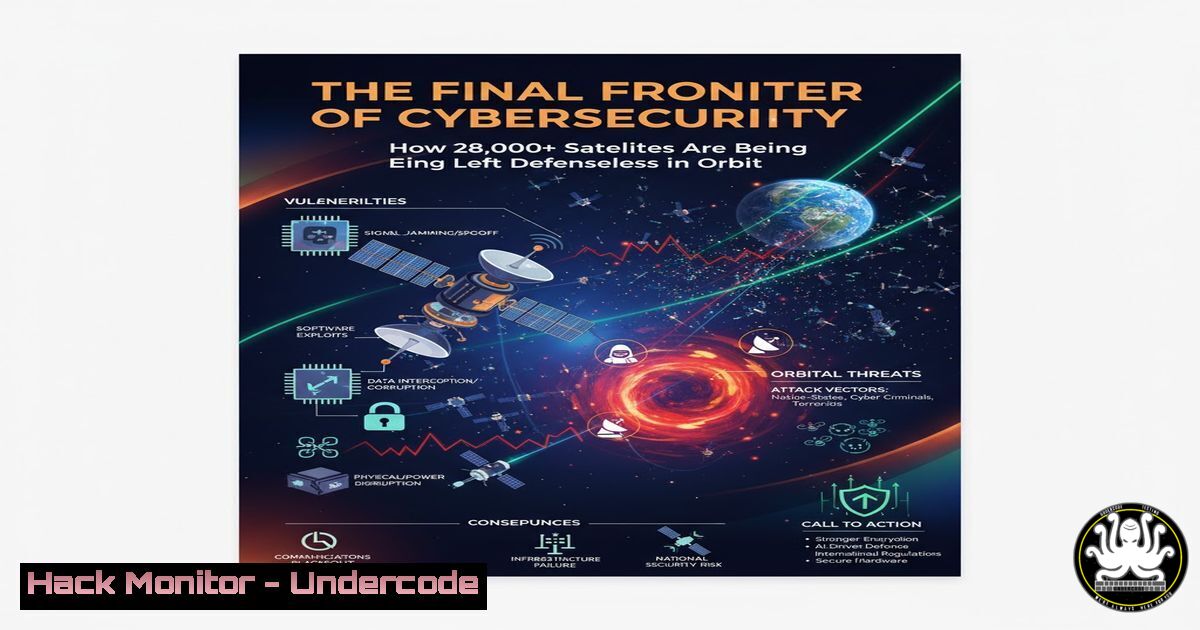
The ever-growing constellation of over 28,000 satellites orbiting Earth forms the invisible backbone of our modern global infrastructure, enabling everything from GPS and global finance to military communications and emergency services. However, this critical infrastructure is increasingly becoming a soft target for cyber adversaries due to widespread reliance on default configurations, weak encryption, and legacy protocols. This article delves into the tangible vulnerabilities of space-based assets and provides a technical roadmap for understanding and mitigating these emerging threats.
Learning Objectives:
- Understand the common attack vectors and vulnerabilities in satellite communication systems.
- Learn practical commands and techniques for analyzing network protocols and hardening systems against space-based threats.
- Develop a security-first mindset for defending critical infrastructure in the space and OT/IT domains.
You Should Know:
- Mapping the Orbital Battlefield: Reconnaissance and Satellite Identification
Before an attack can be mitigated, it must be understood. The first step in satellite security is identifying and enumerating potential targets. Public databases, like the one linked in the original post, provide a wealth of information.Verified Command/Tool: `satelliteseek` (Hypothetical Python Tool for Illustration)
Install required libraries
pip install requests beautifulsoup4

Example script to query a satellite database API
import requests
import json

Target NORAD ID (International Space Station example)
norad_id = 25544
url = f"https://celestrak.org/satcat/tle.php?CATNR={norad_id}"</p></li>
</ol>

<p>response = requests.get(url)
if response.status_code == 200:
print(f"Data for NORAD ID {norad_id}:")
print(response.text)
else:
print("Query failed.")
Step-by-step guide: This Python script demonstrates how to programmatically query a public satellite database (like Celestrak) using an API. An attacker or researcher would use this to gather Two-Line Element (TLE) sets and other metadata about a satellite. This data is crucial for tracking and understanding the satellite’s orbit, which is the first step in planning a ground-station communication attempt. Security professionals can use this same technique to inventory assets their organization relies on.
2. Intercepting the Invisible: Capturing Satellite Signals
Ground-based interception is a real and accessible threat. Using Software-Defined Radio (SDR), individuals can capture and analyze signals broadcast from space.
Verified Command: `rtl_sdr` & `gqrx` (Linux)
 Install SDR tools on Kali Linux/Ubuntu
sudo apt update && sudo apt install -y gqrx-sdr rtl-sdr

Use rtl_sdr to capture raw IQ data from a specified frequency (e.g., 137 MHz for NOAA weather satellites)
rtl_sdr -f 137500000 -s 1024000 -g 40 capture_noaa.iq

Open GQRX for a graphical interface to scan and listen
gqrx
Step-by-step guide: The `rtl_sdr` command is used with a cheap RTL-SDR dongle to capture In-phase and Quadrature (IQ) data from a specified frequency. Here, it’s tuned to 137.5 MHz, a common frequency for weather satellites. The `-s` flag sets the sample rate, and `-g` sets the gain. This captured data can then be decoded using other tools to extract the actual image or data transmission, demonstrating how easily broadcast satellite data can be acquired.
- The Authentication Void: Exploiting Weak or Default Credentials
Many satellite ground control systems and data links suffer from minimal or default authentication, a critical flaw reminiscent of early internet systems.
Verified Command: Hydra for Protocol Brute-Forcing (Linux)
 Brute-force an FTP server (common in data downlink systems)
hydra -L userlist.txt -P passlist.txt ftp://192.168.1.50

Brute-force a Telnet service (an outdated, insecure protocol sometimes found in legacy systems)
hydra -l admin -P rockyou.txt telnet://target-ground-station.ip
Step-by-step guide: Hydra is a powerful network logon cracker. The first command attempts to brute-force an FTP server using a list of usernames (
-L) and passwords (-P). The second command targets a Telnet service with a single username (-l) and a password list. These attacks highlight the danger of using unencrypted, poorly authenticated protocols for critical space infrastructure.4. Hardening the Link: Implementing Strong Encryption
Mitigating signal interception and manipulation requires robust encryption. Moving from legacy protocols to modern, encrypted ones is non-negotiable.
Verified Command: OpenSSL for AES Encryption (Linux/Windows)
 Encrypt a command file before transmission
openssl enc -aes-256-cbc -salt -in sensitive_command.txt -out encrypted_command.enc -k MySuperSecretPassword

Decrypt the file on the receiving end
openssl enc -aes-256-cbc -d -in encrypted_command.enc -out decrypted_command.txt -k MySuperSecretPassword
Step-by-step guide: This OpenSSL command uses the AES-256-CBC cipher, a strong encryption standard, to encrypt a file. The `-salt` flag adds cryptographic salt to strengthen the password. While this is a simplistic example, it underscores the principle: all data and command links must be encrypted end-to-end to prevent eavesdropping and injection.
5. Securing the Ground Station: Windows/Linux Host Hardening
The ground station computer is a prime target. It must be hardened to prevent compromise that could lead to satellite control being hijacked.
Verified Command: Windows Firewall Rule (Windows)
 Create a strict inbound firewall rule using PowerShell
New-NetFirewallRule -DisplayName "Block-SatCom-Inbound" -Direction Inbound -Protocol TCP -LocalPort 1-65535 -Action Block -Enabled True

Verify the rule was created
Get-NetFirewallRule -DisplayName "Block-SatCom-Inbound"
Step-by-step guide: This PowerShell command creates a new Windows Firewall rule that blocks all inbound TCP traffic on all ports. For a ground control system, the firewall should be configured on a “default deny” basis, only allowing explicitly required traffic for the satellite control software. This minimizes the attack surface.
Verified Command: Linux Kernel Hardening with `sysctl` (Linux)
 Edit sysctl configuration for kernel hardening
sudo nano /etc/sysctl.d/99-hardening.conf

Add the following lines:
net.ipv4.ip_forward=0
net.ipv4.conf.all.send_redirects=0
net.ipv4.conf.default.send_redirects=0
net.ipv4.conf.all.accept_redirects=0
net.ipv4.conf.default.accept_redirects=0

Apply the new settings
sudo sysctl -p /etc/sysctl.d/99-hardening.conf
Step-by-step guide: These `sysctl` commands disable IP forwarding and ICMP redirect acceptance, which are common network-level attack vectors. Hardening the underlying OS of a ground station is a foundational step in building a defense-in-depth strategy.
6. Proactive Defense: Continuous Monitoring and Anomaly Detection
You cannot protect what you cannot see. Continuous monitoring of network traffic and system logs is essential for detecting intrusion attempts.
Verified Command: `tcpdump` for Network Traffic Analysis (Linux)
 Capture all traffic on a specific interface, saving to a file
sudo tcpdump -i eth0 -w ground_station_capture.pcap

Analyze the capture file for suspicious activity (e.g., port scanning)
tcpdump -nn -r ground_station_capture.pcap 'tcp[bash] & 2 != 0' | awk '{print $3}' | sort | uniq -c | sort -nr
Step-by-step guide: The first `tcpdump` command captures all traffic on interface `eth0` and writes it to a file. The second command reads that file and filters for TCP SYN packets (
tcp& 2 != 0</code>), which can indicate a port scan. By analyzing source IPs, a defender can identify reconnaissance activity from potential attackers early in the kill chain. <ol> <li>The Human Firewall: API Security and Secret Management Many modern satellite systems use APIs for data transmission and management. Exposed API keys are a common source of compromise.</li> </ol> <h2 style="color: yellow;"> Verified Command: `git` Secrets Scanning (Linux)</h2> [bash] Install and use git-secrets to scan for accidentally committed keys git secrets --install git secrets --register-aws git scan /path/to/ground-control-code Example: Search for hardcoded passwords in a codebase grep -r "password|apikey|secret" /path/to/code --include=".py" --include=".json"
Step-by-step guide: Tools like `git-secrets` help prevent the accidental leakage of credentials in version control. The `grep` command is a simple but effective way to manually search for hardcoded secrets in a codebase. Ensuring that API keys and passwords are stored in secure vaults and not in plaintext is a critical component of satellite security.
What Undercode Say:
- The Space Attack Surface is Already Active: The theoretical threat is now a practical one. As demonstrated by accessible SDR technology and public satellite databases, the barrier to entry for satellite interaction is low, making reconnaissance and basic attacks feasible for a wider range of threat actors.
- Legacy Systems are the Primary Vulnerability: The core issue is not a lack of modern security technology, but the pervasive presence of legacy systems in space infrastructure. These systems were designed for a different era and are now being exposed to a hostile digital environment for which they were never prepared.
The analysis suggests we are in the early stages of a space cyber arms race. The original post's anecdotal findings of "default settings everywhere" and "weak or no encryption" are not isolated but symptomatic of a systemic industry-wide problem. The comparison to 1996-era security is astute; the space sector is currently facing its own "internet of the 90s" moment, where convenience and functionality have been prioritized over security. The industry's response must be swift and standardized, moving beyond best practices to enforceable security baselines for all new satellite deployments and creating mitigation plans for existing assets.
Prediction:
Within the next 3-5 years, we will witness the first publicly attributed, major destructive cyberattack on a satellite or constellation. This will not be mere signal jamming but a sophisticated attack leading to the permanent loss of a asset or a significant, long-term service disruption. This event will serve as a "Sputnik moment" for space cybersecurity, triggering massive investment in satellite hardening, the creation of international regulatory frameworks, and the rapid development of a niche market for offensive and defensive space cyber capabilities. The battleground is no longer coming; it is already here, orbiting silently above us.
🎯Let’s Practice For Free:
IT/Security Reporter URL:
Reported By: Qusaialhaddad Did - Hackers Feeds
Extra Hub: Undercode MoN
Basic Verification: Pass ✅🔐JOIN OUR CYBER WORLD [ CVE News • HackMonitor • UndercodeNews ]
📢 Follow UndercodeTesting & Stay Tuned:
- The Authentication Void: Exploiting Weak or Default Credentials


