
Listen to this Post
Introduction:
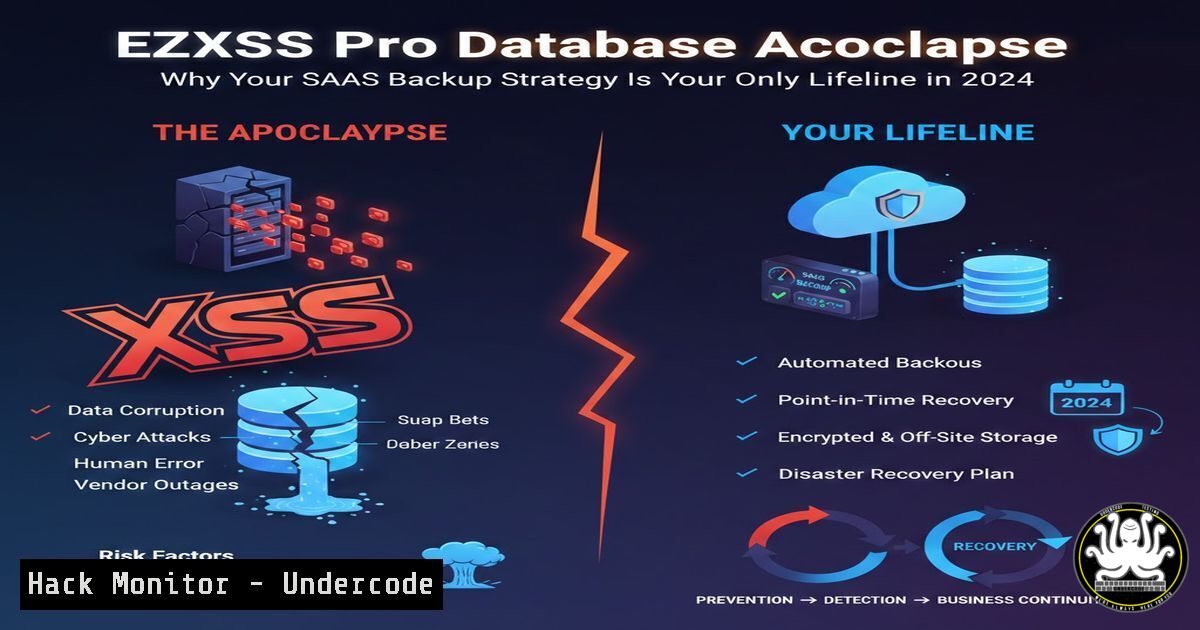
In the high-stakes world of web application security testing, tools like EZXSS Pro are the scalpels of a penetration tester. However, a recent public plea from a certified cybersecurity professional (holding RHCSA, CEH, and eJPT credentials) highlights a terrifying vulnerability that firewalls cannot patch: database corruption. When a critical security tool’s backend fails, it doesn’t just break functionality—it creates a cascading identity crisis where user privileges vanish, access controls reset, and penetration testing workflows grind to a halt. This incident serves as a brutal case study in SaaS resilience, access control inheritance, and the forensic necessity of maintaining cryptographic proof of ownership.
Learning Objectives:
- Understand the technical impact of database corruption on role-based access control (RBAC) systems.
- Learn how to implement local cryptographic verification of SaaS subscription tiers to mitigate server-side data loss.
- Master the command-line techniques for backing up and restoring application configuration data on Linux/Windows.
You Should Know:
- The Anatomy of the Corruption: How Database Integrity Affects Authorization
The user’s issue stems from a backend database corruption that reset his account status from “Pro” to “Sponsor lv.” In modern web applications, user privileges are stored in relational databases (like MySQL, PostgreSQL) or NoSQL structures. When corruption occurs—whether due to power failure, filesystem errors, or software bugs—the tables holding user metadata (e.g.,user_roles,subscriptions) can become inconsistent or lost entirely.
Step‑by‑step guide to verifying database integrity on your own VPS/Server (Linux):
If you are hosting a similar tool and fear corruption, you must check the logs and database integrity immediately.
 Check MySQL/MariaDB table corruption
sudo mysqlcheck -u root -p --all-databases --check

Repair a specific database (if using MyISAM engine)
sudo mysqlcheck -u root -p --databases your_app_db --repair

For PostgreSQL, check for corruption signals in logs
tail -n 50 /var/log/postgresql/postgresql-.log | grep -i corruption

Check filesystem for disk errors that might cause DB corruption
sudo dmesg | grep -i error
sudo smartctl -H /dev/sda
- The “Sponsor lv” Limbo: Understanding RBAC Fallback Mechanisms
When a database corrupts, developers often restore from the latest backup. However, if the backup is outdated or the restoration script fails to migrate complex user tier data, the system defaults to a lower privilege level (like “Sponsor”). This is a security feature to prevent privilege escalation by default, but it becomes a nightmare for legitimate power users.
Step‑by‑step guide to querying and fixing user roles via CLI (Linux/Windows WSL):
Assuming the application uses a SQL backend, here is how an admin should manually verify a user’s status.
-- Connect to the database (example for MySQL)
mysql -u admin -p -h localhost ezxss_db;

-- Check the current user role for a specific user
SELECT user_id, user_email, subscription_tier, account_status
FROM users
WHERE user_email = '[email protected]';

-- If the tier is incorrect and you have proof (backup), update it manually
-- WARNING: Ensure you have a current backup before manual updates
UPDATE users
SET subscription_tier = 'Pro', account_status = 'active'
WHERE user_email = '[email protected]';

-- Verify the change
SELECT user_id, subscription_tier FROM users WHERE user_email = '[email protected]';
- The Forensic Value of Screenshots: Client-Side Evidence in a Server-Side Disaster
The affected user mentioned attaching a “masked screenshot that proves I had a Pro account, as the screenshot feature is available only to Pro users.” This is a critical point for cybersecurity professionals: client-side validation is not security, but it is excellent forensic evidence.
In the absence of server-side logs (which may have been corrupted), the client’s local experience is the only proof of prior access.
Step‑by‑step guide to capturing forensic metadata of your SaaS access (Windows/Linux):
When you detect a privilege downgrade, immediately capture metadata.
 On Linux: Capture network traffic to prove API responses previously showed "Pro"
sudo tcpdump -i eth0 -w pre_downgrade_traffic.pcap host api.ezxss.com

On Windows (PowerShell): Save HTTP Archive (HAR) of the session
 Open Developer Tools in Chrome (F12) -> Network Tab -> Export HAR
 HAR files contain proof of the server's response headers and body.

On Linux: Use curl to manually query the API endpoint and save the response header
curl -I https://api.ezxss.com/v1/user/status --cookie "session=YOUR_TOKEN" > proof_headers.txt
curl https://api.ezxss.com/v1/user/status --cookie "session=YOUR_TOKEN" > proof_response.json

Hash the files for integrity verification later
sha256sum proof_response.json
- Disaster Recovery for Security Tools: The Immutable Backup Strategy
If a database can be corrupted, your penetration testing environment must be ephemeral or backed up immutably. Security professionals running tools like EZXSS, Burp Collaborator, or internal vulnerability scanners should treat their configuration as code.
Step‑by‑step guide to backing up a Dockerized application (most common for modern tools):
If EZXSS Pro runs in Docker (highly likely), the user could have avoided this by backing up the volume.
 1. Identify the container and its volumes
docker ps | grep ezxss
docker inspect ezxss_container | grep -A 10 "Mounts"

<ol>
<li>Backup the volume data (e.g., MySQL data or application config)
docker run --rm -v ezxss_data:/data -v $(pwd):/backup alpine tar czf /backup/ezxss_backup_$(date +%Y%m%d).tar.gz -C /data .</p></li>
<li><p>Backup the database dump from within the container
docker exec ezxss_container mysqldump -u root -p ezxss_db > db_backup.sql</p></li>
<li><p>On Windows, use PowerShell to copy volumes from Docker Desktop
docker run --rm -v ezxss_data:C:\data -v ${PWD}:C:\backup mcr.microsoft.com/windows/servercore cmd /c "xcopy C:\data C:\backup\data_backup /E"
5. API Security and Idempotent Recovery Requests
The user tagged the creator “el-yesa I.” for support. In a secure architecture, recovery requests should be idempotent and verifiable via signed JWTs or API keys that contain the user’s tier claims. The fact that a database wipe caused a tier loss suggests the JWT stored on the client side is not being honored, or the server-side signing key verification is failing due to missing user data.
Step‑by‑step guide to verifying your JWT token for privilege claims (Linux/macOS):
If you suspect your local token still contains the correct “Pro” flag, decode it.
 Assuming your session token is a JWT stored in a cookie or localStorage
 Copy the token and decode it (JWT is base64 encoded)
echo "YOUR_JWT_TOKEN_HERE" | cut -d "." -f2 | base64 -d 2>/dev/null | jq .

Example of a JWT payload with tier info
 {
 "user_id": 12345,
 "tier": "Pro",
 "exp": 1712345678
 }

If the token still says "Pro" but the server rejects you, the server's verification is broken.
6. Windows-Based Exploitation: Hardening Against Local Privilege Descent
While the EZXSS issue is SaaS-based, the concept of “privilege downgrade” is a known vulnerability in thick clients and agents. If a security tool’s agent on Windows loses its configuration, it might revert to an unprivileged state.
Step‑by‑step guide to backing up Windows Registry keys for applications:
If a Windows security tool stores its license in the registry, you can back it up to prevent loss.
rem Export a specific registry key for backup
reg export "HKCU\Software\EZXSS" C:\Backups\ezxss_reg_backup.reg

rem To restore later (run as Administrator)
reg import C:\Backups\ezxss_reg_backup.reg

rem Use PowerShell for a more detailed backup of application data
powershell -Command "Copy-Item -Path $env:APPDATA\EZXSS -Destination D:\Backups\EZXSS_Config -Recurse -Force"
- The Role of CSP (Content Security Policy) in Mitigating XSS Tools
Ironically, the tool in question (“EZXSS”) suggests a focus on Cross-Site Scripting (XSS) security. A corrupted account for an XSS testing tool prevents a researcher from finding vulnerabilities. For defenders, this is a reminder that proper HTTP headers can nullify many XSS attacks, rendering the need for such tools less frequent on well-hardened sites.
Step‑by‑step guide to implementing a strict CSP on an Apache/NGINX server:
 In NGINX server block
add_header Content-Security-Policy "default-src 'self'; script-src 'self'; object-src 'none'; base-uri 'self';" always;

In Apache .htaccess
Header set Content-Security-Policy "default-src 'self'; script-src 'self';"
What Undercode Say:
- Key Takeaway 1: Trust, but verify with local proofs. Never rely solely on a SaaS provider’s database for your access rights. Maintain local copies of invoices, screenshots with metadata, and API response dumps. These are your “offline backups” for identity.
- Key Takeaway 2: Database corruption is a denial of service. In the world of cybersecurity tools, losing access to your testing suite (EZXSS, Burp, etc.) is equivalent to losing your weapons. Implement immutable infrastructure for your own tooling to ensure you can roll back to a fully functional state within minutes, not days.
- Analysis: This incident highlights a systemic fragility in the SaaS model for security tools. We spend our lives securing web applications from external threats, yet we are helpless when the internal database engine of our favorite pentesting tool corrupts. The user’s approach—publicly tagging the creator with visual proof—is a masterclass in escalation tactics. It bypasses the typical broken support ticket system and applies social pressure for a technical fix. For the developer, this is a wake-up call: your database recovery playbook must include a manual override for verified power users. The use of “Sponsor lv” as a fallback indicates a hard-coded default that is now causing active harm to your user base.
Prediction:
In the next 12 months, we will see a rise in “Proof of Subscription” NFTs or cryptographically signed tokens issued at the point of sale. These tokens, stored client-side, will allow users to reassert their privileges directly on a recovered database without admin intervention. This shifts the trust model from “the server remembers everything” to “the client proves everything,” mitigating the impact of catastrophic data loss. Additionally, expect stricter regulatory requirements (like the upcoming EU Cyber Resilience Act) to mandate that software vendors provide verifiable proof of purchase and functionality that survives server-side failures.
▶️ Related Video (76% Match):
🎯Let’s Practice For Free:
IT/Security Reporter URL:
Reported By: Kumavat Harshvardhan – Hackers Feeds
Extra Hub: Undercode MoN
Basic Verification: Pass ✅


