Listen to this Post
Introduction:
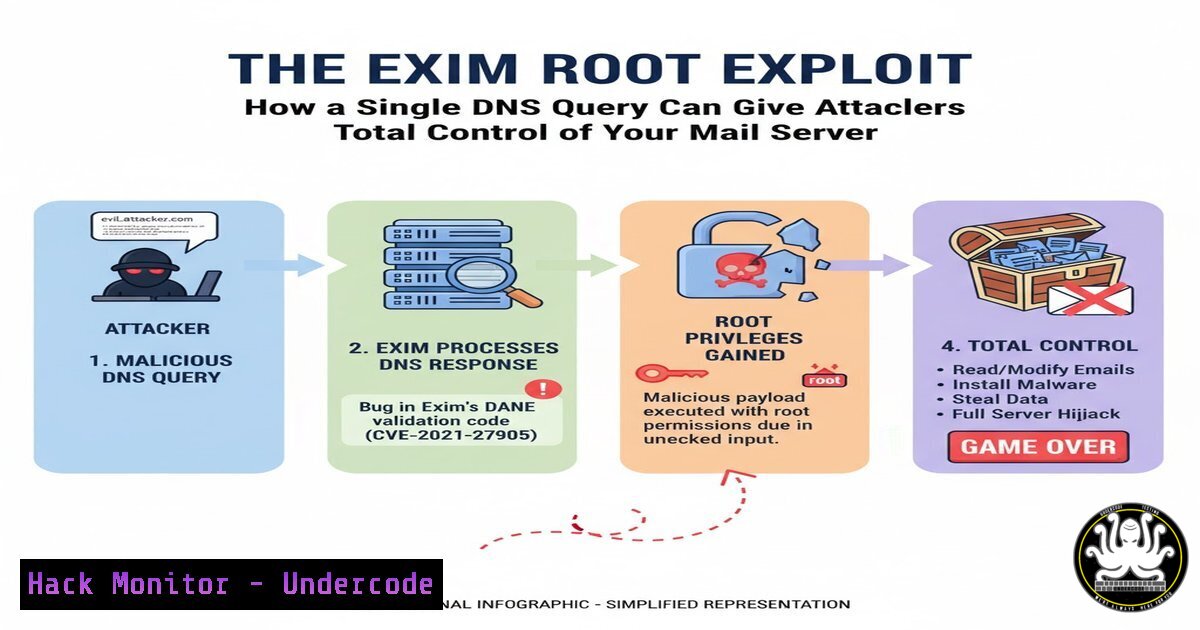
A critical vulnerability in the ubiquitous Exim mail transfer agent has sent shockwaves through the cybersecurity community. Designated CVE-2024-39929, this flaw in the DKIM authentication feature allows unauthenticated remote attackers to execute arbitrary commands with root privileges. Given Exim’s extensive deployment on internet-facing mail servers, this vulnerability represents a significant threat to organizational integrity.
Learning Objectives:
- Understand the mechanism of the CVE-2024-39929 vulnerability in Exim’s DKIM DNS query process.
- Learn to identify vulnerable Exim installations within your network infrastructure.
- Implement effective mitigation and patching strategies to protect mail servers from exploitation.
You Should Know:
- The Anatomy of CVE-2024-39929: DNS Query to Root Shell
The core of this vulnerability lies in Exim’s handling of DNS TXT records during DKIM signature verification. When Exim processes an incoming email with a DKIM signature, it performs a DNS lookup to retrieve the public key for validation. The vulnerability exists in the `dkim_exim_verify_find_key` function, where an unsafe string construction allows for command injection via specially crafted DNS TXT records.
The flawed code path involves:
dkim_exim_verify_find_key() -> dkim_exim_verify_dns_txt() -> dnsdb_find_by_txt()
An attacker can craft a malicious DNS TXT record that, when processed, escapes the intended string context and injects operating system commands. Since Exim typically runs with root privileges, these commands execute with full system control.
2. Identifying Vulnerable Exim Installations
Before attackers can exploit this vulnerability, you must first identify and catalog your Exim installations. The vulnerability affects Exim versions 4.92 through 4.98. Use these commands to check your systems:
On Linux systems:
 Check Exim version
exim --version | head -n1

Alternative method to check version
dpkg -l | grep exim4  Debian/Ubuntu
rpm -qa | grep exim  RHEL/CentOS

Check if Exim is running
ps aux | grep exim
netstat -tlnp | grep :25
On Windows systems (if compiled for Windows):
exim --version
netstat -ano | findstr :25
Regular vulnerability scanning using tools like OpenVAS or Nessus can also detect vulnerable Exim instances across your network.
3. Proof-of-Concept Exploitation Walkthrough
Understanding the exploitation process is crucial for developing effective detection rules. The attack flow involves:
Step 1: Attacker sets up a malicious DNS server with a crafted TXT record containing the payload:
"v=DKIM1; k=rsa; p="malicious_code\" | chmod 4755 /bin/bash "
Step 2: Attacker sends an email to the target Exim server with a DKIM signature that points to the malicious DNS server.
Step 3: Exim performs DNS lookup for DKIM verification and processes the malicious TXT record.
Step 4: The injected command executes with root privileges. A common exploitation creates a SUID shell:
 The injected command effectively runs:
/bin/sh -c 'echo "v=DKIM1; k=rsa; p=\" | chmod 4755 /bin/bash "'
Step 5: Attacker gains persistent root access through the privileged shell.
4. Immediate Mitigation and Patching Strategies
The most critical action is patching Exim to version 4.98.1 or later. If immediate patching isn’t possible, implement these workarounds:
Temporary mitigation through ACL rules:
 In exim.conf, add to ACLs:
deny condition = ${if eq{$dkim_verify_status}{fail}}

Disable DKIM verification temporarily (affects spam filtering)
disable dkim_verify
Configuration hardening in Exim:
 Restrict DNS lookups
dns_dnssec_ok = 0
dns_trust_anchors =
System-level controls:
 Implement strict firewall rules
iptables -A INPUT -p tcp --dport 25 -s trusted_networks -j ACCEPT
iptables -A INPUT -p tcp --dport 25 -j DROP

Apply strict SELinux policies
semanage port -a -t smtp_port_t -p tcp 25
setsebool -P exim_disable_trans 0
5. Detection and Monitoring for Exploitation Attempts
Implement these detection mechanisms to identify exploitation attempts:
Network monitoring with Suricata/Snort rules:
alert udp any 53 -> any any (msg:"EXIM CVE-2024-39929 Exploit Attempt"; content:"|20|"; content:"chmod"; content:"4755"; content:"/bin/bash"; within:100; sid:1000001; rev:1;)
System monitoring commands:
 Monitor for SUID shell creation
find / -perm -4000 -type f -exec ls -ld {} \; | grep bash

Check Exim logs for exploitation patterns
tail -f /var/log/exim/mainlog | grep -i "dkim.fail"
grep "dkim" /var/log/exim/mainlog | awk '{print $6}' | sort | uniq -c

Process monitoring for suspicious Exim child processes
ps aux --forest | grep exim | grep -v grep
6. Cloud and Container Security Hardening
For cloud and containerized Exim deployments, additional security measures are essential:
Docker security hardening:
 Use non-root user in container
FROM debian:bullseye
RUN groupadd -r exim && useradd -r -g exim exim
USER exim

Security context in Kubernetes
apiVersion: apps/v1
kind: Deployment
spec:
template:
spec:
securityContext:
runAsNonRoot: true
runAsUser: 1000
Cloud security group configuration (AWS example):
 Restrict SMTP access
aws ec2 authorize-security-group-ingress \
--group-id sg-xxxxxxxxx \
--protocol tcp \
--port 25 \
--source-group sg-your-trusted-sg
7. Incident Response and Forensic Analysis
If exploitation is suspected, immediate incident response is critical:
Isolation and preservation:
 Isystem without shutting down
echo o > /proc/sysrq-trigger

Create memory dump
./LiME/src/lime-insert.ko "path=/tmp/memdump.lime format=lime"

Preserve evidence
tar czf forensic_evidence_$(hostname)_$(date +%Y%m%d).tar.gz \
/var/log/exim/ /etc/exim/ /var/spool/exim/
Forensic analysis commands:
 Check for rootkits and backdoors
rkhunter --check
chkrootkit

Analyze process tree for anomalies
ps auxf | less

Check network connections
ss -tulnpe | grep exim
netstat -nap | grep exim
What Undercode Say:
- This vulnerability demonstrates the critical risk in trusting external data inputs, even from supposedly benign sources like DNS.
- The widespread nature of Exim means this vulnerability affects a substantial portion of internet mail infrastructure, creating a massive attack surface.
The CVE-2024-39929 vulnerability represents a perfect storm in modern cybersecurity threats: it affects widely deployed software, requires no authentication, provides complete system control, and exploits a trusted protocol (DNS) that typically bypasses security controls. What’s particularly concerning is the elegance of the attack vector—by abusing a security feature (DKIM) designed to enhance email security, attackers can compromise entire systems. This incident should serve as a wake-up call for organizations to implement stricter input validation across all network services, not just web applications. The fact that a mail server component can lead to complete system compromise highlights how architectural decisions from decades ago continue to impact modern security postures.
Prediction:
This vulnerability will likely be integrated into automated attack toolkits and botnets within weeks, leading to widespread exploitation for cryptocurrency mining, data exfiltration, and espionage campaigns. We anticipate seeing variants of this attack targeting other DNS-reliant services, potentially affecting DNS-based authentication mechanisms in various protocols. The cybersecurity industry will likely respond with enhanced DNS security validation and increased scrutiny of mail server security configurations. Long-term, this incident will accelerate the adoption of DNSSEC and more robust input sanitization frameworks across all network-facing services, potentially influencing next-generation secure software development practices.
🎯Let’s Practice For Free:
IT/Security Reporter URL:
Reported By: Ethical Hacks – Hackers Feeds
Extra Hub: Undercode MoN
Basic Verification: Pass ✅


