
Listen to this Post
Introduction:
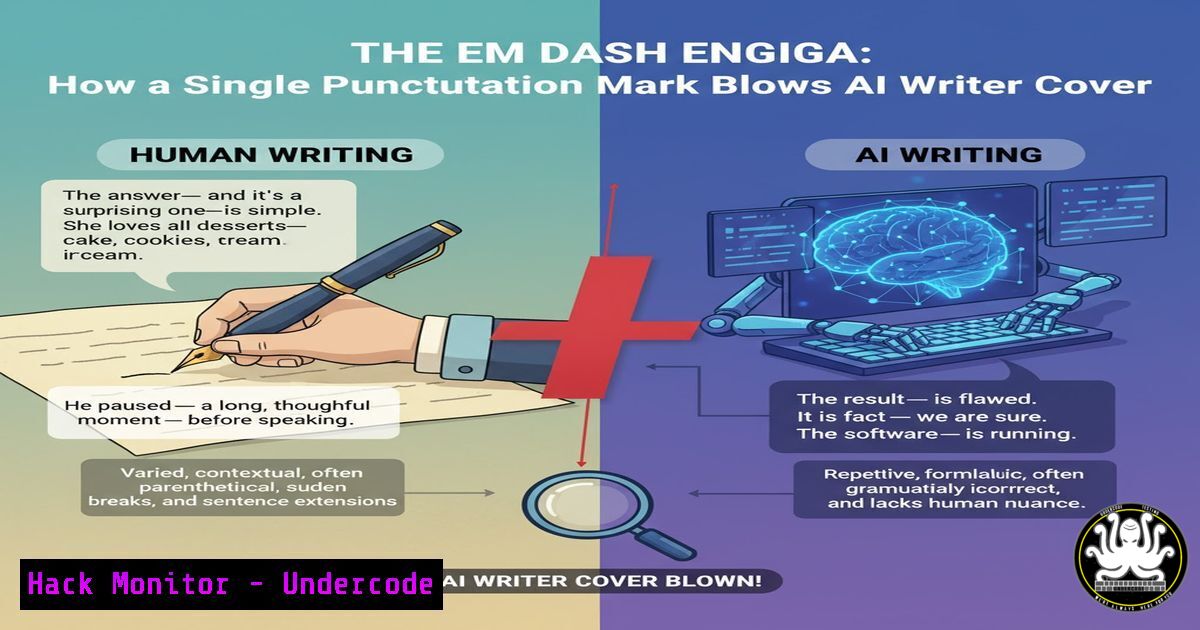
The proliferation of AI-generated text has created a new frontier in digital security and content verification. A seemingly innocuous typographical character—the em dash (—)—has emerged as a surprisingly consistent forensic marker for identifying machine-authored content. This article explores the technical underpinnings of this phenomenon and provides cybersecurity professionals and IT teams with the tools to detect and analyze AI-generated text, a critical skill for combating disinformation, phishing campaigns, and automated social engineering attacks.
Learning Objectives:
- Understand the linguistic and technical reasons why AI models overutilize specific Unicode characters like the em dash.
- Develop a toolkit of command-line, scripting, and API-based methods to automate the detection of AI-generated text.
- Apply text analysis techniques to bolster threat intelligence and identify potential coordinated inauthentic behavior.
You Should Know:
1. Unicode Character Analysis with Command Line
`grep -n -o -P “[\x{2014}]” suspect_document.txt | wc -l`
This command uses `grep` to search for the specific Unicode code point for an em dash (U+2014) within a text file. The `-n` flag shows line numbers, `-o` prints only the matched character, and `-P` enables Perl-compatible regex for Unicode handling. Piping to `wc -l` counts the total number of em dashes found. A high density of em dashes relative to the document’s length can be a primary indicator of AI authorship, as language models are trained on formal corpora rich with this punctuation.
2. Statistical Text Analysis with Python
import re
from collections import Counter

def analyze_punctuation(text):
 Count em dashes (Unicode U+2014)
em_dashes = len(re.findall(r'\u2014', text))
 Count en dashes (Unicode U+2013)
en_dashes = len(re.findall(r'\u2013', text))
 Count regular hyphens
hyphens = len(re.findall(r'-', text))
total_words = len(text.split())

return {
'em_dash_freq': em_dashes / total_words  1000,
'en_dash_freq': en_dashes / total_words  1000,
'hyphen_freq': hyphens / total_words  1000
}

Example usage
sample_text = "Your suspect text here — full of potential AI markers."
print(analyze_punctuation(sample_text))
This script quantifies the frequency of different dash types per 1000 words. Establishing a baseline frequency for human-written text in your organization allows you to flag documents that deviate significantly, particularly those with a high `em_dash_freq` and low en_dash_freq, a common AI signature.
3. PowerShell Text Profiling for Windows Forensics
$fileContent = Get-Content "C:\path\to\file.txt" -Raw
$emDashCount = ([bash]::Matches($fileContent, "[\u2014]")).Count
$enDashCount = ([bash]::Matches($fileContent, "[\u2013]")).Count
$hyphenCount = ([bash]::Matches($fileContent, "-")).Count

$stats = [bash]@{
FileName = "file.txt"
EmDashCount = $emDashCount
EnDashCount = $enDashCount
HyphenCount = $hyphenCount
EmDashRatio = if ($hyphenCount -gt 0) { $emDashCount / $hyphenCount } else { 0 }
}
$stats | Format-List
This PowerShell script profiles a text file for dash usage. The `EmDashRatio` is a key metric; a high ratio suggests a preference for em dashes over common hyphens, a stylistic choice deeply embedded in the training data of models like GPT. This can be integrated into automated email security gateways to scan incoming messages.
4. Leveraging AI Detection APIs for Scalable Analysis
`curl -X POST https://api.originality.ai/v1/scan -H “Authorization: Bearer YOUR_API_KEY” -H “Content-Type: application/json” -d ‘{“content”: “Text to analyze here.”, “title”: “Scan”}’`
Originality.ai and similar APIs use a ensemble of models, including linguistic feature analysis (like punctuation quirks) and statistical classifiers, to detect AI-generated content. Integrating these APIs into content management systems or social media monitoring tools can help automatically flag synthetic text at scale, crucial for moderating forums or vetting user-generated content.
- Building a YARA Rule for Threat Intelligence Platforms
rule Detect_AIStylometric_Markers
{
meta:
description = "Detects text with high em dash frequency, an AI indicator"
author = "Your CIRT"
date = "2024-05-20"</li>
</ol>

strings:
$em_dash = /\x{2014}/

condition:
em_dash > 10 and filesize < 200KB
}
YARA is a pattern-matching tool used extensively in malware analysis. This rule can be deployed on security platforms to scan documents and log files for an unusually high count of em dash characters. While not conclusive on its own, it serves as a low-cost, high-speed triage mechanism to identify files worthy of deeper forensic analysis.
- Browser Console Script for Real-Time Social Media Analysis
// Run this in the browser console on a LinkedIn or Twitter feed
const posts = document.querySelectorAll('[data-test-id="post-message"]');
let aiScore = 0;</li>
</ol>

posts.forEach(post => {
const text = post.innerText;
const emDashMatches = text.match(/\u2014/g);
const emDashCount = emDashMatches ? emDashMatches.length : 0;
const wordCount = text.split(/\s+/).length;

if (wordCount > 50 && emDashCount / wordCount > 0.005) { // Threshold of 0.5%
console.warn("Potential AI-generated post detected:", post);
aiScore++;
}
});

console.log(<code>AI Suspicion Score for this feed: ${aiScore} potentially synthetic posts.</code>);
This script allows security analysts to perform a quick, manual assessment of social media feeds for signs of coordinated inauthentic activity. A cluster of posts with high em dash frequency from different accounts could indicate a botnet or influence operation.
7. Advanced N-gram and Perplexity Analysis
For a more advanced approach, tools like the Hugging Face `transformers` library can be used to calculate a text’s perplexity—a measure of how “surprised” the model is by the text. AI-generated text often has an unnaturally low perplexity.
 Example using a pre-trained model (install transformers library first)
python -c "
from transformers import GPT2LMHeadModel, GPT2TokenizerFast
model = GPT2LMHeadModel.from_pretrained('gpt2')
tokenizer = GPT2TokenizerFast.from_pretrained('gpt2')
text = 'Your text to analyze — with its suspect em dash.'
encodings = tokenizer(text, return_tensors='pt')
import torch
with torch.no_grad():
outputs = model(encodings, labels=encodings['input_ids'])
perplexity = torch.exp(outputs.loss)
print(f'Perplexity: {perplexity}')
"
A very low perplexity score, combined with a high frequency of formal punctuation, strongly suggests AI generation.
What Undercode Say:
- The em dash is a “stylometric fingerprint.” AI models don’t understand style; they replicate statistical patterns from their training data, and the over-representation of formal punctuation is a direct leak of that data’s composition.
- This is an arms race. As this specific marker becomes known, future AI models will be explicitly tuned to vary their punctuation, making detection a continuous process of identifying new, subtler linguistic artifacts.
The identification of the em dash as an AI marker is not just a parlor trick; it’s a case study in forensic stylometry. It demonstrates that even the most advanced models are constrained by the latent patterns in their training corpora. For cybersecurity, this provides a low-friction initial vector for identifying phishing lures, fake news, and automated propaganda. However, reliance on a single marker is a temporary advantage. A robust defense requires a layered approach, combining multiple linguistic features, behavioral analysis, and AI-powered detection tools to stay ahead of increasingly sophisticated synthetic text generators.
Prediction:
The cat-and-mouse game of AI text generation and detection will rapidly escalate. In the short term, we will see a surge in “AI-humanizing” tools designed specifically to remove these forensic markers, making detection more difficult. In the long term, the ability to verify the provenance of digital information will become a foundational security control. This will drive the adoption of cryptographic solutions like digital content signatures and the integration of AI detection as a standard feature in enterprise security suites, email platforms, and major social networks, fundamentally changing how we trust digital communication.
🎯Let’s Practice For Free:
IT/Security Reporter URL:
Reported By: Michael Bon – Hackers Feeds
Extra Hub: Undercode MoN
Basic Verification: Pass ✅🔐JOIN OUR CYBER WORLD [ CVE News • HackMonitor • UndercodeNews ]
📢 Follow UndercodeTesting & Stay Tuned:
- Browser Console Script for Real-Time Social Media Analysis


