Listen to this Post
Introduction:
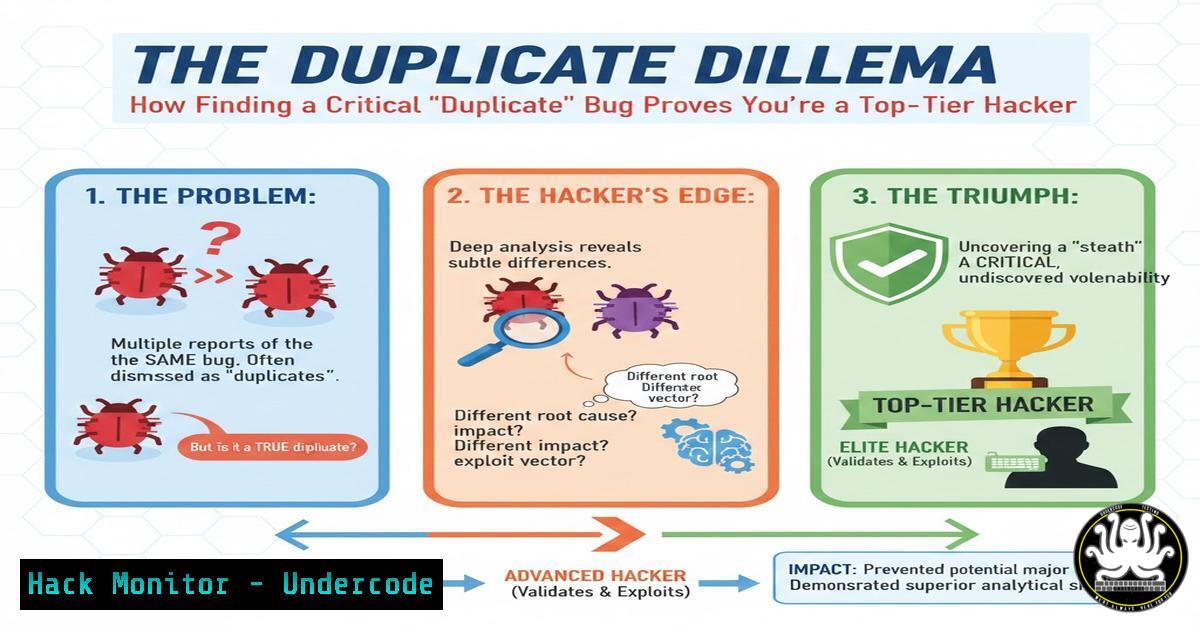
In the competitive arena of bug bounty hunting, discovering a critical vulnerability only to have it marked as a duplicate is often seen as a failure. However, this experience is a critical rite of passage and a definitive indicator that a researcher’s methodology, technical depth, and threat modeling align with the elite. This article deconstructs the journey behind a duplicate report, transforming perceived setback into a masterclass in professional vulnerability research.
Learning Objectives:
- Reframe the psychology of duplicate reporting from disappointment to a validation of skill.
- Systematize a replicable methodology for vulnerability discovery, validation, and reporting.
- Implement advanced reconnaissance and validation techniques used by top bounty hunters.
You Should Know:
1. The Mindset Shift: Duplicate as a Benchmark
The initial sting of a duplicate report is emotional, but the technical reality is different. Finding a high-severity duplicate means your independent research converged on the same attack vector as another skilled researcher. This is a quality benchmark. It validates that your target scoping, understanding of the application’s attack surface, and vulnerability hypothesis were correct.
Step‑by‑step guide:
Post-Submission Analysis: When you receive a duplicate closure, immediately request details on the disclosure policy. Some programs share the time difference between reports.
Gap Analysis: Objectively compare your report’s depth to the public write-ups you later find. Did you miss an exploitation edge case? Was your proof-of-concept (PoC) less comprehensive?
Journaling: Maintain a private log of your thought process for each finding. Reviewing this after a duplicate closure helps identify and reinforce successful thinking patterns.
- Pre-Hunt Reconnaissance: Mapping the Attack Surface Like a Pro
Duplicates often occur because researchers are looking at the same entry points. To find unique bugs, you must see the target differently. This requires broadening your recon beyond standard subdomain enumerations.
Step‑by‑step guide:
Asset Discovery: Use project discovery tools to find related domains, cloud buckets, and forgotten subdomains.
 Using subfinder and httpx for live subdomain discovery
subfinder -d target.com -silent | httpx -silent -status-code -title -tech-detect -o live_subs.txt
 Using amass for passive and active mapping
amass enum -passive -d target.com -o passive_subs.txt
Technology Stack Analysis: Identify all JavaScript files, API endpoints, and third-party services. Look for deprecated libraries or misconfigured cloud services (S3, Azure blobs) other hunters might overlook.
 Using waybackurls and gau to gather historical URLs and parameters
echo "target.com" | waybackurls | grep ".js$" > js_files.txt
echo "target.com" | gau | grep "=" | sort -u > parameters.txt
3. Vulnerability Validation: Proving Impact Beyond “It Works”
A critical severity (CVSS 9-10) requires demonstrating real-world impact like data breach, account takeover, or system compromise. Your validation steps must be airtight and documented.
Step‑by‑step guide:
Isolate the Variable: Create a controlled test to prove the flaw is in the target system, not a false positive. Use a local proxy like Burp Suite to manipulate requests.
Craft a Deterministic PoC: Write a script that reliably reproduces the issue. This is crucial for triagers.
 Example Python PoC for a hypothetical IDOR (Insecure Direct Object Reference)
import requests
import sys

target_url = "https://api.target.com/v1/user/{id}/profile"
headers = {"Authorization": "Bearer YOUR_VALID_TOKEN"}

for user_id in range(1000, 1005):
resp = requests.get(target_url.format(id=user_id), headers=headers)
if resp.status_code == 200 and "email" in resp.text:
print(f"[+] Vulnerable! Accessed data for UID: {user_id}")
print(f" Data: {resp.json()['email']}")
Document the Chain: If the bug requires multiple steps (e.g., XSS to steal token to API access), document each step with screenshots and curl commands.
- Report Crafting: The Art of Clear, Actionable Disclosure
A poorly written report can lead to delays, misunderstandings, or even rejection. A great report is a technical document that enables swift remediation.
Step‑by‑step guide:
Structure: Use a clear template: Summary, Vulnerability Details (Steps to Reproduce, PoC), Impact, Proposed Remediation.
Evidence: Embed annotated screenshots, videos (screen-to-gif tools are ideal), and raw HTTP requests/responses.
Impact Analysis: Clearly articulate the business risk. Instead of “can steal data,” say “This IDOR allows any authenticated user to retrieve the PII (email, address) of all other users, violating GDPR 32.”
5. Toolchain Hardening: Configuring Your Hunting Environment
Efficiency separates finders from duplicators. A configured, automated environment allows you to test hypotheses faster.
Step‑by‑step guide:
Browser Setup: Use a dedicated browser profile with Burp Suite as the proxy, and critical extensions (FoxyProxy, Wappalyzer, Hunter, Retire.js).
Automated Scanning Caution: Use tools like Nuclei not for mindless scanning, but for targeted checks based on your recon.
 Run nuclei only on endpoints found to use a specific tech
cat live_subs.txt | httpx -silent | nuclei -t /nuclei-templates/technologies/wordpress-detection.yaml -o wp_targets.txt
cat wp_targets.txt | nuclei -t /nuclei-templates/vulnerabilities/wordpress/ -o wp_vulns.txt
Knowledge Management: Use Obsidian or Notion to link findings, code snippets, and target notes for cross-pollination of ideas.
6. Post-Duplicate Workflow: Converting Loss into Learning
The work doesn’t stop at “Duplicate.” This is the most critical phase for growth.
Step‑by‑step guide:
Pattern Recognition: Analyze the vulnerability class. Was it a logic flaw in a multi-step process? A server-side request forgery (SSRF) in a webhook handler? Deeply study that vulnerability class across other targets.
Expand the Attack: Could the same root cause manifest elsewhere in the same target? The duplicate might be for /api/v1/user/[bash], but does `/api/v2/admin/[bash]` or `/legacy/user/[bash]` have the same issue?
Network & Engage: Follow the researcher who got the bounty. Study their public reports. Engage respectfully in community discussions about similar bugs.
What Undercode Say:
- A Duplicate Critical is a Merit Badge: It is empirical proof that your skills are production-grade. The only missing variable was time, which is mitigated by consistency and process refinement.
- The Real Bounty is in the Methodology: The cash reward is ephemeral. The refined, repeatable process you build from analyzing both hits and duplicates compounds, leading to more unique findings over time.
The emotional intelligence to process rejection and the systematic rigor to learn from it are the true differentiators. Hunting is a probabilistic game; by treating each duplicate as a data point confirming your technical direction, you remove emotion from the equation and turn persistence into a scientific process. This iterative honing of instinct and technique is what eventually creates the first-to-find researcher.
Prediction:
The bug bounty landscape will increasingly leverage AI for initial surface area analysis and duplicate detection, making human creativity in attack vector design even more valuable. Platforms will likely introduce “partial credit” or skill-based metrics for high-quality duplicate reports to better incentivize and retain researchers. Furthermore, we will see a rise in collaborative hunting platforms where researchers can team up pre-submission to combine unique perspectives on a target, thereby reducing duplicate rates and increasing the discovery of complex, chained vulnerabilities that solo hunters might miss. The community will mature from pure competition to a hybrid model of cooperative competition.
▶️ Related Video (80% Match):
🎯Let’s Practice For Free:
IT/Security Reporter URL:
Reported By: Skideveloper Bugbounty – Hackers Feeds
Extra Hub: Undercode MoN
Basic Verification: Pass ✅


