Listen to this Post
Introduction:
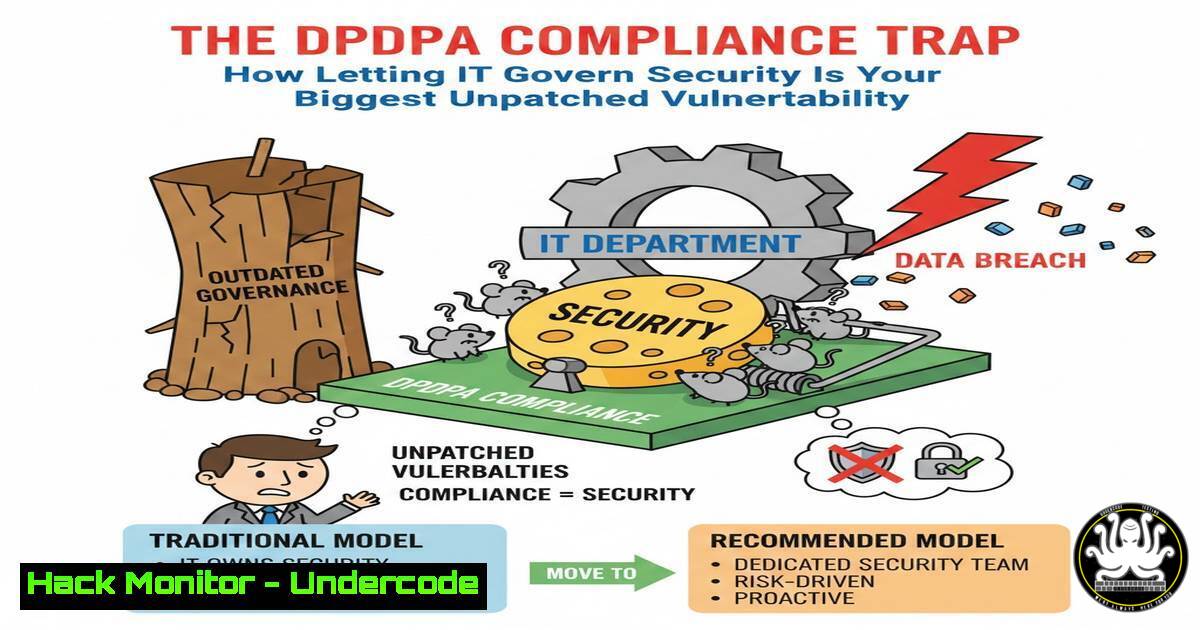
The Digital Personal Data Protection Act (DPDPA) 2023 represents a watershed moment for data privacy in India, yet a critical governance flaw threatens to undermine its implementation. Organizations without a dedicated Chief Information Security Officer (CISO) are erroneously conflating IT operations with security governance and misassigning security duties to the Data Protection Officer (DPO). This creates a “structural vulnerability” where compliance is performative, not substantive, leaving data exposed despite checkbox audits. This article dissects this governance gap and provides a technical blueprint for establishing a defensible security posture under the DPDPA.
Learning Objectives:
- Understand the critical distinction between IT Operations, Security Governance, and Privacy Governance (DPO) roles.
- Identify the technical control gaps that emerge when governance is misplaced.
- Implement practical, actionable steps to establish minimum viable security governance, including technical configurations for IAM, logging, and encryption.
You Should Know:
- The Structural Vulnerability: IT’s Inherent Conflict of Interest
When IT departments are tasked with both maintaining systems (operations) and defining the security rules for those systems (governance), a fundamental conflict arises. IT’s key performance indicators are uptime, speed, and delivery, which often directly conflict with security controls that can introduce latency, complexity, or access restrictions. Without independent oversight, risk is “accommodated” rather than “challenged,” leading to informal, undocumented risk acceptance.
Step‑by‑step guide explaining what this does and how to use it:
Step 1: Identify Self-Reviewed Controls. Audit your control framework. Where is the same team that implements a control also responsible for its design and effectiveness review? Common examples include:
IAM Rules: The team managing Active Directory/Azure AD also defines the privileged access policy.
Firewall Rules: Network engineers who need ports open for applications are also the sole approvers of firewall rule changes.
Patch Management: The team deciding patch schedules is also measured on system stability.
Step 2: Introduce a Technical Governance Checkpoint. For high-risk changes, implement a mandatory technical review by an independent party (e.g., a fractional CISO, an external advisor). This can be enforced via workflow tools.
Example – Technical Implementation: For a critical firewall rule change request, use a tool like Terraform with a Git-based workflow. The IT engineer submits a Pull Request (PR) modifying the rule set. This PR must be approved by a “SecurityGovernance” user in GitHub/GitLab before it can be merged and applied.
Command-Line (Conceptual): `terraform plan -var=”new_rule=’permit tcp any any'”` → Engineer creates PR → Security governance reviews `plan` output → `terraform apply` is auto-run post-approval.
- DPO vs. Security Governance: A Critical Category Error
The DPO is a privacy governance role mandated by the DPDPA, focused on lawfulness, fairness, transparency, and data subject rights. They are not security architects or engineers. Expecting a DPO to govern security controls is a “category error” that leaves critical gaps in technical defenses.
Step‑by‑step guide explaining what this does and how to use it:
Step 1: Map Responsibilities Clearly.
DPO (Privacy Governance): Manages Data Privacy Impact Assessments (DPIAs), data subject request workflows, vendor privacy clauses, and privacy notice compliance. They answer “Are we processing data lawfully?”
Security Governance: Defines the technical and organizational measures. They answer “Is the data secured against unauthorized access or loss?”
Step 2: Establish a Collaboration Protocol. The DPO and Security Governance lead must collaborate. For instance, the DPO identifies “special category” data in a DPIA. Security Governance then translates this into technical controls.
Example – Technical Implementation: The DPO identifies that customer health records in `Database_A` require enhanced protection. Security Governance mandates encryption-at-rest and stricter access logs.
Linux Command (for audit): `sudo grep -r “health_record” /var/log/postgresql/` to check for unlogged access queries (if logging is misconfigured).
AWS CLI Command (for control): `aws kms encrypt –key-id alias/my-health-key –plaintext fileb://healthdata.json –output text –query CiphertextBlob` – Ensuring encryption via Key Management Service.
- Building Minimum Viable Security Governance: The Technical Controls
You don’t need a full-time CISO to start. A fractional CISO or an internal “Security Head” with clear authority can define the control framework. The core is establishing policy that IT operates under.
Step‑by‑step guide explaining what this does and how to use it:
Step 1: Define the “Security Baseline” Policy. This is a non-negotiable set of technical standards. Key elements include:
IAM Policy: Enforce Least Privilege. Require Just-In-Time (JIT) access for administrative accounts. Mandate Multi-Factor Authentication (MFA) for all cloud and privileged access.
Encryption Standard: All data at rest (databases, backups) must use AES-256 encryption. All data in transit must use TLS 1.2+.
Logging & Monitoring: All critical systems must forward logs to a central SIEM. Retention period: Minimum 180 days.
Step 2: Implement Enforceable Technical Standards.
For Cloud (AWS Example – IAM): Use AWS IAM Roles and Policies. Create a policy that denies creating access keys without MFA.
{
"Version": "2012-10-17",
"Statement": [
{
"Sid": "DenyCreateAccessKeyWithoutMFA",
"Effect": "Deny",
"Action": "iam:CreateAccessKey",
"Resource": "",
"Condition": {"BoolIfExists": {"aws:MultiFactorAuthPresent": "false"}}
}
]
}
For On-Prem (Linux – Logging): Configure `auditd` to monitor access to sensitive files and forward to a SIEM.
 Add to /etc/audit/audit.rules
-w /etc/passwd -p wa -k identity_access
-w /var/www/html/ -p rwa -k web_access
 Install & configure filebeat to ship logs
sudo apt-get install filebeat
sudo filebeat modules enable auditd
- Closing the Gap: From Informal Risk to Formal Acceptance
When IT operates without governance, risk acceptance is ad-hoc and undocumented. Security Governance formalizes this process, forcing business-level accountability.
Step‑by‑step guide explaining what this does and how to use it:
Step 1: Establish a Risk Register. Use a simple tool (a spreadsheet or a GRC platform) to track identified risks.
Step 2: Implement a Risk Acceptance Workflow. Any deviation from the Security Baseline must be documented.
Process: 1) IT identifies a needed exception (e.g., an old server cannot be patched). 2) They document the risk (CVE, likelihood, impact). 3) Security Governance reviews and proposes compensating controls (e.g., network segmentation, WAF rules). 4) The business owner (not IT) formally accepts the residual risk in writing.
Technical Compensation Example: Isolate the unpatched server.
Windows Firewall Command: `New-NetFirewallRule -DisplayName “Isolate_Server” -Direction Inbound -RemoteAddress “192.168.1.0/24” -Action Block` (Only allow from specific subnet).
Network Segmentation: Configure VLANs and ACLs on the switch/router to restrict traffic flow.
5. Enabling Defensible Compliance: The Auditor’s Lens
An auditor will look for evidence that controls are not only designed but operating effectively. Clear separation of duties provides this evidence and makes compliance “defensible.”
Step‑by‑step guide explaining what this does and how to use it:
Step 1: Generate Artifacts of Governance. Security Governance should produce:
Quarterly security policy reviews.
Signed risk acceptance forms.
Minutes from meetings challenging IT-proposed changes.
Step 2: Demonstrate Technical Control Operation.
Example – Prove Logging Works: From the SIEM, run a query showing privileged user activity and MFA use. Provide this as evidence.
SIEM Query (Splunk-like): `index=aws_cloudtrail eventName=ConsoleLogin | stats count by userIdentity.arn, responseElements.ConsoleLogin`
Example – Prove Encryption: Run a script to check database encryption status.
MySQL Command: `SELECT TABLE_SCHEMA, TABLE_NAME, CREATE_OPTIONS FROM INFORMATION_SCHEMA.TABLES WHERE CREATE_OPTIONS LIKE ‘%ENCRYPTION%’;`
What Undercode Say:
- Governance is a Non-Delegatable Technical Control: Just as you wouldn’t let developers self-approve code deployments to production without oversight, you cannot let IT self-govern security. The technical controls (encryption, IAM, logging) are only as strong as the governance framework that mandates and verifies them.
- The DPO is Your Privacy Compass, Not Your Security Firewall: The DPO ensures you are on the right road legally, but Security Governance builds the guardrails, airbags, and brakes for the journey. Conflating the two roles guarantees a catastrophic failure in one or both areas.
Analysis: Bodda’s post exposes a systemic issue in mid-market organizations globally, not just in India. The core problem is viewing security as a technical implementation rather than a management system. IT’s operational excellence culture is antithetical to the precautionary, challenge-driven culture of security. The DPDPA, like GDPR, acts as a catalyst, making this governance debt visible and costly. The solution isn’t necessarily capital-intensive; it’s about clarity of roles, authority, and process. Fractional or virtual CISO services are a pragmatic market response to this exact gap, providing the necessary governance layer without the full-time executive cost. The organizations that succeed will be those that recognize security governance as a distinct, critical business function that enables both compliance and resilience.
Prediction:
Within the next 18-24 months, the first major DPDPA penalties will not stem from malicious breaches, but from investigations into “preventable” incidents that reveal an absolute lack of independent security governance. This will create a watershed moment, triggering a rush towards fractional CISO and managed security governance services in the Indian market. Additionally, cybersecurity insurance providers will increasingly mandate evidence of separated IT and security governance roles as a precondition for coverage, turning this operational model into a financial imperative. The era of IT-led security is ending, replaced by a model of governed IT.
▶️ Related Video (80% Match):
🎯Let’s Practice For Free:
IT/Security Reporter URL:
Reported By: Rajendra Bodda – Hackers Feeds
Extra Hub: Undercode MoN
Basic Verification: Pass ✅


