Listen to this Post
Introduction:
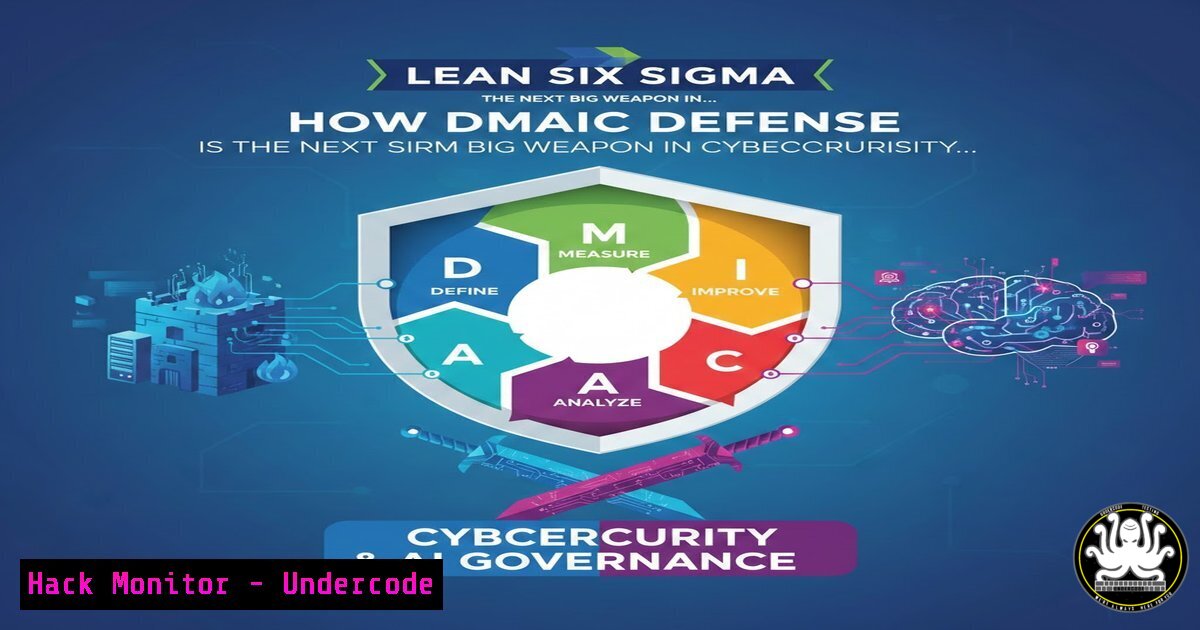
In an era of escalating cyber threats and complex AI regulations, organizations are seeking methodologies that provide measurable, repeatable security improvements. The rigorous, data-driven DMAIC framework from Lean Six Sigma is emerging as a powerful system for hardening defenses, managing AI risk, and achieving compliance with standards like ISO 42001 and the EU AI Act, moving beyond checkbox security to genuine systemic resilience.
Learning Objectives:
- Understand how to map the DMAIC (Define, Measure, Analyze, Improve, Control) lifecycle to cybersecurity incident response and AI governance programs.
- Apply Lean Six Sigma tools like SIPOC, Pareto Analysis, and CTQ Trees to prioritize security investments and quantify risk.
- Integrate the “Three Voices” (Customer, Business, Regulator) into a unified security strategy that balances protection, cost, and compliance.
You Should Know:
- Define Phase: Securing Your Value Stream with Threat Modeling
The Define phase sets the project scope. In cybersecurity, this means defining the “Critical-to-Quality” (CTQ) security outcomes for a specific process or application. Start by creating a SIPOC (Suppliers, Inputs, Process, Outputs, Customers) diagram for the system you’re securing. This exposes every touchpoint where data can be compromised.
Step‑by‑step guide:
- Identify the Process: Select a high-value process (e.g., “User Authentication Flow” or “AI Model Training Data Pipeline”).
- Map the SIPOC: List all Suppliers (e.g., IAM provider, data vendors), Inputs (credentials, training datasets), Process steps, Outputs (access tokens, trained model), and Customers (end-users, downstream applications).
- Conduct Threat Modeling: Use the SIPOC as a guide for a structured threat modeling session using the STRIDE model (Spoofing, Tampering, Repudiation, Information Disclosure, Denial of Service, Elevation of Privilege). For each element in your SIPOC, ask: “How could it be compromised via STRIDE?”
- Define CTQs: Convert findings into measurable security requirements. E.g., “Authentication spoofing attempts must be detected and blocked with 99.9% efficacy (CTQ).”
-
Measure Phase: Quantifying Risk with DPMO for Vulnerabilities
You can’t improve what you don’t measure. Lean Six Sigma uses Defects Per Million Opportunities (DPMO). Translate this to Vulnerabilities Per Million Lines of Code or Security Misconfigurations Per Cloud Asset.
Step‑by‑step guide:
- Establish a Baseline: Use automated tools to scan your environment.
Linux Command (using Trivy for containers): `trivy image –severity CRITICAL,HIGH your-app:latest`
Windows Command (using built-in tools): `Test-NetConnection -ComputerName target -Port 443` (to check for open, measurable endpoints). - Calculate Your Security DPMO: For example, if your web app has 500,000 lines of code (LOC) and your SAST tool finds 25 critical/high vulnerabilities, your DPMO = (25 / 500,000) 1,000,000 = 50,000.
-
Benchmark: Compare this figure to industry baselines or your own past performance to gauge the scale of the problem objectively.
-
Analyze Phase: Root Cause Analysis with The 5 Whys & Pareto for Incident Response
When a security incident occurs, superficial fixes are costly. Use the 5 Whys and Pareto Principle (80/20 Rule) to find the root cause.
Step‑by‑step guide:
- Collect Incident Data: Aggregate logs from SIEM, endpoint detection, and cloud trails.
2. Apply the 5 Whys:
Why 1: The server was breached. Why? A vulnerable library (Log4j) was exploited.
Why 2: Why was the vulnerable library present? The patch was not applied.
Why 3: Why was the patch not applied? The automated patch management system failed for that asset class.
Why 4: Why did it fail? The system’s API call to the inventory DB times out for assets with a specific tag.
Why 5 (Root Cause): Why does it time out? The inventory DB query is not indexed on the asset-tag column, causing full-table scans and timeouts.
3. Pareto Analysis: Analyze the last 100 incidents. You’ll likely find 80% stem from 20% of root causes (e.g., misconfigured IAM roles, unpatched middleware). Focus your “Improve” phase here.
4. Improve Phase: Hardening Systems with Automated Controls
The Improve phase is about implementing and validating fixes. Automate security controls based on your root cause analysis.
Step‑by‑step guide (Automating Patch Compliance):
- Design the Fix: Create an Ansible playbook to ensure patching and verify the fix for the DB index issue from the Analyze phase.
2. Implement Code (Example Ansible Snippet):
- name: Ensure critical security patches are applied
hosts: web_servers
become: yes
tasks:
- name: Update apt cache (Linux)
apt:
update_cache: yes
cache_valid_time: 3600
when: ansible_os_family == "Debian"

<ul>
<li>name: Apply security updates only
apt:
name: ""
state: latest
update_cache: yes
upgrade: 'dist'
autoremove: yes
when: ansible_os_family == "Debian"
- Validate: Re-run your DPMO measurement (e.g.,
trivy scan) to confirm a reduction in vulnerabilities attributable to patching. -
Control Phase: Sustaining Security with Continuous Monitoring & AI Governance
The Control phase ensures improvements are sustained. For AI systems, this aligns directly with ISO 42001 and EU AI Act requirements for continuous monitoring and human oversight.
Step‑by‑step guide (AI Model Drift Detection):
- Establish Control Charts: Monitor your AI model’s performance and fairness metrics over time.
2. Implement Drift Detection Script (Python Example):
from alibi_detect.cd import KSDrift
import numpy as np

Reference data (baseline performance)
X_ref = np.load('baseline_data.npy')

Initialize detector
detector = KSDrift(X_ref, p_val=0.05)

New production data batch
X_new = np.load('latest_production_batch.npy')
preds = detector.predict(X_new)

if preds['data']['is_drift']:
print("ALERT: Model input drift detected! Trigger review per AI Act 15.")
 Log incident, notify model owner, trigger retraining pipeline
3. Document for Compliance: This automated check provides auditable evidence for “Voice of the Regulator” compliance, showing systematic control.
What Undercode Say:
- Process Rigor is a Technical Control: The most advanced firewall is useless if the process for managing its rules is ad-hoc. Lean Six Sigma provides the procedural backbone that turns technical tools into a reliable system.
- Arbitrating the “Three Voices” is the Core of Modern Security: The “Voice of the Customer” (privacy, uptime), “Business” (cost, agility), and “Regulator” (GDPR, AI Act) are often in tension. Security leaders must use data from DMAIC to make conscious, defensible trade-offs, moving from saying “no” to guiding “how.”
Prediction:
Within two years, formal process improvement methodologies like Lean Six Sigma and Agile/DevSecOps will converge into a new standard for cybersecurity and AI risk management. Regulatory pressure from DORA, the EU AI Act, and others will mandate not just what to secure, but how to manage the security process itself. Organizations that have embedded DMAIC discipline will pass audits with less friction, adapt to new threats faster, and demonstrate quantifiable ROI on security spending, turning their security office from a cost center into a demonstrable value engine.
▶️ Related Video (74% Match):
🎯Let’s Practice For Free:
IT/Security Reporter URL:
Reported By: Rammohanthiru %F0%9D%97%9E%F0%9D%97%B6%F0%9D%97%B0%F0%9D%97%B8%F0%9D%97%B6%F0%9D%97%BB%F0%9D%97%B4 – Hackers Feeds
Extra Hub: Undercode MoN
Basic Verification: Pass ✅


