Listen to this Post
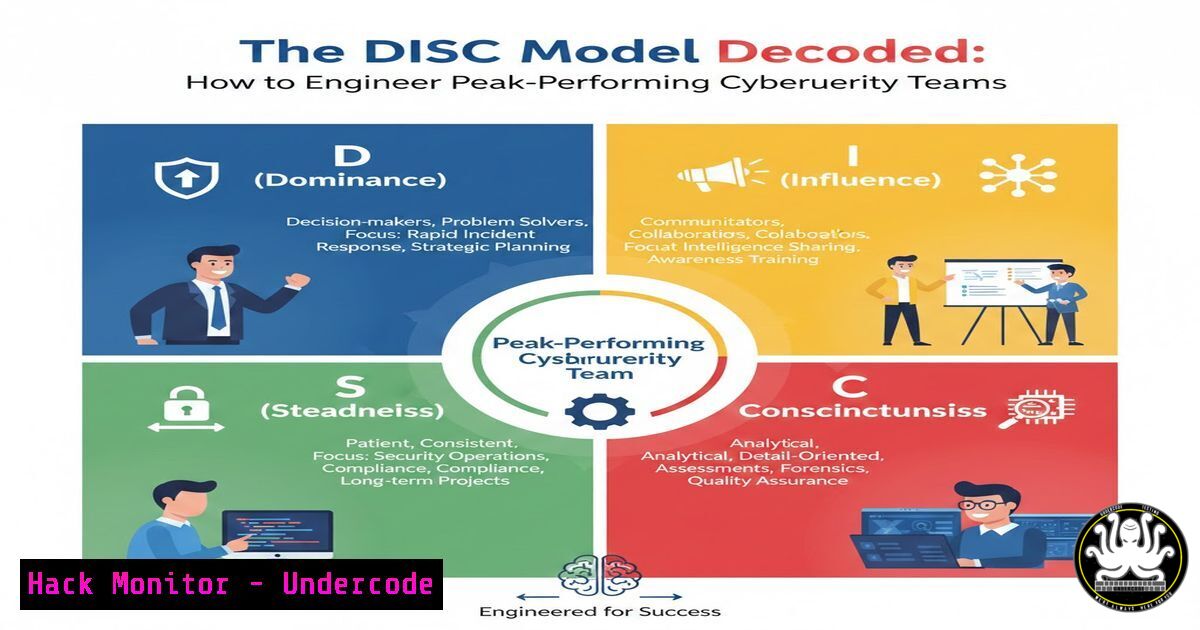
Introduction:
In the high-stakes world of cybersecurity, technical prowess is only half the battle. The other, often neglected half, is human dynamics. The DISC behavioral model provides a powerful framework for understanding communication styles within your Security Operations Center (SOC), incident response team, and development teams, directly impacting your organization’s security posture. By tailoring your leadership and communication to these styles, you can reduce misconfigurations, accelerate incident response, and foster a culture of shared security responsibility.
Learning Objectives:
- Understand the four core DISC behavioral styles and how they manifest in technical roles.
- Learn to adapt security briefings, incident commands, and code reviews to different communication preferences.
- Apply practical techniques to reduce human error and improve collaboration across security and IT functions.
You Should Know:
- Dominance (D) in Incident Command: Clarity and Autonomy
The ‘D’ style thrives on directness and results. In a security context, these are your incident commanders and penetration testers. They want the bottom line: what is the threat, what is the impact, and what action do you need them to take. Ambiguity and excessive process can frustrate them and slow down critical response efforts.
Step‑by‑step guide explaining what this does and how to use it.
Scenario: A critical vulnerability (e.g., Log4Shell) is announced, and immediate patching is required.
Ineffective Communication: “Team, there’s a new vulnerability. It’s pretty bad. We should probably look into our systems and see if we’re affected when we get a chance.”
Effective Communication for a ‘D’:
- State the Objective Clearly: “Our objective is to patch all internet-facing Java applications against CVE-2021-44228 within the next 4 hours to prevent RCE.”
- Define the “Why”: “This is a CVSS 10.0 vulnerability with active exploitation. Failure to patch could lead to a full domain compromise.”
- Grant Autonomy: “You have authority to deploy the emergency patch. Use the `find` command to locate vulnerable `.jar` files and report your patch status directly to me.”
Technical Command Example (Linux):
 Command a 'D' would appreciate for its directness and action-orientation
find / -name ".jar" -type f -exec grep -l "JndiLookup" {} \;
- Conscientiousness (C) in Secure Code Review: Precision and Data
The ‘C’ style is analytical, detail-oriented, and values accuracy. These are your security auditors, reverse engineers, and architects. They need data, evidence, and well-documented procedures. Rushing them or providing vague requirements can lead to overlooked vulnerabilities.
Step‑by‑step guide explaining what this does and how to use it.
Scenario: Requesting a security review for a new authentication module.
Ineffective Communication: “Can you check if this login code is secure?”
Effective Communication for a ‘C’:
- Provide Structured Data: “Please review the Pull Request 45 for the new auth module against the OWASP ASVS checklist, specifically sections 2 (Authentication) and 3 (Session Management).”
- Give Time to Process: “I need your analysis by EOD tomorrow. Please document any findings with the exact code snippet, the potential impact, and a suggested remediation.”
- Reference Standards: “Focus on ensuring the password hashing uses Argon2id with these parameters and that the session tokens are generated using a cryptographically secure random function.”
Technical Reference Example (Code Comment):
 For 'C' Reviewer: This function uses bcrypt with 12 rounds.
 OWASP recommends a work factor of 10. Please verify if 12 is sufficient for our use case.
password_hash = bcrypt.hashpw(password, bcrypt.gensalt(rounds=12))
- Influence (i) in Security Awareness Training: Engagement and Collaboration
The ‘i’ style is enthusiastic, collaborative, and people-focused. They are your security champions within development teams or your front-line SOC analysts who need to communicate alerts. They respond best to positive reinforcement and collaborative problem-solving.
Step‑by‑step guide explaining what this does and how to use it.
Scenario: Rolling out a new phishing simulation campaign.
Ineffective Communication: “Mandatory phishing training is in your inbox. Complete it.”
Effective Communication for an ‘i’:
- Create Energy: “Team, we’re launching a ‘Phish-Foilers’ campaign this week! Let’s see who can spot the bait and help keep our company safe.”
- Make it Collaborative: “We’ll have a leaderboard and shout-outs for the top detectors. Share your tips in the security-champions Slack channel!”
- Provide Positive Feedback: “Great job, Sarah! You were the first to report the simulated phishing email. Your vigilance is what makes our defense strong.”
-
Steadiness (S) in SOC Operations: Stability and Support
The ‘S’ style is patient, reliable, and values a stable, harmonious environment. These are the steady hands in your SOC who manage alert fatigue and perform consistent monitoring. They need clear expectations, reassurance, and a blame-free culture to report potential incidents.
Step‑by‑step guide explaining what this does and how to use it.
Scenario: A junior analyst is investigating a potentially malicious PowerShell script.
Ineffective Communication: “Why is this alert still open? Is it bad or not? Hurry up.”
Effective Communication for an ‘S’:
- Be Reassuring: “Take your time with this investigation. It’s better to be thorough.”
- Provide a Structured Process: “Follow our runbook for suspicious PowerShell. First, check the command-line arguments in the EDR console. Then, cross-reference the script hash with VirusTotal. I’m here if you need a second opinion.”
- Focus on Team Stability: “Remember, our goal is to learn from every alert, whether it’s a true or false positive. Your careful work makes the whole team better.”
Technical Command Example (Windows/EDR Query):
 A structured query for an 'S' to execute methodically
Get-EDREvent -Filter "ProcessName = 'powershell.exe'" -TimeRange "Last 1 Hour" | Where-Object CommandLine -Match "Invoke-Expression"
5. Integrating DISC into DevSecOps Pipelines
A mature security program embeds checks into the software development lifecycle. Understanding DISC helps you design these checks to be accepted, not resisted.
Step‑by‑step guide explaining what this does and how to use it.
For D (Developer): Integrate fast, actionable security tools directly into their IDE or CLI, like static analysis that fails the build immediately with a clear reason.
Command: `sast-scan –fail-on high –output concise`
For C (Architect/Lead): Provide comprehensive, data-rich reports post-build from Software Composition Analysis (SCA) tools, detailing all dependencies and their associated CVEs.
Command: `sca-scan –detailed-report –export json –output sca-report.json`
For i (Team): Use gamified dashboards that show the team’s progress in reducing vulnerabilities and celebrate milestones.
For S (Ops): Ensure security gates in the pipeline are predictable and non-punitive, providing clear rollback procedures if a security check fails in production.
What Undercode Say:
- Human Factor is the Critical Vulnerability: The most advanced technical controls can be undermined by communication breakdowns. Tailoring communication to behavioral styles is not “soft skills”—it’s a essential risk mitigation strategy.
- Intentional Communication is a Force Multiplier: By speaking the language of your team members, you reduce the cognitive load and friction that leads to burnout, misconfigurations, and slow incident response, ultimately creating a more resilient security organization.
Analysis: The original post highlights a universal leadership truth, but in the context of cybersecurity, its implications are profound. A ‘D’ style CISO might dismiss a ‘C’ analyst’s nuanced risk report as pedantry, missing a critical threat. An ‘i’ style developer might skip rigorous security testing if it’s presented as a bureaucratic hurdle rather than a collaborative challenge. Applying the DISC framework allows security leaders to engineer human systems that are as robust as their technical ones. This leads to a culture where security is built in, not bolted on, because the people involved feel understood, respected, and communicated with effectively.
Prediction:
The future of cybersecurity leadership will increasingly rely on this blend of technical and social intelligence. As AI and automation handle more routine tasks, the human role will shift towards complex decision-making, cross-team orchestration, and managing psychological safety during crises. Leaders who master frameworks like DISC will be better equipped to build adaptive, high-trust teams capable of defending against not just technical exploits, but the human error and internal friction that often enable them. This will become a key differentiator between organizations that are merely compliant and those that are truly resilient.
🎯Let’s Practice For Free:
IT/Security Reporter URL:
Reported By: Pradykumaar Leadershipdevelopment – Hackers Feeds
Extra Hub: Undercode MoN
Basic Verification: Pass ✅


