Listen to this Post
Introduction
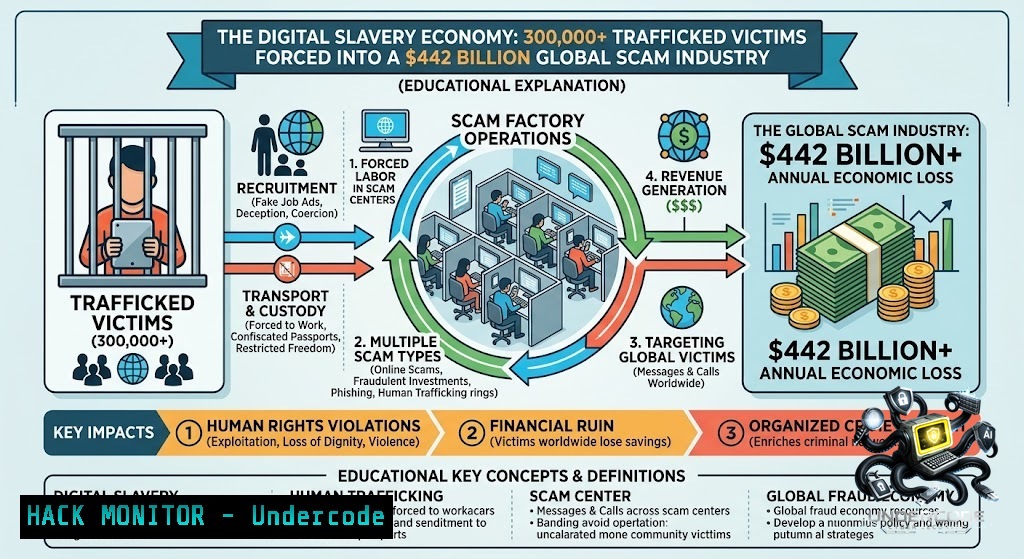
The person behind that random scam call or investment pitch may not be a criminal by choice—they could be one of over 300,000 people trapped in cyber-scam operations across Southeast Asia, held in debt bondage with confiscated passports and forced to meet daily financial quotas under threat of violence. According to the UNODC, human trafficking has evolved into an $18+ billion illicit industry, with trafficking for forced criminality surging from just 1 percent a decade ago to 8 percent today. While movie myths teach us to look for violent abductions and physical chains, today’s reality is that job seekers go through professional interviews and sign six-month contracts for fake customer service roles—only to end up trapped in scam compounds.
Learning Objectives
- Understand the scale and mechanics of the global cyber-scam compound industry, including how traffickers use legitimate-looking recruitment processes to trap victims
- Identify the technical infrastructure powering these operations—from VoIP systems and AI deepfake tools to cloud services and cryptocurrency laundering networks
- Implement defensive measures across Linux and Windows environments to detect, block, and disrupt scam-related infrastructure
You Should Know
1. The Industrialization of Cyber-Scam Operations
Modern scam centers more closely resemble commercialized cybercrime enterprises than backroom hustles, complete with onboarding processes, sales scripts, performance quotas, and structured shifts. The UNODC has documented that criminal networks operating out of Southeast Asia have evolved into a sophisticated global industry, with hundreds of large-scale scam farms generating tens of billions of dollars in annual profits. These operations have expanded beyond Southeast Asia into South America and Africa, with the UNODC describing the spread as a “cancer” that simply migrates when authorities crack down in one area.
Victims are typically recruited through fraudulent job advertisements on social media and legitimate job platforms, promised high-paying customer service or IT roles. Once transported to compounds primarily located in Cambodia, Myanmar, Laos, the Philippines, and Malaysia, they are deprived of their liberty and subjected to torture, beatings, electrocution, solitary confinement, and sexual violence. They are forced to work 10 to 16 hours daily with little to no pay, and failure to meet quotas results in severe punishment.
The financial scale is staggering. INTERPOL’s 2026 Global Financial Fraud Threat Assessment estimated that global losses from financial fraud reached $442 billion in 2025. The United States alone reported more than $5.6 billion in losses to cryptocurrency scams in 2023, including “pig-butchering” romance-investment scams designed to extort money from often elderly and vulnerable people.
2. The Technical Infrastructure Powering Scam Compounds
Scam compounds operate as hybrid digital-physical entities relying on a sophisticated technology stack that includes VoIP systems, AI tools, cloud infrastructure, and global money-mule networks. Understanding this infrastructure is critical for defenders.
Voice Over IP (VoIP) and Caller ID Spoofing
Scam call centers extensively use VoIP systems to conduct fraud at scale. Attackers exploit poorly secured PBX systems and SIP endpoints through weak passwords and outdated software. Common attack patterns include:
- Brute-force attacks on SIP extensions and accounts
- Abuse of DISA (Direct Inward System Access), IVR, and voicemail systems
- False Answer Supervision (FAS)—manipulating systems to register calls as answered when they are not
Linux Command to Detect Suspicious SIP Traffic:
 Monitor SIP traffic on port 5060
sudo tcpdump -i any -1n port 5060 -v

Log all SIP INVITE requests to detect brute-force attempts
sudo tcpdump -i any -1n port 5060 -v | grep "INVITE" >> /var/log/sip_monitor.log

Use iptables to rate-limit SIP requests (prevent brute-force)
sudo iptables -A INPUT -p udp --dport 5060 -m limit --limit 10/minute -j ACCEPT
sudo iptables -A INPUT -p udp --dport 5060 -j DROP
Windows PowerShell Commands for VoIP Security:
 Check for unauthorized SIP connections
Get-1etTCPConnection -RemotePort 5060 | Where-Object {$_.State -eq "Established"}

Monitor outbound call patterns (requires administrative privileges)
Get-WinEvent -LogName Security -FilterXPath "[System[EventID=4624]]" |
Where-Object {$_.Message -match "5060"}
AI-Powered Scam Automation
Artificial intelligence has become a force multiplier for scam operations. Traffickers now deploy AI to generate realistic ads, conduct scams, and produce fake content, while cryptocurrencies and digital payment systems obscure financial flows. AI voice cloning can replicate a person’s voice from as little as ten seconds of audio, enabling scammers to impersonate family members in distress or colleagues requesting urgent transfers.
Detection Techniques for AI-Generated Content:
 Analyze audio files for potential deepfake artifacts using Python
pip install librosa numpy scipy
 Script to detect spectral anomalies in voice samples
python -c "
import librosa
import numpy as np
audio, sr = librosa.load('suspicious_audio.wav', sr=None)
spectral_centroid = librosa.feature.spectral_centroid(y=audio, sr=sr)
if np.mean(spectral_centroid) > 3000:
print('Potential AI-generated voice detected - unusual frequency distribution')
"
Windows Command to Verify Caller Identity:
 Use PowerShell to cross-reference caller ID with known legitimate numbers
$callerID = "1234567890"
$knownContacts = Import-Csv "C:\Security\verified_contacts.csv"
if ($knownContacts.Phone -contains $callerID) {
Write-Host "Caller verified" -ForegroundColor Green
} else {
Write-Host "UNVERIFIED CALLER - Potential spoofing" -ForegroundColor Red
 Trigger alert
}
3. Cloud Services and Infrastructure Abuse
A major investigation by the Associated Press and FRONTLINE revealed how American technology is being exploited by scam centers, particularly in Myanmar. The investigation examined more than 200,000 device connections from Myanmar-based scam compounds and found that U.S.-registered internet service providers and infrastructure companies were part of the connectivity chain. Tools designed for productivity and communication are being repurposed inside a forced labor economy.
Linux Commands to Block Malicious Domains and IPs:
 Block known scam domains using iptables and ipset
sudo ipset create scam_domains hash:net
sudo iptables -A OUTPUT -m set --match-set scam_domains dst -j DROP

Add known malicious IPs to the blocklist
sudo ipset add scam_domains 192.168.1.100
sudo ipset add scam_domains 10.0.0.0/24

Use DNS-based blocking with dnscrypt-proxy
 Configure /etc/dnscrypt-proxy/dnscrypt-proxy.toml:
 blocklist = ['https://raw.githubusercontent.com/.../scam-domains.txt']
 blocked_names = ['scamdomain.com', 'fakeinvestment.net']

Monitor outbound connections to suspicious domains
sudo tcpdump -i any -1n | grep -E "(scam|fraud|fake|crypto|investment)"
Windows Firewall Rules to Block Scam Infrastructure:
 Block specific IP ranges associated with scam compounds
New-1etFirewallRule -DisplayName "Block Scam IP Range" -Direction Outbound -RemoteAddress "192.168.1.0/24" -Action Block

Block known malicious domains via hosts file
Add-Content -Path "C:\Windows\System32\drivers\etc\hosts" -Value "0.0.0.0 scamdomain.com"
Add-Content -Path "C:\Windows\System32\drivers\etc\hosts" -Value "0.0.0.0 fakeinvestment.net"

Use PowerShell to monitor DNS queries for suspicious patterns
Register-EngineEvent -SourceIdentifier DNSQuery -Action {
$query = $event.SourceEventArgs
if ($query.Query -match "(scam|fraud|fake|crypto)") {
Write-Warning "Suspicious DNS query detected: $($query.Query)"
}
}
4. Cryptocurrency and Pig-Butchering Scam Infrastructure
“Pig-butchering” (sha zhu pan) scams represent a distinctive hybrid cyber threat that merges psychological exploitation with technical fraud infrastructure. Criminal networks have industrialized these operations through “Pig Butchering as a Service” (PBaaS), where service providers supply criminal ecosystems with the tools and infrastructure needed to conduct fraud at industrial scale.
Blocking Cryptocurrency Scam Domains:
 Download and apply crypto scam domain blocklists
wget https://raw.githubusercontent.com/spmedia/Crypto-Scam-and-Crypto-Phishing-Threat-Intel-Feed/main/domains.txt -O /tmp/crypto_scam_domains.txt

Convert domains to IPs and add to ipset
while read domain; do
ip=$(dig +short $domain | head -1)
if [[ -1 "$ip" ]]; then
sudo ipset add scam_domains $ip
fi
done < /tmp/crypto_scam_domains.txt

Block cryptocurrency mixing services (used for money laundering)
sudo iptables -A OUTPUT -d 45.33.0.0/16 -j DROP  Known mixing service IP range
Windows Command to Detect Cryptocurrency Mining Malware:
 Check for unauthorized cryptocurrency mining processes
Get-Process | Where-Object {$_.ProcessName -match "miner|xmrig|ethminer|claymore"}

Monitor for suspicious network connections to mining pools
Get-1etTCPConnection | Where-Object {
($<em>.RemotePort -eq 4444 -or $</em>.RemotePort -eq 14444) -and
$_.State -eq "Established"
}

Use Windows Defender to scan for mining malware
Start-MpScan -ScanType QuickScan -Force
5. Victim Identification and the Non-Punishment Principle
According to INTERPOL data from March 2025, nearly three-quarters of all detected trafficking victims in the past five years were brought into scam centers in Southeast Asia. This stark figure illustrates how trafficking is increasingly driven by financial fraud, with victims forced to commit online scams rather than being recognized and supported as victims of crime.
A critical challenge is that victims of trafficking are often mistakenly treated as criminals and prosecuted rather than recognized and supported. In October 2024, as part of INTERPOL-coordinated Operation Liberterra II, authorities in the Philippines raided a warehouse and found more than 250 individuals running romance scams at scale. Distinguishing between trafficking victims and members of the criminal enterprise required intensive investigative work.
Digital Forensic Techniques for Victim Identification:
 Analyze device connections to identify potential trafficking victims
 Look for patterns indicating restricted communication

Check for missing or modified system files (indicative of monitoring software)
sudo find / -1ame ".keylog" -o -1ame "spy" -o -1ame "monitor" 2>/dev/null

Examine browser history for signs of forced activity
sudo cat ~/.mozilla/firefox/.default/places.sqlite | sqlite3 "SELECT url, visit_count FROM moz_places WHERE url LIKE '%crypto%' OR url LIKE '%investment%'"

Check for excessive outbound connections to known scam infrastructure
sudo netstat -tunap | grep ESTABLISHED | awk '{print $5}' | sort | uniq -c | sort -1r
Windows PowerShell for Digital Evidence Collection:
 Collect evidence of potential trafficking for law enforcement
 Capture recent network connections
Get-1etTCPConnection | Export-Csv -Path "C:\Forensics\network_connections.csv"

Capture running processes
Get-Process | Export-Csv -Path "C:\Forensics\running_processes.csv"

Capture scheduled tasks (potential indicators of forced activity)
Get-ScheduledTask | Export-Csv -Path "C:\Forensics\scheduled_tasks.csv"

Capture browser history (Chrome)
Get-ChildItem -Path "$env:LOCALAPPDATA\Google\Chrome\User Data\Default\History" -ErrorAction SilentlyContinue |
ForEach-Object {
$history = $_
 Parse SQLite database
}
Legal Framework and Protection Measures:
The non-punishment principle must be fully applied, ensuring that victims are not punished for offenses committed as a direct result of being trafficked. UN experts have called on States to:
– Prioritize victim identification and protection
– Develop clear guidelines and protocols for victim treatment
– Leverage INTERPOL’s color-coded system of Notices to identify potential victims
– Ensure victims can access meaningful torture and trauma rehabilitation
The UNODC emphasizes that employment contracts that serve as the basis to force a person to commit criminal acts are null and void. The return of trafficking victims must be strictly voluntary, carried out safely, and conducted with dignity.
6. Enterprise Defensive Measures Against Scam Infrastructure
Organizations must implement layered defenses to protect against scams originating from these compounds. F-Secure’s threat intelligence highlights that service providers must move beyond stereotypes to protect consumers, as the threat landscape has evolved beyond simple robocalls to sophisticated, AI-powered fraud operations.
Linux Enterprise Defenses:
 Deploy comprehensive DNS filtering
 Install and configure Pi-hole or similar DNS sinkhole
curl -sSL https://install.pi-hole.net | bash

Add scam domain blocklists
pihole -a adlist add https://raw.githubusercontent.com/StevenBlack/hosts/master/hosts
pihole -a adlist add https://raw.githubusercontent.com/spmedia/Crypto-Scam-and-Crypto-Phishing-Threat-Intel-Feed/main/domains.txt

Configure fail2ban to protect against SIP brute-force
sudo apt-get install fail2ban
sudo cp /etc/fail2ban/jail.conf /etc/fail2ban/jail.local
 Edit jail.local to include:
 [bash]
 enabled = true
 port = 5060
 filter = sip
 logpath = /var/log/asterisk/security
 maxretry = 5
 bantime = 3600

Monitor for data exfiltration to known scam IPs
sudo iptables -A OUTPUT -d 185.0.0.0/8 -j LOG --log-prefix "SUSPICIOUS_OUTBOUND: "
Windows Enterprise Defenses:
 Deploy Advanced Threat Protection
Set-MpPreference -EnableNetworkProtection Enabled
Set-MpPreference -EnableControlledFolderAccess Enabled

Configure Windows Defender Firewall with Advanced Security
 Block all outbound connections to high-risk countries (where scams originate)
New-1etFirewallRule -DisplayName "Block High-Risk Countries" -Direction Outbound -RemoteAddress "1.0.0.0/8","14.0.0.0/8","27.0.0.0/8" -Action Block

Enable PowerShell script block logging for threat hunting
Set-ItemProperty -Path "HKLM:\SOFTWARE\Policies\Microsoft\Windows\PowerShell\ScriptBlockLogging" -1ame "EnableScriptBlockLogging" -Value 1

Deploy Microsoft Defender for Endpoint
 Configure automatic investigation and remediation
Set-MpPreference -SubmitSamplesConsent 2
7. What Undercode Say
Key Takeaway 1: The human trafficking component of cybercrime is not an edge case—it is the central engine. With over 300,000 people trapped in scam compounds and nearly 75% of detected trafficking victims in the past five years ending up in these centers, the scam economy is fundamentally a modern slavery enterprise. The $442 billion in global fraud losses represents the financial output of forced labor, not just cybercrime.
Key Takeaway 2: Defending against these threats requires understanding both the human and technical dimensions. Traditional cybersecurity measures are insufficient when the threat actors are themselves victims operating under coercion. Organizations must implement technical controls—from DNS filtering and VoIP security to AI detection and cryptocurrency transaction monitoring—while also supporting victim identification and the non-punishment principle.
Analysis: The global scam compound industry represents a fundamental shift in how organized crime operates. Criminal networks have industrialized fraud, creating vertically integrated operations that combine human trafficking, technology exploitation, and money laundering at unprecedented scale. The use of AI tools, cloud infrastructure, and VoIP systems has made these operations highly scalable and difficult to disrupt. What makes this particularly challenging is that the perpetrators are often victims themselves, creating a complex legal and ethical landscape where traditional law enforcement approaches—treating all scammers as criminals—may actually perpetuate the cycle of exploitation.
The expansion of these operations beyond Southeast Asia into South America, Africa, and Eastern Europe suggests that this is not a regional problem but a global one requiring coordinated international response. The U.S. Treasury Department’s sanctions against entities in Myanmar and Cambodia and the UNODC’s characterization of the spread as “potentially irreversible” underscore the urgency of the situation. For cybersecurity professionals, this means the threat landscape is evolving rapidly—the same AI tools and cloud services that power legitimate businesses are being weaponized inside a forced labor economy.
Expected Output
Introduction:
The $442 billion global scam industry is not merely a cybercrime problem—it is a human trafficking crisis enabled by technology. Over 300,000 people are currently trapped in scam compounds across Southeast Asia, forced to conduct online fraud under threat of violence, while criminal networks leverage AI, VoIP, and cloud infrastructure to industrialize deception at global scale. Understanding both the human and technical dimensions of this crisis is essential for effective defense and victim protection.
What Undercode Say:
- The scam economy is a modern slavery enterprise, not just cybercrime. With 300,000+ trapped victims and $442 billion in annual losses, the human trafficking component is the engine driving the entire ecosystem. Cybersecurity professionals must recognize that the “threat actors” they are defending against are often victims themselves.
-
Technical defenses must be layered and proactive. Organizations need to implement DNS filtering, VoIP security, AI detection, and cryptocurrency transaction monitoring while also supporting victim identification protocols. The non-punishment principle is not just a human rights consideration—it is essential for breaking the cycle of exploitation.
Prediction:
-
+1 The global scam economy will continue to expand as AI tools become more sophisticated and accessible, potentially exceeding $600 billion in annual losses by 2028 if current trends continue.
-
-1 The human trafficking component will intensify as syndicates expand into new regions (South America, Africa, Eastern Europe) with weaker governance and higher corruption, creating a “potentially irreversible spillover” as described by UNODC.
-
+1 Increased international cooperation, sanctions, and law enforcement operations (such as INTERPOL-coordinated efforts) will lead to more victim rescues and prosecutions of trafficking networks.
-
-1 AI-powered scams will become 4.5 times more profitable, making it economically rational for criminal networks to invest even more heavily in both technology and human trafficking.
-
+1 Technology companies will face increasing pressure to detect and disrupt abuse of their platforms, potentially leading to new industry standards for AI governance and infrastructure monitoring.
-
-1 Without a victim-centered approach that applies the non-punishment principle, many trafficking victims will continue to be prosecuted as criminals, perpetuating the cycle of exploitation and making it harder to dismantle these networks.
▶️ Related Video (72% Match):
https://www.youtube.com/watch?v=7b7JAX03x2Q
🎯Let’s Practice For Free:
🎓 Live Courses & Certifications:
Join Undercode Academy for Verified Certifications
🚀 Request a Custom Project:
Secure, high-velocity infrastructure and disruptive technological engineering. Contact our engineering team for high-tier development and proprietary systems:
[email protected]
💎 Smart Architecture | 🛡️ Secure by Design | ⭐ Trusted by Thousands
IT/Security Reporter URL:
Reported By: Empoweringlives Restoringrights – Hackers Feeds
Extra Hub: Undercode MoN
Basic Verification: Pass ✅


