Listen to this Post
Introduction:
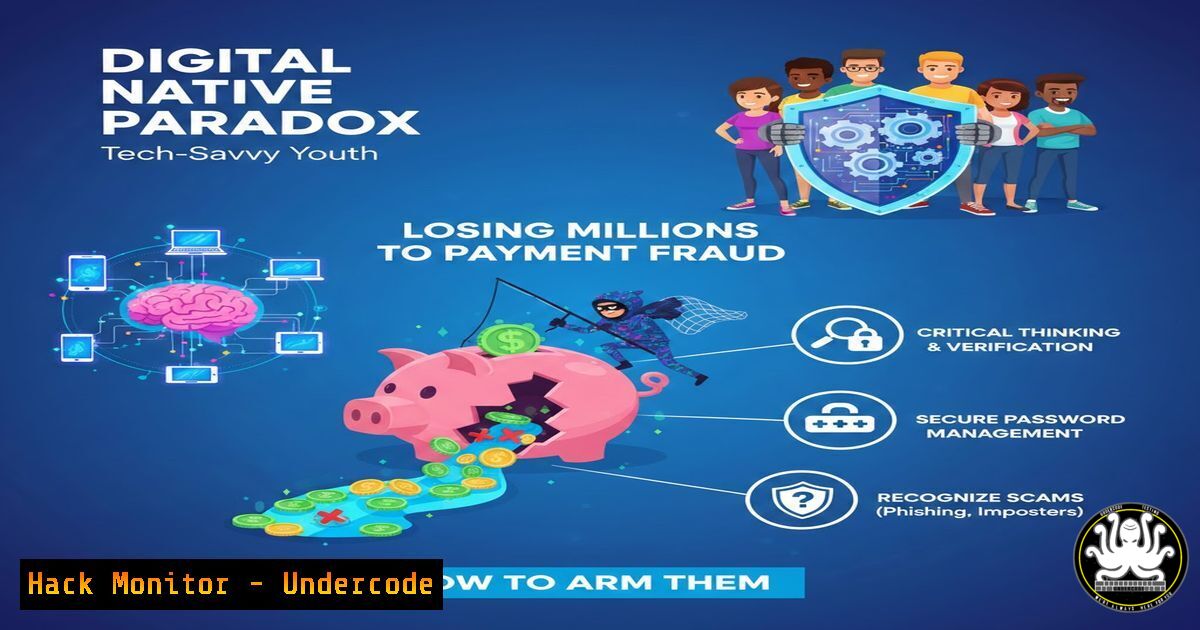
A recent campaign by the Banque de France and the French Banking Federation (FBF) has cast a stark light on a critical cybersecurity vulnerability: young adults aged 18-34. Despite being digital natives, this group is disproportionately targeted by payment fraud, with nearly two-thirds having faced an attempted scam. This article deconstructs the technical and behavioral reasons behind this threat landscape and provides actionable, technical defenses to secure digital transactions.
Learning Objectives:
- Understand the primary technical and social engineering vectors used in modern payment fraud targeting younger demographics.
- Implement hardened configurations for web applications, APIs, and cloud environments to protect transaction integrity.
- Deploy active monitoring and forensic techniques to detect and respond to fraudulent activities.
You Should Know:
- The Social Engineering Arsenal: Phishing, Vishing, and SIM-Swapping
The human layer is the primary attack surface. Fraudsters exploit the comfort and habitual trust young users have with digital communication.
Step‑by‑step guide explaining what this does and how to use it.
Phishing Kit Deployment (Attacker View): Attackers often deploy phishing kits on compromised servers. A basic kit includes fake login pages and a script to harvest credentials.
Command to Find Recently Uploaded Phish Kits (Linux Defender): find /var/www/ -type f -name ".php" -mtime -1. This scans the web root for PHP files modified in the last day, a common indicator.
Analyzing a Phish Kit’s C2: Use `cat config.php` or `grep -r “mail\|telegram” /path/to/seized_kit/` to identify where stolen data is sent.
Defensive Email Header Analysis (User & Admin): Teach users to inspect email headers. Key fields to check:
`Return-Path:` and `Reply-To:` – Do they match the alleged sender?
`Received-SPF:` – Does it show `pass` or fail?
In Gmail, click “Show original” to see this data. Sysadmins can enforce policies using DMARC, DKIM, and SPF records in their DNS.
- Hardening the Transaction Endpoint: Browser & Application Security
Many frauds start by compromising the user’s device or exploiting weak client-side security.
Step‑by‑step guide explaining what this does and how to use it.
Enforcing Secure Browser Policies (Enterprise/Advanced User):
Disable Saved Passwords & Autofill: For Chromium-based browsers via Group Policy or command line: google-chrome --disable-features=AutofillServerCommunication,PasswordSave. This prevents credential capture by malware.
Harden SSL/TLS Settings: Navigate to `chrome://flags/tls13-variant` and ensure TLS 1.3 is enabled. Disable obsolete SSLv2/3.
Secure Web Application Configuration (Developer/Admin): Payment portals must implement strict headers.
Apache Example (`.htaccess`):
Header always set Content-Security-Policy "default-src 'self'; script-src 'self' https://trusted.cdn.com;"
Header always set X-Frame-Options "DENY"
Header always set Strict-Transport-Security "max-age=63072000; includeSubDomains"
Nginx Example (`nginx.conf`):
add_header Content-Security-Policy "default-src 'self';";
add_header X-Frame-Options "DENY";
add_header X-Content-Type-Options "nosniff";
- API Security: The Silent Backbone of Payment Apps
Mobile and fintech apps rely on APIs, which are prime targets for credential stuffing and logic abuse attacks.
Step‑by‑step guide explaining what this does and how to use it.
Implementing Rate Limiting: Use a web application firewall (WAF) like ModSecurity or a gateway like NGINX to block brute-force attacks on login/transaction APIs.
NGINX Rate Limit in `nginx.conf`:
limit_req_zone $binary_remote_addr zone=api_limit:10m rate=10r/s;
location /api/v1/transaction {
limit_req zone=api_limit burst=20 nodelay;
proxy_pass http://backend;
}
Scanning for API Vulnerabilities: Use OWASP ZAP or Burp Suite to audit your APIs.
Basic OWASP ZAP Automated Scan: ./zap.sh -cmd -quickurl https://yourapi.example.com -quickout /tmp/report.xml. Review the report for `API` and `JSON` related alerts.
4. Cloud Account & Infrastructure Hardening
Fraudsters often leverage compromised cloud accounts (AWS, Azure, GCP) to run fraudulent operations or mine for data.
Step‑by‑step guide explaining what this does and how to use it.
Enforce Multi-Factor Authentication (MFA) & Minimal Privileges:
AWS CLI Command to Check Root Account MFA: aws iam get-account-summary. Ensure `AccountMFAEnabled` equals 1.
Azure PowerShell to Require MFA for Admins: New-ConditionalAccessPolicy -DisplayName "Require MFA for Admins" -State "enabled" -Conditions ....
Audit Publicly Accessible Storage (S3 Buckets): Misconfigured storage leaks millions of records.
AWS CLI to Check Bucket Policies: aws s3api get-bucket-policy --bucket BUCKET_NAME. Look for overly permissive `”Effect”: “Allow”` with "Principal": "".
5. Proactive Threat Hunting & Digital Forensics Basics
Early detection is key. Suspicious activity leaves traces in system logs.
Step‑by‑step guide explaining what this does and how to use it.
Linux Auditd for Suspicious Process Monitoring: Monitor for unauthorized credit card memory scrapers.
Rule to Log Processes Using `libpcap` or Memory Access: Add to /etc/audit/rules.d/audit.rules:
-a always,exit -F arch=b64 -S process_vm_readv -S ptrace -k memory_access
-w /usr/sbin/tcpdump -p x -k packet_capture
Search Audit Log: ausearch -k memory_access | aureport -summary.
Windows Event Log Analysis for Lateral Movement: After initial compromise, attackers move laterally.
PowerShell to Query for Pass-the-Hash/Ticket Events: Get-WinEvent -FilterHashtable @{LogName='Security'; ID=4624, 4672} | Where-Object {$_.Properties[bash].Value -eq '3' -or $_.Properties[bash].Value -eq '9'} | Select-Object TimeCreated, Message. Look for Logon Type `3` (network) with high-privilege accounts.
What Undercode Say:
Key Takeaway 1: The youth’s vulnerability stems from an optimism bias blended with technical overconfidence. Their fluency in using apps does not equate to an understanding of the underlying security mechanisms (APIs, TLS, session management) that they implicitly trust. This creates a perfect gap for sophisticated social engineering that appears technically credible.
Key Takeaway 2: Awareness campaigns must evolve into hands-on, technical drilling. Telling someone “be careful” is insufficient. Training must involve interactive modules—like reading email headers, configuring 2FA in an app’s settings, or recognizing the difference between `HTTP` and `HTTPS` in a browser’s address bar—to build instinctive, secure behaviors.
The FBF study reveals a profound disconnect. The generation that can effortlessly navigate a dozen social platforms lacks the foundational “mechanics” of digital safety. The solution is not to scare them but to empower them with the same level of technical curiosity applied to security. Cybersecurity education must shift from abstract warnings to practical, tool-centric literacy—turning users from the weakest link into a vigilant first line of defense.
Prediction:
The convergence of AI-generated synthetic media (deepfakes) for vishing and automated, AI-driven fraud platforms will exacerbate this trend. We will see hyper-personalized phishing at scale, where fraudsters use leaked data to generate convincing fake video calls or voice messages from “friends.” Simultaneously, attacks will increasingly target the financial API ecosystem directly, rather than end-users, exploiting minor logic flaws in fintech apps to initiate unauthorized transactions. The defense will lie in behavioral biometrics, AI-powered anomaly detection in API traffic, and mandatory, simulation-based cybersecurity literacy becoming a core component of secondary and tertiary education curricula.
▶️ Related Video (72% Match):
🎯Let’s Practice For Free:
IT/Security Reporter URL:
Reported By: We Are – Hackers Feeds
Extra Hub: Undercode MoN
Basic Verification: Pass ✅


