Listen to this Post
Introduction:
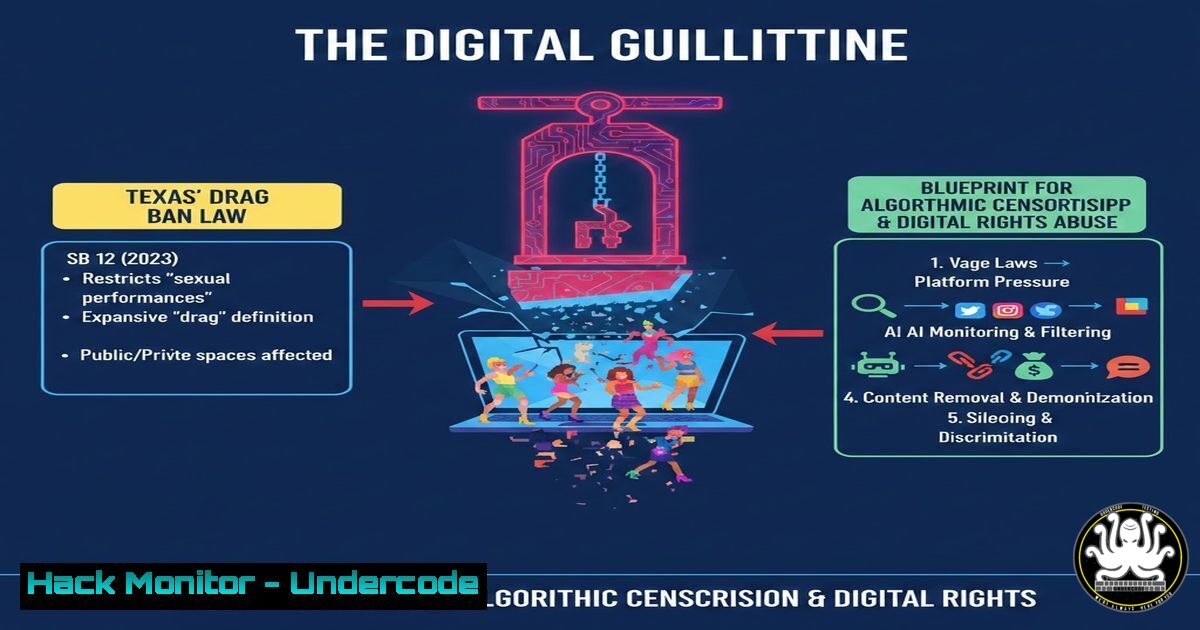
The recent federal appeals court ruling allowing Texas to enforce Senate Bill 12—which imposes hefty fines on businesses and jail time for performers regarding drag restrictions—signals a significant escalation in the legal regulation of expression. While the law targets physical performances, its enforcement infrastructure relies heavily on digital surveillance, social media monitoring, and content moderation algorithms. For cybersecurity and IT professionals, this shift represents a critical case study in how legislation is weaponizing technology to monitor, flag, and prosecute individuals based on subjective content analysis.
Learning Objectives:
- Understand the intersection of legal frameworks and digital surveillance technologies used for content moderation.
- Learn how to identify and bypass geo-restrictions and censorship mechanisms using VPNs and proxy chains.
- Analyze the role of AI and machine learning in automated flagging systems and their inherent biases.
- Implement operational security (OPSEC) measures to protect digital identity in highly regulated online environments.
- Explore the technical architecture of “notice and takedown” systems and their vulnerability to exploitation.
You Should Know:
- The Digital Dragnet: How AI is Trained to Flag “Deviant” Content
The enforcement of SB 12 will not rely solely on officers attending performances. Instead, platforms like Meta, TikTok, and X (formerly Twitter) will be pressured to integrate the vague legal definitions of the law into their automated content moderation algorithms. These AI models are trained on massive datasets to identify “adult content,” “drag performance,” or “sexually oriented behavior.”
Step‑by‑step guide to analyzing an AI moderation model (Conceptual):
While you cannot access proprietary algorithms, you can test their biases using adversarial inputs.
– Linux Command (Image Analysis): Use `exiftool` to strip metadata from images before uploading to test if platforms flag based on content or file data.
`exiftool -all= suspected_drag_image.jpg`
- Python Script (API Testing): Use a script to send similar images (one of a cisgender male in a suit, one of a drag performer) to a platform’s moderation API (if available) or a public AI vision API like Google Cloud Vision to compare label outputs.
from google.cloud import vision import io def detect_labels(path): client = vision.ImageAnnotatorClient() with io.open(path, 'rb') as image_file: content = image_file.read() image = vision.Image(content=content) response = client.label_detection(image=image) print(response.label_annotations) detect_labels('drag_performer.jpg') detect_labels('businessman.jpg') - Analysis: Compare the confidence scores for labels like “Fashion,” “Costume,” “Performance Art,” vs. “Adult” or “Suggestive.” Discrepancies highlight algorithmic bias.
2. Bypassing Geo-Blocks and Censorship to Access Content
As platforms over-censor to avoid legal liability in Texas, content may be hidden based on geolocation. Accessing restricted information requires technical controls.
Step‑by‑step guide to setting up a VPN with Kill Switch (Linux):
– Install OpenVPN: `sudo apt update && sudo apt install openvpn -y`
– Download Configuration: Obtain `.ovpn` files from a reputable VPN provider that does not log data.
– Connect: `sudo openvpn –config /path/to/config/file.ovpn`
– Implement Kill Switch (UFW): To ensure no traffic leaks if the VPN drops.
`sudo ufw –force enable`
`sudo ufw default deny outgoing`
`sudo ufw default deny incoming`
`sudo ufw allow out on tun0 from any to any` (Allow VPN tunnel)
`sudo ufw allow out 53` (Allow DNS if needed)
`sudo ufw enable`
- Windows (PowerShell): Use `Get-VpnConnection` to check status and `rasdial` to connect/disconnect.
`rasdial “YourVPNName” username password`
3. Financial Surveillance and the $10,000 Fine
The law threatens businesses with a $10,000 fine. This financial penalty is enforced through traditional legal channels, but the evidence gathering is digital. Investigators will scrape social media for event listings, ticket sales platforms, and business pages.
Step‑by‑step guide to Digital Evidence Removal (OPSEC for Businesses):
– Linux (Log Cleaning): Ensure no local logs store incriminating browser history.
`history -c && cat /dev/null > ~/.bash_history`
- Windows (Event Viewer): Navigate to Event Viewer > Windows Logs > Application/Security. While you cannot delete security logs without admin privileges (and shouldn’t if legal holds are in place), you must be aware that PowerShell commands are logged.
- Check PowerShell History: `(Get-PSReadlineOption).HistorySavePath` reveals the file path. Open it to see executed commands.
- Digital Hygiene: Use `Bulk Crap Uninstaller` (BCUninstaller) to remove event promotion software that might leave traces.
4. The Architecture of “Notice and Takedown” Systems
Under SB 12, a complaint against a digital advertisement for a show can trigger a takedown. This is typically automated via abuse reporting APIs.
Step‑by‑step guide to analyzing a DMCA/Abuse Report:
If you receive a takedown notice, verify its technical legitimacy.
– Analyze Headers: Use `curl -I [bash]` to see the origin server of the notice.
– Check SPF/DKIM: Verify the email’s authentication. In Linux, use `dig TXT [bash]` to check SPF records.
`dig TXT _spf.google.com` (Example for Google notices)
- Abuse API: Platforms often have an API endpoint for submissions. Understand the rate limits and parameters to prevent automated abuse. For example, a malicious actor could flood the system with fake reports to de-platform a venue.
- Exploiting the Legal Ambiguity: Command Injection into Reporting Systems
A sophisticated attack vector involves exploiting the text fields in online reporting forms. If a platform’s backend uses the reported content’s metadata in a vulnerable way, it could lead to exploits.
Step‑by‑step guide to testing web form security (Ethically/Lab Only):
– Recon: Identify the reporting page.
– Parameter Fuzzing: Use `ffuf` or Burp Suite to inject payloads into the “Reason for Report” field.
`ffuf -u https://target.com/report/FUZZ -w /usr/share/wordlists/legion/legion.txt`
– SQL Injection: Test for SQLi by inputting: `’ OR ‘1’=’1` in the report description.
– XSS: Input `` to see if the admin panel executing the report is vulnerable.
– Command Injection (Linux): If the system pings the reported URL, test with: `; whoami ;` or `| whoami` in the URL field.
- Mitigating False Positives: Hardening Cloud Infrastructure for Advocacy Groups
Groups opposing SB 12 or supporting affected venues will face DDoS attacks or heavy traffic.
Step‑by‑step guide to configuring Cloudflare WAF (Web Application Firewall):
– Login to Cloudflare: Navigate to your domain.
– Security > WAF > Create Rule:
– Field: URI Path
– Operator: contains
– Value: /events
– Then: Managed Challenge (not block, to avoid over-blocking legitimate users).
– Rate Limiting: Create a rule to block IPs that request more than 100 pages in 60 seconds.
– `http.request.rate.limit == 100`
– Linux Server (Nginx Fail2ban): Install Fail2ban to block IPs that show malicious patterns.
`sudo apt install fail2ban -y`
`sudo cp /etc/fail2ban/jail.conf /etc/fail2ban/jail.local`
`sudo systemctl start fail2ban`
What Undercode Say:
- Key Takeaway 1: The Texas Drag Ban is a harbinger of “Law as Code,” where vague legal terms are hardcoded into brittle AI systems, leading to over-censorship and technical errors that criminalize protected speech.
- Key Takeaway 2: Cybersecurity professionals must now understand constitutional law and civil rights, as the technical controls we implement (firewalls, filters, algorithms) are becoming the primary enforcement mechanism for social legislation.
This ruling fundamentally weaponizes the digital infrastructure. The $10,000 fines and jail time are not just legal threats; they are technical challenges that require robust encryption, decentralized communication platforms, and rigorous OPSEC. The fight for digital rights has shifted from preventing data breaches to preventing digital identities from becoming exhibits in a courtroom based on algorithmic misinterpretation.
Prediction:
Within 12 months, we will see the rise of “censorship-resistant” protocols specifically designed for performance artists and LGBTQ+ communities, mirroring the dark web’s evolution for journalists. Concurrently, we will witness the first class-action lawsuit against an AI moderation company for flagging a non-violating performance due to biased training data, setting a precedent for algorithmic accountability under civil rights law.
▶️ Related Video (72% Match):
🎯Let’s Practice For Free:
IT/Security Reporter URL:
Reported By: Noh8 Share – Hackers Feeds
Extra Hub: Undercode MoN
Basic Verification: Pass ✅


