Listen to this Post
Introduction:
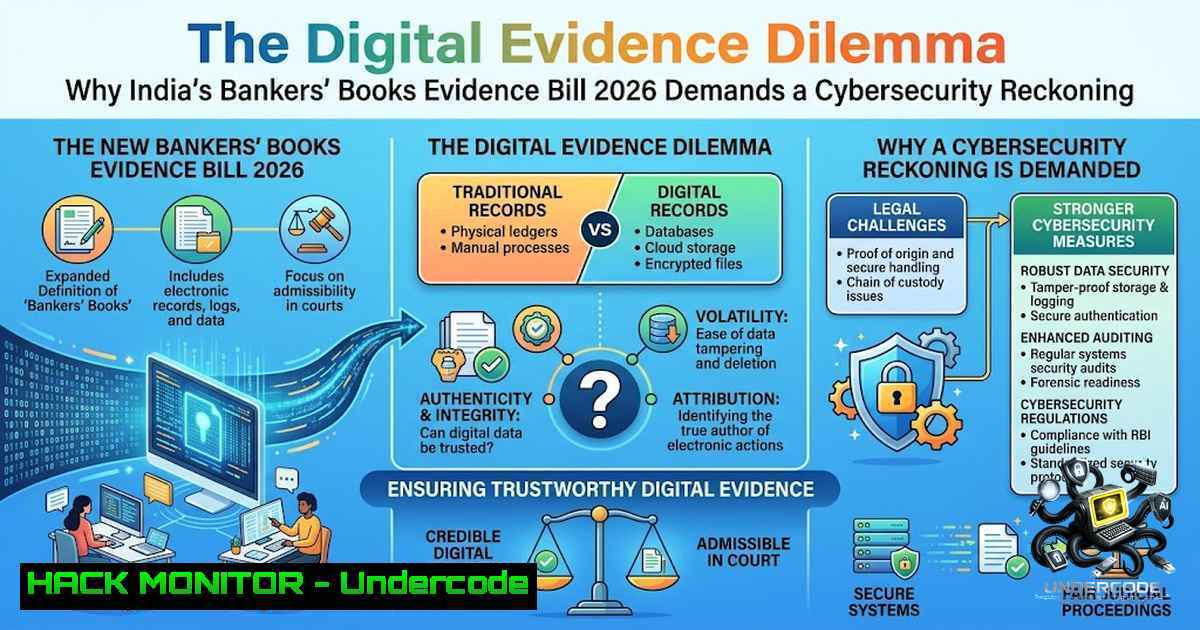
The passage of the Bankers’ Books Evidence Bill 2026 in India marks a watershed moment for the country’s financial legal framework, formally recognizing digital, virtual, and cloud-based bank records as admissible evidence in courts. While the modernization of the colonial-era Bankers’ Books Evidence Act, 1891, appears progressive on the surface, it simultaneously exposes a critical vulnerability: the Indian banking sector’s cybersecurity infrastructure is demonstrably unprepared for the scale of digital fraud that now threatens rural and urban account holders alike. With the Reserve Bank of India classifying AI-enabled cyberattacks as the “most important” near-term threat and six of seven cyber predictions from 2024 already materializing, the Bill’s passage without parliamentary debate raises urgent questions about citizen protection in an increasingly hackable financial ecosystem.
Learning Objectives:
- Understand the cybersecurity implications of the Bankers’ Books Evidence Bill 2026 and the expanded definition of “bankers’ books” to include digital, virtual, and cloud-based records
- Identify the attack vectors targeting Aadhaar-enabled Payment Systems (AePS), KYC processes, and shell company frauds that threaten rural and illiterate bank users
- Master practical Linux and Windows commands for digital forensics, log analysis, and threat detection in banking environments
- Implement step-by-step security hardening measures for financial data protection and API security
- Develop a risk mitigation framework for individuals and institutions facing the digital evidence paradigm shift
You Should Know:
- The Expanded Attack Surface: Understanding the Bill’s Cybersecurity Gaps
The Bankers’ Books Evidence Bill 2026, passed by voice vote without discussion amid opposition protests, expands the definition of “bankers’ books” to include records maintained in physical, electronic, digital, virtual, cloud-based, or any other form. The Bill introduces a two-track certification framework with separate certificates for physical and electronic records, authenticated through manual or digital signatures under the Information Technology Act, 2000. Crucially, it expressly provides that electronic or digital bank records cannot be denied admissibility solely because they are in electronic form, prescribing statutory safeguards to establish authenticity, integrity, and cybersecurity.
However, the Bill’s safeguards remain vaguely defined. The Digital Threat Report 2025-26 reveals that India’s mid-sized banks face 1.6 times more attacks per organization than global peers, largely due to underinvestment in cybersecurity. The exploit window between vulnerability discovery and weaponization has collapsed from 745 days to just 44 days—a 94% reduction in five years. The report identifies AI asymmetry, social engineering, credential theft, supply-chain attacks, cloud exploitation, and API abuse as now-established attack methods.
Step-by-Step: Assessing Your Digital Footprint Vulnerability
Step 1: Audit Digital Identity Exposure (Linux)
 Check for exposed credentials in public repositories
git log --all --grep='password|secret|key' --oneline
 Scan for hardcoded credentials in local files
grep -r "password|secret|key|token" /path/to/banking/app --include=.{py,js,java,properties}
Step 2: Analyze System Logs for Anomalies (Linux)
 Check authentication logs for failed attempts
sudo grep "Failed password" /var/log/auth.log | tail -50
 Monitor unusual account activities
sudo lastlog | grep -v "Never"
 Review sudo access attempts
sudo grep "sudo" /var/log/auth.log | grep -v "COMMAND"
Step 3: Windows Event Log Forensics (PowerShell)
 Check for failed login attempts (Event ID 4625)
Get-WinEvent -FilterHashtable @{LogName='Security'; ID=4625} -MaxEvents 50
 Audit account management (Event ID 4720 - user created)
Get-WinEvent -FilterHashtable @{LogName='Security'; ID=4720,4722,4723} -MaxEvents 50
 Check for suspicious scheduled tasks
Get-ScheduledTask | Where-Object {$_.State -1e "Disabled"}
Step 4: Validate Digital Certificate Integrity
 Check SSL/TLS certificate validity
openssl x509 -in /path/to/certificate.crt -text -1oout
 Verify certificate chain
openssl verify -CAfile ca-bundle.crt /path/to/certificate.crt
 Check for revoked certificates (using CRL)
openssl crl -in crl.pem -text -1oout
- The KYC Vulnerability: How Shell Companies Exploit Digital Identity Systems
The post’s concern about shell companies hacking digital Aadhaar, PAN, and KYC records is not hypothetical. In February 2026, the DGGI busted a ₹13,000 crore illegal online gaming network operating through shell firms and fake digital identities, where a fintech founder cleared fraudulent KYC verifications that allowed shell entities to access RBI-regulated banking channels. The investigation revealed that shell firms paid verifiers to clear onboarding without adequate scrutiny, with around 100 shell entities identified across the country.
In Jharkhand, police uncovered an Aadhaar tampering racket where cybercriminals misused Aadhaar cards of unsuspecting villagers, altering addresses to open fake bank accounts, then restoring the Aadhaar to its original form to evade detection. Fraudsters lured villagers with payments of ₹2,000–₹3,000 for their Aadhaar cards. This modus operandi directly impacts rural, illiterate bank users who are often unaware their identities have been compromised until their accounts are frozen or they face legal action.
Step-by-Step: Securing KYC Data and Detecting Shell Company Activity
Step 1: Monitor KYC Database for Anomalies (PostgreSQL/MySQL)
-- Detect multiple KYC attempts from same Aadhaar
SELECT aadhaar_number, COUNT() as attempts,
array_agg(bank_name) as banks
FROM kyc_verification_logs
WHERE verification_date > NOW() - INTERVAL '30 days'
GROUP BY aadhaar_number
HAVING COUNT() > 3;

-- Identify shell company patterns: multiple companies, same director
SELECT director_pan, COUNT() as company_count,
array_agg(company_name) as companies
FROM company_registration
WHERE registration_date > NOW() - INTERVAL '90 days'
GROUP BY director_pan
HAVING COUNT() > 5;
Step 2: Analyze Network Traffic for Suspicious API Calls (Linux)
 Monitor API endpoints for unusual payload sizes
sudo tcpdump -i eth0 -1n 'port 443' -v | grep -E "POST|PUT" | awk '{print $NF}' | sort | uniq -c | sort -1r
 Check for data exfiltration patterns
sudo tcpdump -i eth0 -1n -s0 -w exfil.pcap 'port 443 and (tcp[((tcp[12:1] & 0xf0) >> 2):4] = 0x504f5354)'
 Analyze DNS queries for C2 communication
sudo tcpdump -i eth0 -1n -s0 'udp port 53' | grep -v ".in-addr.arpa"
Step 3: Implement Biometric Authentication Hardening
 For AePS implementations - validate biometric device signatures
openssl dgst -sha256 -verify public_key.pem -signature biometric.sig biometric_data.bin
 Check for spoofing attempts in biometric logs
grep -i "spoof|replay|clone" /var/log/biometric/.log | tail -100
Step 4: Windows-based Identity Theft Detection
 Monitor for unusual Active Directory changes
Get-ADUser -Filter  -Properties WhenChanged | Where-Object {$<em>.WhenChanged -gt (Get-Date).AddDays(-1)}
 Check for new admin accounts
Get-ADUser -Filter {Enabled -eq $true -and AdminCount -eq 1} | Select-Object Name, SamAccountName, Created
 Audit Group Policy changes
Get-GPO -All | ForEach-Object { Get-GPOReport -1ame $</em>.DisplayName -ReportType Xml }
- GST and Financial Fraud: The Shell Company Digital Trail
The post’s allegations regarding GST shell company frauds are substantiated by recent enforcement actions. In May 2026, Delhi Police’s Economic Offences Wing busted a ₹128 crore fake GST invoicing cartel operating through shell companies, identifying approximately 50 shell entities used for routing money and fake GST entries. One accused allegedly created and operated nearly 250 shell companies using forged documents for bogus billing and fraudulent tax claims. In another case, two startup founders and two chartered accountants were arrested for a ₹200 crore GST fraud executed through nearly 30 shell companies generating fake invoices without actual supply of goods.
These frauds rely on compromised digital KYC records, fake PAN cards, and manipulated Aadhaar data—precisely the vulnerabilities the Bankers’ Books Evidence Bill fails to address. When digital records become legally admissible, the burden of proof shifts to the accused to demonstrate that records are fraudulent, a nearly impossible task for rural, illiterate bank users.
Step-by-Step: Detecting GST and Financial Fraud Indicators
Step 1: Analyze Transaction Patterns for Shell Activity (Python)
import pandas as pd
import numpy as np
from sklearn.ensemble import IsolationForest

Load transaction data
transactions = pd.read_csv('bank_transactions.csv')

Feature engineering for anomaly detection
transactions['hour'] = pd.to_datetime(transactions['timestamp']).dt.hour
transactions['day_of_week'] = pd.to_datetime(transactions['timestamp']).dt.dayofweek

Calculate velocity metrics
transactions['rolling_sum'] = transactions.groupby('account_id')['amount'].transform(
lambda x: x.rolling(window=5, min_periods=1).sum()
)

Isolation Forest for outlier detection
model = IsolationForest(contamination=0.01, random_state=42)
transactions['anomaly'] = model.fit_predict(transactions[['amount', 'hour', 'rolling_sum']])

Flag suspicious transactions
suspicious = transactions[transactions['anomaly'] == -1]
print(f"Flagged {len(suspicious)} suspicious transactions")
suspicious.to_csv('suspicious_transactions.csv', index=False)
Step 2: Validate GST Invoice Integrity (Linux)
 Check for fake invoice patterns using grep
zgrep -E "INV-[0-9]{6}|GST-[A-Z]{5}[0-9]{4}" /var/log/gst/invoices/.log.gz | \
awk -F',' '{print $2}' | sort | uniq -c | sort -1r | head -20

Verify digital signatures on GST returns
for file in /var/gst/returns/.xml; do
echo "Verifying $file"
xmlsec1 --verify --pubkey-pem gst_public_key.pem "$file"
done
Step 3: Monitor Bank API Abuse Patterns
 Check for bulk payout API abuse (non-OTP transactions)
sudo grep -E "payout|bulk_transfer|batch" /var/log/banking/api/.log | \
grep -v "OTP" | awk -F'[|]' '{print $3}' | sort | uniq -c | sort -1r
 Detect rapid succession transactions from same IP
sudo awk '{print $1, $7}' /var/log/banking/access.log | sort | uniq -c | \
awk '$1 > 50 {print "Suspicious IP:", $2, "Count:", $1}'
Step 4: Forensic Analysis of Compromised Accounts (Windows)
 Export security logs for forensic analysis
wevtutil epl Security security_export.evtx
 Parse for account lockouts and password changes
Get-WinEvent -Path security_export.evtx -FilterXPath "[System[EventID=4740 or EventID=4723]]" |
Select-Object TimeCreated, Id, Message | Export-Csv account_anomalies.csv

Check for unauthorized registry modifications
Get-ChildItem -Path "HKLM:\SOFTWARE\Microsoft\Windows\CurrentVersion\Run" |
ForEach-Object { Get-ItemProperty $_.PSPath }
4. Rural Banking Cybersecurity: Protecting the Unprotected
The post’s focus on rural illiterate bank users is a critical concern. Aadhaar-enabled Payment Systems (AePS) have revolutionized financial inclusion, enabling rural users to access banking services using just their Aadhaar number and biometric verification. However, cybercriminals are now exploiting this system. Fraudsters pose as bank agents or government employees to obtain Aadhaar and fingerprint data, often using fake biometric devices to withdraw money without OTPs.
The RBI has tightened rules for Aadhaar-enabled payment operators, but enforcement remains inconsistent. Cybercriminals specifically target rural regions, luring villagers with cash rewards for sharing Aadhaar cards or masquerading as officials conducting KYC for government welfare schemes. When digital records become legally admissible, these victims face the dual threat of financial loss and potential legal liability for fraud they did not commit.
Step-by-Step: Securing Rural Banking Infrastructure
Step 1: Implement Biometric Liveness Detection
 Check biometric device integrity
lsusb -v | grep -A 10 "Biometric"
 Validate fingerprint scanner firmware
sudo dmidecode -t bios | grep -i version
 Monitor for unauthorized biometric devices
sudo dmesg | grep -i "fingerprint|biometric" | tail -20
Step 2: Configure AEPS Transaction Monitoring
 Monitor for transactions without location consistency
awk -F',' '{print $1, $4, $5}' /var/log/aeps/transactions.log | \
while read account lat lon; do
 Check if transaction location matches registered address
registered_location=$(grep "$account" /var/log/aeps/registered_locations.txt | awk '{print $2, $3}')
 Calculate distance (simplified)
distance=$(python3 -c "from geopy.distance import geodesic; print(geodesic(($lat,$lon),($registered_location)).km)")
if (( $(echo "$distance > 50" | bc -l) )); then
echo "Suspicious: $account distance $distance km"
fi
done
Step 3: Deploy SMS/OTP Security Hardening
 Check for SMS gateway abuse
sudo grep -E "OTP|verification" /var/log/sms/.log | \
awk -F'[|]' '{print $4}' | sort | uniq -c | sort -1r | head -20
 Monitor for OTP replay attempts
sudo grep -i "replay|invalid otp|expired" /var/log/auth/.log | tail -50
Step 4: Windows-based Rural Banking Terminal Security
 Disable unnecessary USB ports (prevent rogue biometric devices)
Disable-PnpDevice -InstanceId (Get-PnpDevice -Class USB | Where-Object {$_.FriendlyName -match "USB"})
 Enable BitLocker for endpoint encryption
Enable-BitLocker -MountPoint "C:" -EncryptionMethod XtsAes256 -SkipHardwareTest
 Configure Windows Defender for advanced threat protection
Set-MpPreference -DisableRealtimeMonitoring $false
Set-MpPreference -SubmitSamplesConsent 2
- API Security and Cloud Exploitation: The Unseen Threat
The Bill’s inclusion of cloud-based records as admissible evidence introduces another layer of risk. The Digital Threat Report 2025-26 identifies API abuse and cloud exploitation as now-established attack methods. The ₹13,000 crore online gaming scam involved misuse of banks’ payout APIs by technology providers posing as fintech firms, enabling bulk automated transfers without OTPs or manual checks.
With the central government empowered to extend the Bill’s provisions to other financial sector entities, the attack surface expands exponentially. Fintech intermediaries, payment aggregators, and NBFCs—many with weaker security postures than traditional banks—will now have their digital records treated with the same legal weight.
Step-by-Step: Hardening API and Cloud Security
Step 1: Implement API Rate Limiting and Anomaly Detection (Linux)
 Configure Nginx rate limiting for API endpoints
echo '
limit_req_zone $binary_remote_addr zone=api_limit:10m rate=10r/s;
location /api/ {
limit_req zone=api_limit burst=20 nodelay;
proxy_pass http://backend;
}
' >> /etc/nginx/nginx.conf
sudo nginx -t && sudo systemctl reload nginx

Monitor API response times for DDoS detection
sudo tail -f /var/log/nginx/access.log | \
awk '{if ($NF > 5) print "Slow response:", $0}'
Step 2: Validate Cloud Storage Security (AWS CLI)
 Check S3 bucket permissions for public access
aws s3api get-bucket-acl --bucket banking-records --query 'Grants[?Grantee.URI==`http://acs.amazonaws.com/groups/global/AllUsers`]'
 Enable bucket encryption
aws s3api put-bucket-encryption --bucket banking-records --server-side-encryption-configuration '{"Rules":[{"ApplyServerSideEncryptionByDefault":{"SSEAlgorithm":"AES256"}}]}'
 Audit IAM roles for excessive permissions
aws iam list-roles --query 'Roles[?contains(AssumeRolePolicyDocument.Statement[bash].Action, ``)]'
Step 3: Implement Zero-Trust API Security (Linux)
 Generate and verify API request signatures
echo -1 "GET /api/accounts" | openssl dgst -sha256 -sign private_key.pem -out signature.bin
openssl dgst -sha256 -verify public_key.pem -signature signature.bin <<< "GET /api/accounts"
 Monitor for JWT token abuse
sudo grep -E "JWT|Bearer" /var/log/api/.log | \
awk -F'[.]' '{print $2}' | base64 -d 2>/dev/null | grep -i "exp|iat"
Step 4: Windows-based Cloud Access Monitoring
 Monitor Azure AD sign-in logs for anomalies
Get-AzureADAuditSignInLogs -All $true |
Where-Object {$_.Status.ErrorCode -1e 0} |
Select-Object UserPrincipalName, AppDisplayName, CreatedDateTime, Status

Check for unusual Azure resource deployments
Get-AzResource -ResourceGroupName  -ExpandProperties |
Where-Object {$_.Properties.provisioningState -eq "Succeeded"} |
Select-Object Name, Type, Location
- Legal Protection and Individual Rights: What Bank Users Must Know
While the Bill recognizes digital records as admissible, it also introduces provisions for “special cause” where a court may compel a bank officer to produce bankers’ books or appear as a witness. This creates a potential pathway for individuals to challenge digital evidence, but the burden remains on the accused to prove records are fraudulent.
For rural and illiterate bank users, the most practical protection is proactive: regular monitoring of bank statements, immediate reporting of suspicious transactions, and maintaining physical records of all banking activities. The post’s suggestion of physical ration card booklets for KYC records, while extreme, highlights a genuine need for parallel physical documentation systems.
Step-by-Step: Individual Protection Measures
Step 1: Set Up Automated Account Monitoring (Linux)
 Create a cron job to check for unusual transactions
echo '!/bin/bash
/usr/bin/python3 /home/user/monitor_banking.py
' > /etc/cron.daily/bank_monitor
chmod +x /etc/cron.daily/bank_monitor

Sample Python monitoring script (monitor_banking.py)
cat > /home/user/monitor_banking.py << 'EOF'
import requests
import json
 Check transaction history via bank API
response = requests.get('https://api.bank.com/transactions',
headers={'Authorization': 'Bearer YOUR_TOKEN'})
transactions = response.json()
 Flag transactions above threshold
threshold = 50000
for txn in transactions:
if txn['amount'] > threshold:
print(f"ALERT: Large transaction {txn['id']}: {txn['amount']}")
EOF
Step 2: Digital Evidence Preservation (Windows)
 Create a hashed log of all banking communications
Get-ChildItem -Path "C:\Banking\" -Recurse |
ForEach-Object { Get-FileHash -Path $_.FullName -Algorithm SHA256 } |
Export-Csv banking_hashes.csv

Archive all banking emails for legal preservation
New-MailboxExportRequest -Mailbox [email protected] -FilePath "\server\banking_export\user.pst"
 Enable litigation hold for banking-related correspondence
Set-Mailbox -Identity [email protected] -LitigationHoldEnabled $true
Step 3: Monitor Credit and Aadhaar Usage
 Check for unauthorized Aadhaar authentication requests
curl -X GET "https://api.uidai.gov.in/auth/history" \
-H "Authorization: Bearer $AADHAAR_TOKEN" | jq '.history[] | select(.status=="FAILED")'
 Verify PAN card usage across financial institutions
curl -X GET "https://api.incometax.gov.in/pan/verify" \
-d "{\"pan\":\"YOUR_PAN\"}" -H "Content-Type: application/json"
- The Path Forward: Recommendations for Policymakers and Citizens
The Bill’s passage without debate, in just five minutes, raises legitimate concerns about the thoroughness of cybersecurity safeguards. The government’s argument that “bank records are increasingly created, stored and maintained using contemporary technology” is valid, but the accompanying security framework must be equally contemporary.
What Undercode Say:
- Key Takeaway 1: The Bankers’ Books Evidence Bill 2026 represents a necessary modernization of India’s banking legal framework, but it has been enacted without adequate cybersecurity safeguards or parliamentary debate, exposing vulnerable rural populations to unprecedented digital fraud risks.
-
Key Takeaway 2: The documented rise in shell company frauds, Aadhaar tampering, KYC bypasses, and GST invoicing scams demonstrates that India’s digital identity infrastructure is already compromised; legalizing digital evidence without addressing these foundational vulnerabilities places the burden of proof on innocent victims.
Analysis: The intersection of digital evidence admissibility and India’s cybersecurity reality creates a perfect storm. The RBI has identified AI-enabled cyberattacks as the most significant near-term threat, yet the BFSI sector remains underinvested in cybersecurity, with only 19% raising security budgets by more than 10%. The exploit window has collapsed from 745 days to 44 days, meaning vulnerabilities are weaponized faster than banks can patch them. Rural users, who constitute a growing share of digital banking adopters, are the least equipped to defend against these threats. The Bill’s provision that electronic records cannot be denied admissibility solely because they are in electronic form, while well-intentioned, ignores the reality that digital records are far more susceptible to manipulation than physical ledgers. Until India implements mandatory physical KYC backups, real-time biometric liveness detection, and strict liability for financial institutions that fail to prevent digital fraud, the Bill will serve as a shield for criminals and a sword against innocent citizens. The recommendation for physical ration card booklets, while politically charged, highlights a legitimate gap: the absence of a parallel, non-digital verification system that rural, illiterate users can trust.
Prediction:
- -1: Increased targeting of rural bank users through sophisticated social engineering and biometric spoofing attacks, with fraudsters exploiting the legal admissibility of digital records to frame innocent victims.
-
-1: A surge in legal cases where innocent bank users are unable to disprove fraudulent digital records, leading to frozen accounts, wrongful arrests, and prolonged legal battles.
-
-1: Acceleration of shell company frauds as criminals gain confidence that manipulated digital KYC records will hold up in court, further eroding trust in India’s banking system.
-
+1: Potential for a judicial backlash that forces the government to implement mandatory physical record-keeping and enhanced cybersecurity standards, creating a more balanced legal framework.
-
-1: Deepening of the digital divide, with rural and illiterate populations increasingly excluded from formal banking as they fear the legal consequences of digital fraud.
-
-1: International reputational damage as India’s digital banking framework is perceived as insecure, potentially affecting foreign investment and cross-border financial partnerships.
▶️ Related Video (78% Match):
https://www.youtube.com/watch?v=6IE81rEeABM
🎯Let’s Practice For Free:
🎓 Live Courses & Certifications:
Join Undercode Academy for Verified Certifications
🚀 Request a Custom Project:
Secure, high-velocity infrastructure and disruptive technological engineering. Contact our engineering team for high-tier development and proprietary systems:
[email protected]
💎 Smart Architecture | 🛡️ Secure by Design | ⭐ Trusted by Thousands
IT/Security Reporter URL:
Reported By: Pal B – Hackers Feeds
Extra Hub: Undercode MoN
Basic Verification: Pass ✅


