Listen to this Post
Introduction:
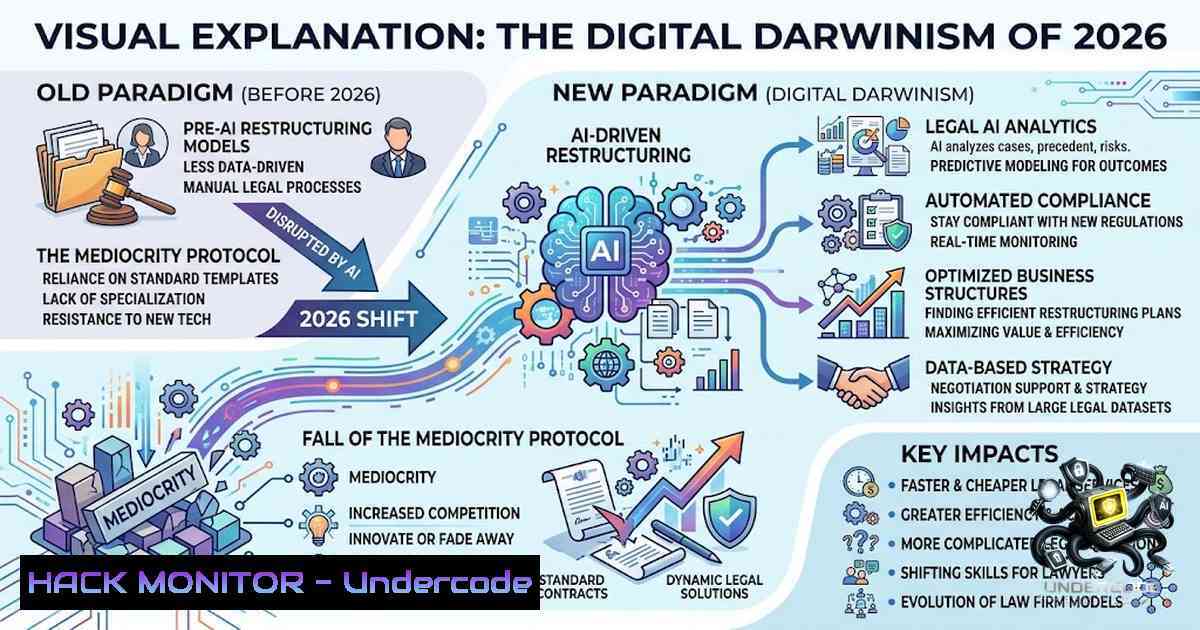
The corporate technology landscape is undergoing a fundamental restructuring as AI adoption accelerates workforce reductions at an unprecedented scale. Oracle’s recent SEC filing explicitly attributing 21,000 job cuts to AI deployment represents a watershed moment, validating what industry observers have long suspected: the “mediocrity protocol” of legacy corporate hierarchies is being systematically dismantled by automated intelligence. This shift extends beyond individual companies to reshape entire industry bodies, IT management frameworks, and the very definition of technical competency in the modern enterprise.
Learning Objectives:
- Understand the quantitative scope of AI-driven workforce reduction across major technology firms in 2026
- Identify the technical and managerial patterns enabling AI replacement of traditional IT roles
- Develop practical strategies for cybersecurity, cloud, and infrastructure professionals to adapt to the AI-first enterprise
You Should Know:
1. The AI Layoff Wave: By the Numbers
The scale of AI-attributed job displacement in 2026 has surpassed all of 2025 with a third of the year remaining. Oracle reduced its global workforce from 162,000 to 141,000 employees—a net reduction of approximately 21,000 positions or 13% of its staff. The company’s regulatory filing stated plainly that “the adoption and deployment of AI technologies across our operations have resulted, and may continue to result, in reductions to our workforce”.
The deepest cuts targeted Oracle Health, built on the $28.3 billion Cerner acquisition, where an estimated 8,000 to 10,000 employees were let go. Legacy SaaS operations and revenue teams lost roughly 30% of staff, while entire database administration teams were replaced with AI agents—one Austin-based unit of 47 DBAs reportedly had its workload taken over by automated systems supervised by just three senior architects.
The pattern extends across the industry: Meta cut 8,000 employees in May 2026, Amazon removed 14,000 corporate roles in late 2025 followed by another 16,000 in early 2026, Cisco eliminated 4,000 positions, Microsoft cut 4,800 roles, and Intuit reduced its workforce by 3,000—approximately 17%. In total, more than 125,000 tech jobs have been lost globally in 2026, with nearly 88,000 directly attributed to AI-related efficiency drives.
2. The Economics of AI Restructuring
Oracle’s financial restructuring reveals the strategic calculus behind these cuts. The company spent $1.84 billion on restructuring costs in fiscal 2026, up from $374 million the previous year. Capital expenditure jumped 162% to $55.7 billion, almost entirely tied to AI cloud and data centre buildout, producing negative free cash flow of $23.7 billion—a figure Oracle treats as strategic investment. The company raised $30 billion in debt in February 2026 to fund Oracle Cloud Infrastructure, and for fiscal 2027 is guiding for roughly $70 billion in capex.
The returns are measurable: Cloud Infrastructure revenue grew 93% to $5.8 billion in Q4, total cloud revenue reached $34 billion, up 39%, and remaining performance obligations jumped $85 billion to $638 billion. Oracle signed a massive $300 billion, five-year deal with OpenAI and another with Meta to provide AI compute power.
This pattern—converting payroll into data centre spending—represents a fundamental reallocation of corporate resources. Companies are effectively betting that AI infrastructure investments will yield greater returns than human labour in traditional IT functions.
3. Linux and Windows Commands for AI-Ready Infrastructure
As organizations restructure toward AI-first operations, systems administrators and cloud engineers must adapt their skill sets. Below are essential commands for managing the infrastructure that powers modern AI workloads:
Linux Commands for AI Infrastructure Monitoring:
 Monitor GPU utilization for AI workloads
nvidia-smi --query-gpu=index,name,utilization.gpu,memory.total,memory.used --format=csv

Check container resource usage for AI services
docker stats --1o-stream --format "table {{.Container}}\t{{.CPUPerc}}\t{{.MemUsage}}"

Monitor Kubernetes cluster health for AI deployments
kubectl top nodes
kubectl top pods --all-1amespaces

Audit system logs for security events related to AI services
journalctl -u docker -u kubelet -f --since "1 hour ago" | grep -E "error|fail|denied"

Check storage performance for AI training datasets
iostat -x 1 5 | grep -E "Device|sd|nvme"

Monitor network throughput for distributed AI training
iftop -i eth0 -t -s 5

Verify Python environment integrity for AI frameworks
pip freeze | grep -E "torch|tensorflow|transformers|langchain"
Windows Commands for Enterprise AI Environments:
 Check GPU utilization in Windows Server
nvidia-smi

Monitor AI service performance counters
Get-Counter "\Process(python)\% Processor Time" -SampleInterval 5 -MaxSamples 10

Audit Windows Event Logs for AI service anomalies
Get-WinEvent -LogName Application -MaxEvents 50 | Where-Object {$_.ProviderName -match "Python|AI|Tensor"}

Check Azure AI services connectivity
Test-1etConnection -ComputerName <your-ai-endpoint>.azure.com -Port 443

Monitor Windows Defender for AI-related threats
Get-MpPreference | Select-Object -Property ExclusionPath, ExclusionExtension, PUAProtection

Verify PowerShell execution policy for automation scripts
Get-ExecutionPolicy -List

Check Windows Update status for security patches
Get-WUInstall -MicrosoftUpdate -AcceptAll -AutoReboot
4. Cloud Hardening for AI Workloads
As companies migrate to AI-first architectures, cloud security becomes paramount. Organizations must implement robust IAM policies, network segmentation, and data encryption strategies to protect AI training data and model outputs.
AWS CLI Commands for AI Security Hardening:
 List and audit IAM roles with AI service permissions
aws iam list-roles --query 'Roles[?contains(PolicyName, <code>SageMaker</code>) || contains(PolicyName, <code>Bedrock</code>) || contains(PolicyName, <code>Rekognition</code>)]'

Check S3 bucket policies for AI training data exposure
aws s3api get-bucket-policy --bucket <your-ai-training-bucket>
aws s3api get-bucket-acl --bucket <your-ai-training-bucket>

Enable encryption for AI model artifacts
aws s3api put-bucket-encryption --bucket <your-model-bucket> --server-side-encryption-configuration '{"Rules":[{"ApplyServerSideEncryptionByDefault":{"SSEAlgorithm":"AES256"}}]}'

Audit SageMaker notebook instance security groups
aws ec2 describe-security-groups --filters Name=group-1ame,Values='sagemaker' --query 'SecurityGroups[].[GroupId,GroupName,IpPermissions]'

Review CloudTrail for AI service API calls
aws cloudtrail lookup-events --lookup-attributes AttributeKey=EventSource,AttributeValue=sagemaker.amazonaws.com --max-results 50
Azure CLI Commands for AI Security:
 List AI services and their network configurations
az cognitiveservices account list --query '[].{name:name, kind:kind, location:location, networkAcls:properties.networkAcls}'

Enable private endpoints for AI services
az network private-endpoint create --1ame <private-endpoint-1ame> --resource-group <rg> --vnet-1ame <vnet> --subnet <subnet> --connection-1ame <conn> --private-connection-resource-id <resource-id> --group-id <group-id>

Audit Azure OpenAI deployments for security compliance
az openai deployment list --resource-group <rg> --account-1ame <account> --query '[].{name:name, model:properties.model, scaleType:properties.scaleSettings.scaleType}'

Configure diagnostic settings for AI services
az monitor diagnostic-settings create --1ame <settings-1ame> --resource <ai-resource-id> --logs '[{"category": "AuditEvent","enabled": true}]'
5. Cybersecurity Implications of AI Restructuring
The rapid replacement of human IT staff with AI agents introduces significant security vulnerabilities. Organizations are eliminating the very personnel responsible for monitoring, detecting, and responding to cyber threats—creating a dangerous gap in defence capabilities.
Google’s quiet cuts across its Cloud division’s Threat Intelligence Group and Mandiant-linked cybersecurity staff exemplify this trend, even as Cloud revenue grew 63%. The paradox of cutting security teams while expanding cloud infrastructure creates an expanded attack surface with reduced defensive capacity.
Key Security Commands for AI Environment Auditing:
 Check for exposed AI model endpoints
nmap -p 443 -sV --script http-title <your-ai-endpoint-ip-range>

Audit TLS/SSL configurations for AI APIs
openssl s_client -connect <your-ai-endpoint>:443 -tls1_2

Verify API security headers for AI services
curl -I https://<your-ai-endpoint>/health

Scan for common AI framework vulnerabilities
safety check -r requirements.txt

Check for hardcoded credentials in AI codebase
grep -r --include=".py" --include=".js" --include=".json" -E "API_KEY|SECRET|TOKEN|PASSWORD" .
6. API Security for AI Services
As organizations deploy AI agents and large language models, API security becomes critical. The following practices should be implemented:
API Security Checklist:
- Implement rate limiting to prevent abuse of AI endpoints
- Use API keys with minimal privilege scoping
- Enable request validation to prevent prompt injection attacks
- Monitor API usage patterns for anomalous behaviour
- Encrypt all data in transit using TLS 1.3
Sample Nginx Configuration for AI API Rate Limiting:
 Rate limiting for AI API endpoints
limit_req_zone $binary_remote_addr zone=ai_api:10m rate=10r/s;

server {
location /api/v1/ai/ {
limit_req zone=ai_api burst=20 nodelay;
proxy_pass http://ai-backend;
proxy_set_header Host $host;
proxy_set_header X-Real-IP $remote_addr;

Additional security headers
add_header X-Content-Type-Options "nosniff";
add_header X-Frame-Options "DENY";
}
}
What Undercode Say:
- The “Mediocrity Protocol” is Being Automated Out of Existence — Legacy corporate hierarchies built on managerial bureaucracy and technical mediocrity are the primary targets of AI restructuring. Organizations are compressing management layers—Google cut 35% fewer managers overseeing small teams—and replacing entire DBA teams with AI agents supervised by minimal staff.
-
The Rise of “Logic” Over “Belief” — The transition from human-dependent IT operations to AI-driven infrastructure represents a shift from faith-based system administration to logic-based automation. Companies that fail to adopt AI-first architectures risk becoming obsolete, while professionals who cannot transition from traditional IT roles to AI supervision face displacement.
Prediction:
-
+1 The AI restructuring wave will accelerate through 2027, with total tech job losses potentially exceeding 200,000 globally as companies complete their transition to AI-first operating models.
-
-1 The elimination of cybersecurity and IT operations personnel will create a significant security gap, potentially leading to major breaches as AI systems are deployed without adequate human oversight.
-
+1 New roles will emerge focusing on AI supervision, prompt engineering, and AI security architecture, creating opportunities for professionals who adapt their skill sets.
-
-1 The concentration of AI infrastructure investment in a few major players (Oracle, Microsoft, Amazon, Google) may create systemic risks, with cloud outages potentially disrupting AI-dependent enterprises at unprecedented scale.
-
+1 Indian enterprises are showing strong momentum in responsible AI adoption, with 60% of businesses confident in scaling AI responsibly, potentially positioning India as a global leader in AI governance and ethical deployment.
▶️ Related Video (80% Match):
https://www.youtube.com/watch?v=2Fe9cRjhx3s
🎯Let’s Practice For Free:
🎓 Live Courses & Certifications:
Join Undercode Academy for Verified Certifications
🚀 Request a Custom Project:
Secure, high-velocity infrastructure and disruptive technological engineering. Contact our engineering team for high-tier development and proprietary systems:
[email protected]
💎 Smart Architecture | 🛡️ Secure by Design | ⭐ Trusted by Thousands
IT/Security Reporter URL:
Reported By: https://lnkd.in/p/egp2qP3F – Hackers Feeds
Extra Hub: Undercode MoN
Basic Verification: Pass ✅


